SPHEREx prepares an all-sky infrared survey after spacecraft testing
SPHEREx plans an infrared survey of galaxies and Milky Way stars. Its January 2025 launch target follows spacecraft testing and sets out a public data programme
Published Jan 30, 2025
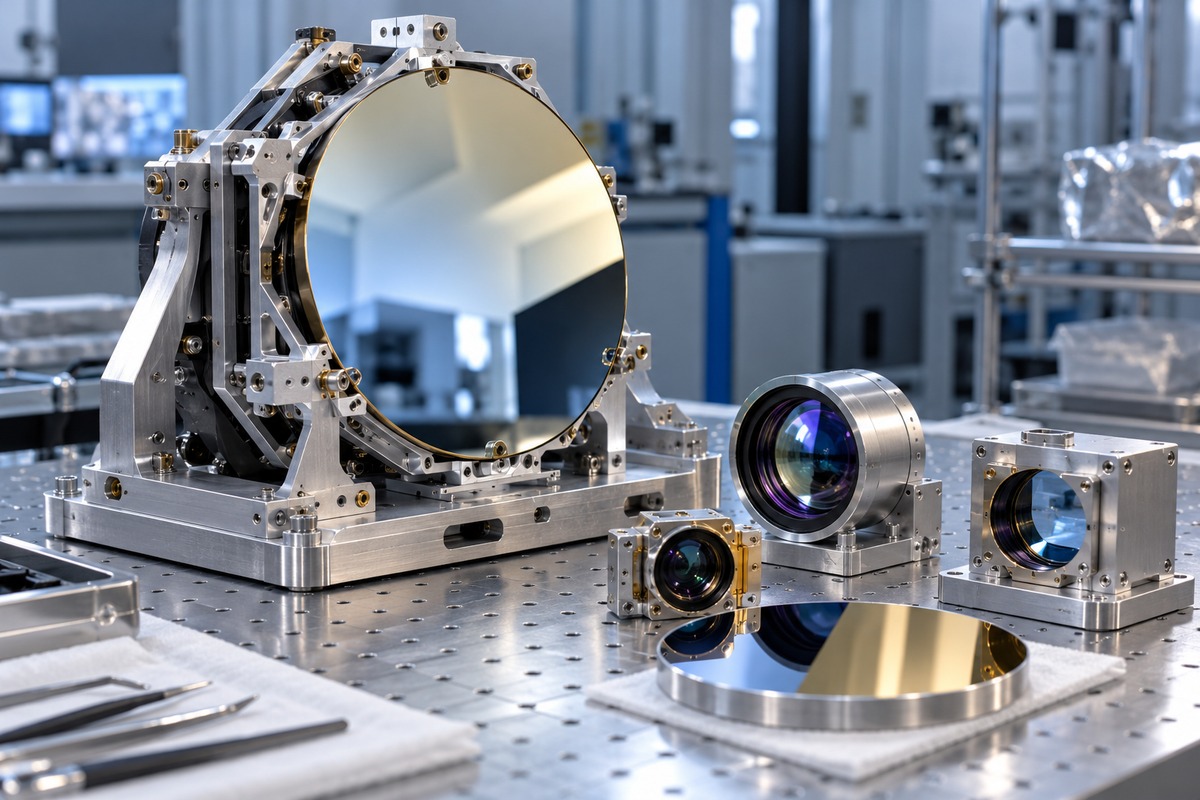
A planned survey of galaxies and stars
NASA is targeting late February 2025 for the launch of SPHEREx, a space observatory designed to survey the sky in infrared light. The two-year mission is planned to examine hundreds of millions of galaxies and search for water and organic molecules within the Milky Way. The launch target was current in the agency information carried by Xinhua on 30 January, before the observatory had begun its survey.
SPHEREx stands for Spectro-Photometer for the History of the Universe, Epoch of Reionization and Ices Explorer. Its planned catalogue covers more than 450 million galaxies and more than 100 million stars in the Milky Way. The molecular search includes stellar nurseries, where gas and dust form new stars, and disks surrounding stars where planets could be forming. These are targets for the forthcoming observing programme.

Infrared measurements across the sky
From low Earth orbit, the observatory is designed to take about 600 exposures each day. Its mapping plan combines 102 infrared views of each section of sky, with a different wavelength selected for each view. The combined measurements will provide information about the composition of objects and their distance. Objects within the Milky Way and galaxies beyond it form separate parts of that intended map.
Conical photon shields protect the telescope from infrared light and heat arriving from the Sun and Earth. The shields form part of the observatory’s configuration for its planned low-Earth-orbit observations. The light measurements support three research questions identified for the mission:
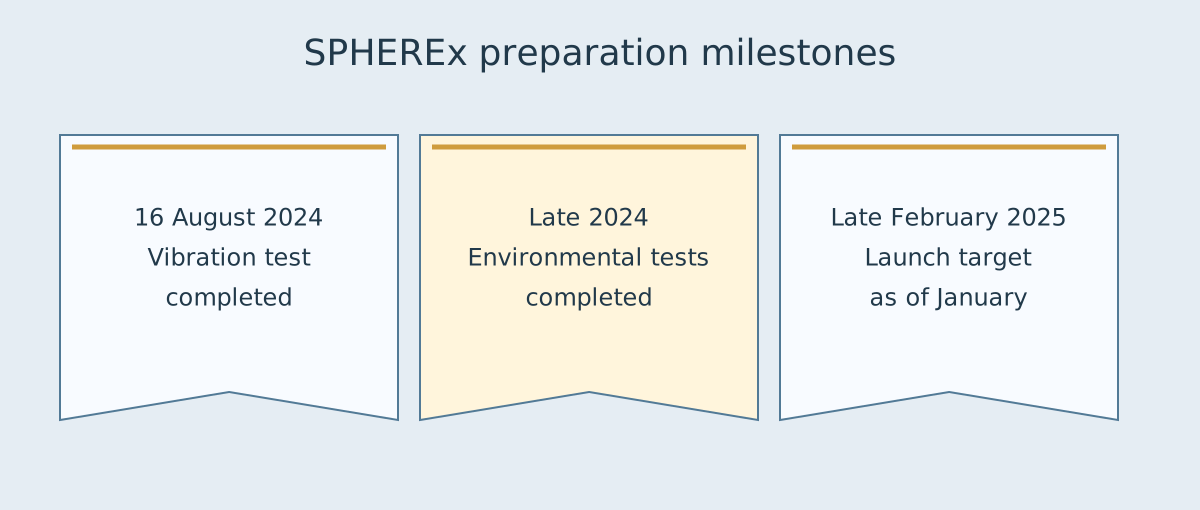
Illustration details
- SPHEREx preparation milestones
- 16 August 2024
- Vibration test
- completed
- Late 2024
- Environmental tests
- completed
- Late February 2025
- Launch target
- as of January
- What happened in the first fraction of a second after the big bang.
- How galaxies formed and evolved.
- Where water in planetary systems in the Milky Way originated.
Hardware testing before the launch target
Vibration testing at BAE Systems in Boulder, Colorado, subjected the spacecraft to motion along three axes separately. The test was successfully completed on 16 August 2024. The associated preparation placed the observatory on a vibration table in its Z-axis configuration. That completed hardware test preceded the January 2025 announcement of a prospective launch window.
SPHEREx was in a clean room at BAE Systems in Boulder, Colorado, after environmental testing in late 2024. BAE Systems, formerly Ball Aerospace, built both the telescope and the spacecraft bus.

Science teams and a public archive
NASA’s Jet Propulsion Laboratory manages SPHEREx for the Astrophysics Division within the agency’s Science Mission Directorate in Washington. The science-analysis team spans 10 institutions in the United States, two in South Korea and one in Taiwan. Caltech manages JPL for NASA, and the mission’s principal investigator has both a Caltech base and a joint JPL appointment.
IPAC at Caltech will process and archive the observations. The planned dataset will be publicly available, extending the use of the sky measurements beyond the mission’s own science team. The archive, the observing targets and the late-February launch window were prospective elements of the programme at the January announcement; the vibration and environmental tests were already part of its completed preparation.






Leave a comment