Piano manufacturing: how wood and soundboard structure shape tone
Wood selection, grain direction and soundboard construction connect the piano workshop to vibration testing and research on how instruments radiate sound.
Published Oct 10, 2025
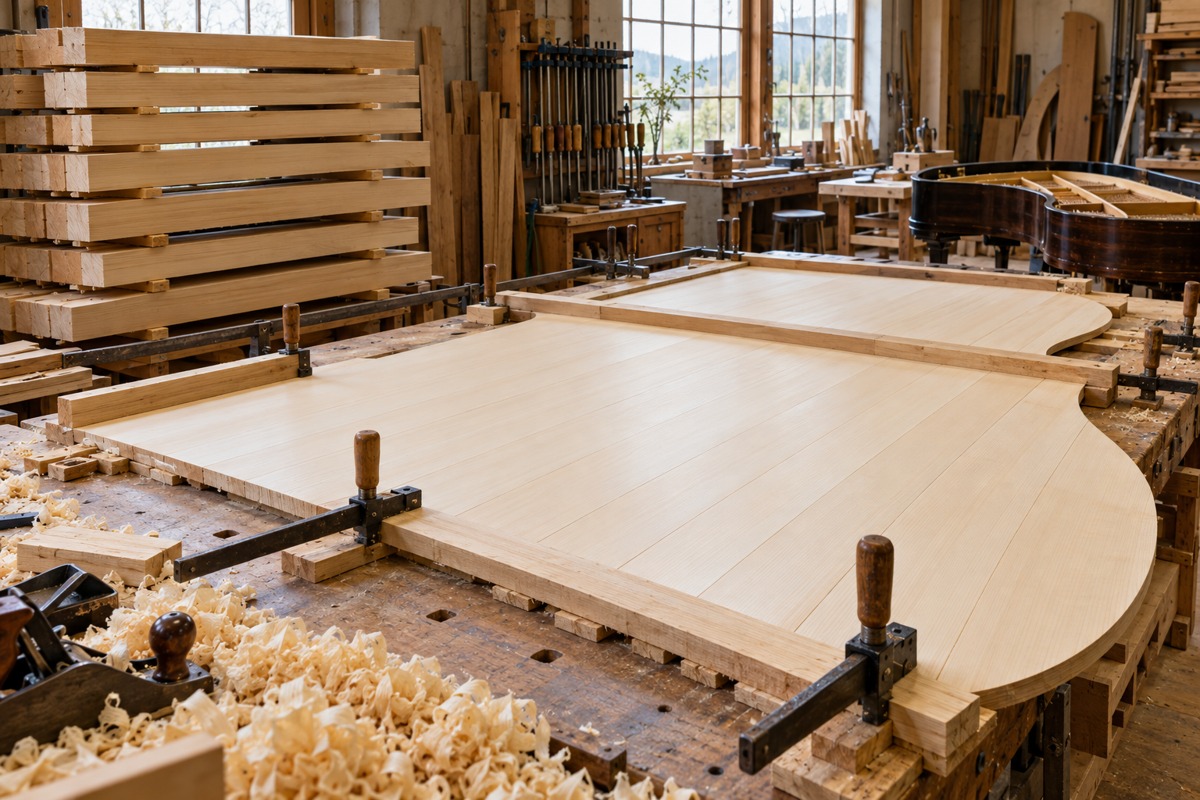
A grand piano begins with timber that must become both a load-bearing structure and a responsive musical instrument. At Steinway’s Hamburg factory in Germany, production takes close to a year. During Saeed Saeed’s October 2025 visit for The National, laminated maple was being bent into curved rims, while strips of Sitka spruce were assembled into soundboards. The workshop brings together two related tasks: building a stable instrument and shaping the wooden surface that radiates its sound.
Factory representative Camilo Daza Tapia described timber drying for up to two years and a 100-day rest for a newly formed rim. Those waiting periods sit alongside precise assembly work. The soundboard is a thin panel beneath the strings, connected to them through bridges and strengthened by ribs. Its response depends on the material, its direction and the way those parts are joined. Acoustic research follows that response from a local string force to the motion of a much larger wooden surface.

Illustration details
- Two soundboard research milestones
- 18 Apr 2023
- Hammer-to-sound model
- 22 Feb 2024
- Four panel structures tested
Grain direction is a structural property
Spruce has different mechanical properties in different directions. Along the grain, its fibres run lengthwise; across that direction, the radial axis crosses the growth rings and the tangential axis follows their circumference. Engineers describe this directional behaviour as orthotropy. A soundboard model therefore needs more than one stiffness value. Rotating the grain relative to the board’s outline changes how the material resists deformation along the instrument’s own axes, even when the species and external dimensions remain the same.
Stiffness describes the relationship between applied load and deformation, while density describes mass within a given volume. Both enter the vibration problem. A thin wooden panel must respond to changing forces while carrying its own mass and the mass of attached components. Grain direction also affects how a board resists twisting, which is a different deformation from bending. Research on soundboards consequently considers elastic and shear moduli, rather than describing the material with a single general measure of strength.
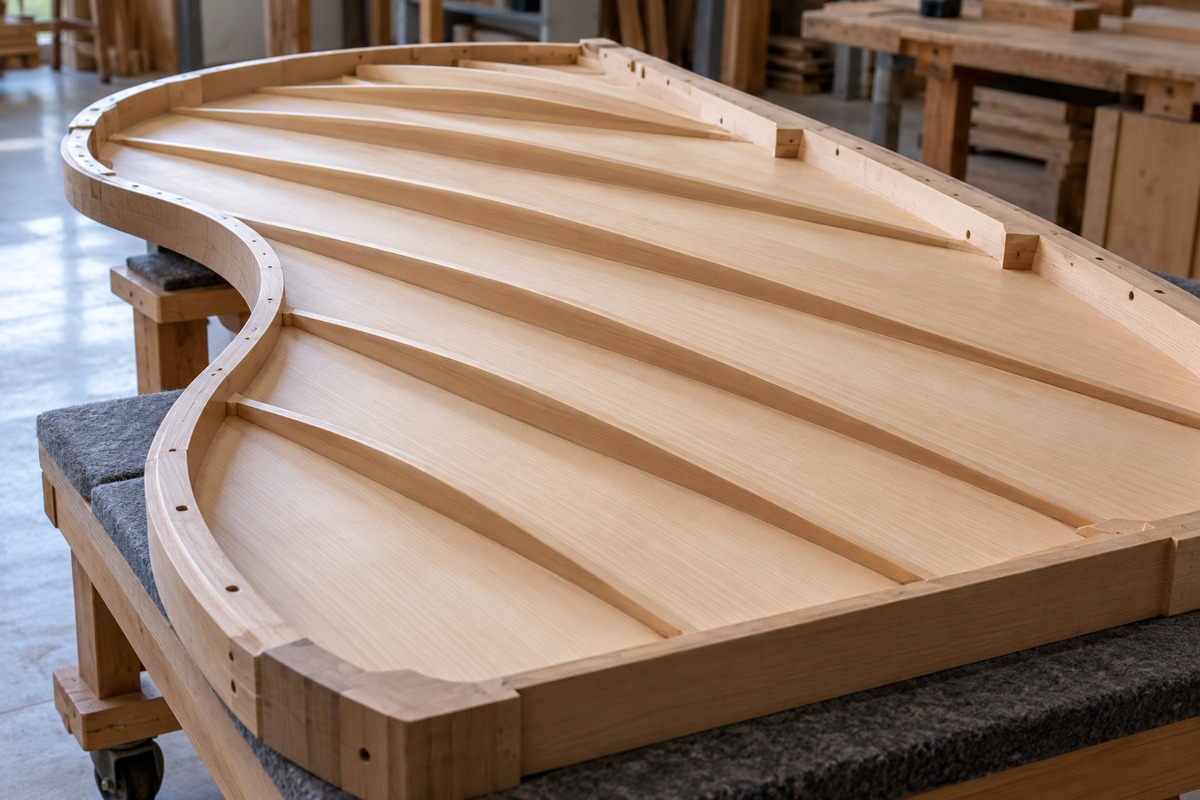
The soundboard’s geometry adds another set of variables. Its outline, thickness and attachments determine how the wooden plate can move. Ribs stiffen it from below, and bridges connect it to the strings from above. Together, these parts form a structure whose behaviour differs from an isolated strip of spruce. A specimen cut from a board can reveal material properties, while a test of the larger assembled panel includes the effects of joints, orientation and the arrangement of its constituent pieces.
Solid panels and layered construction
Wooden soundboards can be assembled from joined solid-wood pieces or from layers with different grain directions. In the layered construction described by a 2024 Materials study, face and core panels are glued together, with their textures crossing at selected angles. The core can be arranged vertically, diagonally or horizontally relative to the chosen reference. These are structural choices: a change in orientation changes the paths through which deformation passes across the panel and its glued joints.
Lan He and colleagues examined four rectangular soundboards made by Chengdu CANYA Wood Industry Company. One was a tone-wood panel and three were laminated panels with different core arrangements. The surface and core material was radially cut spruce. For convenient measurement, the researchers used boards with dimensions half those of actual upright-piano soundboards. The resulting objects were laboratory specimens representing different constructions. Their measurements describe those panels and provide a way to compare the effects of assembly and grain orientation.
The specimens were roughly 700 millimetres long and 500 millimetres wide, with thicknesses ranging from about 7.4 to 9.3 millimetres. They were conditioned to moisture contents of 7–9 per cent. Those dimensions and conditions matter because vibration depends on the specimen’s mass and geometry as well as its material. The four boards also differed in density and thickness. Their measured responses therefore reflect the complete specimens, including those differences, alongside the changes in their layered arrangements.
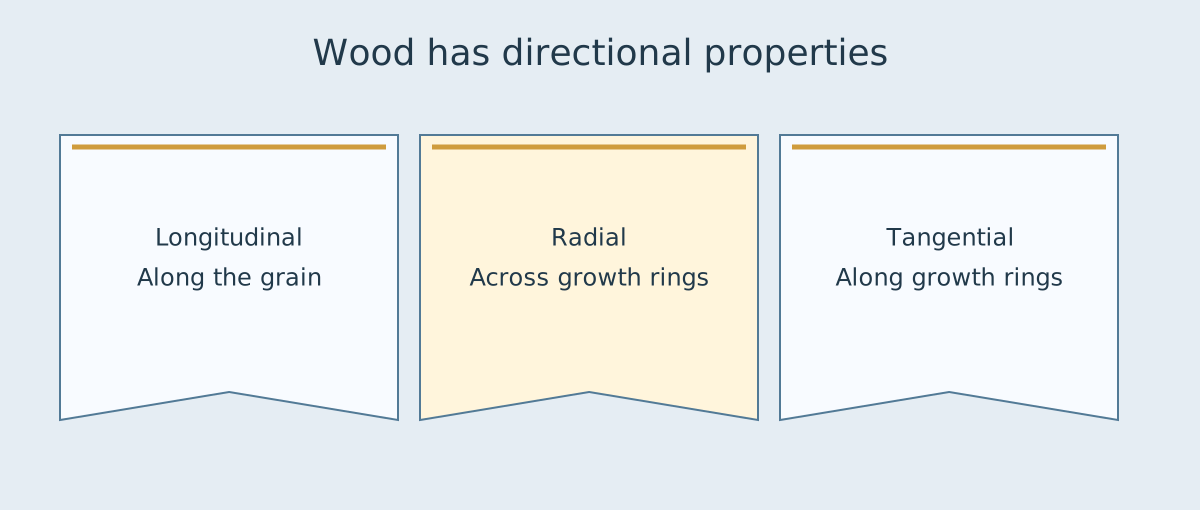
Illustration details
- Wood has directional properties
- Longitudinal
- Along the grain
- Radial
- Across growth rings
- Tangential
- Along growth rings
A vibrating board has several patterns of motion
A soundboard does not move as one rigid sheet. Different parts can move in different directions, producing patterns known as vibration modes. Each mode has a characteristic frequency and shape. Some patterns mainly involve bending; others include twisting. Lines with little movement separate regions with greater movement. In a wooden panel, those patterns depend on directional stiffness and construction. Joining pieces at different angles can produce less regular patterns than those associated with an ideal plate whose properties are identical in every direction.
These patterns explain why the position of a tap matters during testing. A strike at one point couples strongly to some modes and weakly to others. Moving the strike can therefore change which peaks stand out in a frequency plot. The board still has its underlying structural behaviour, but the measurement highlights a different part of it. A microphone’s position also forms part of the test arrangement, because the recorded signal depends on how the vibrating surface sends sound toward the receiver.
In the 2024 experiment, the boards were suspended using elastic rope and excited with a hammer. A microphone and multichannel analyser recorded their responses in time and frequency. Measurements at several positions helped identify bending and torsional modes. Frequencies associated with the same modes were broadly similar across different excitation positions, while their recorded amplitudes changed substantially. That combination made the location of the strongest peak an incomplete guide to the identity of a mode; the spatial pattern provided additional information.
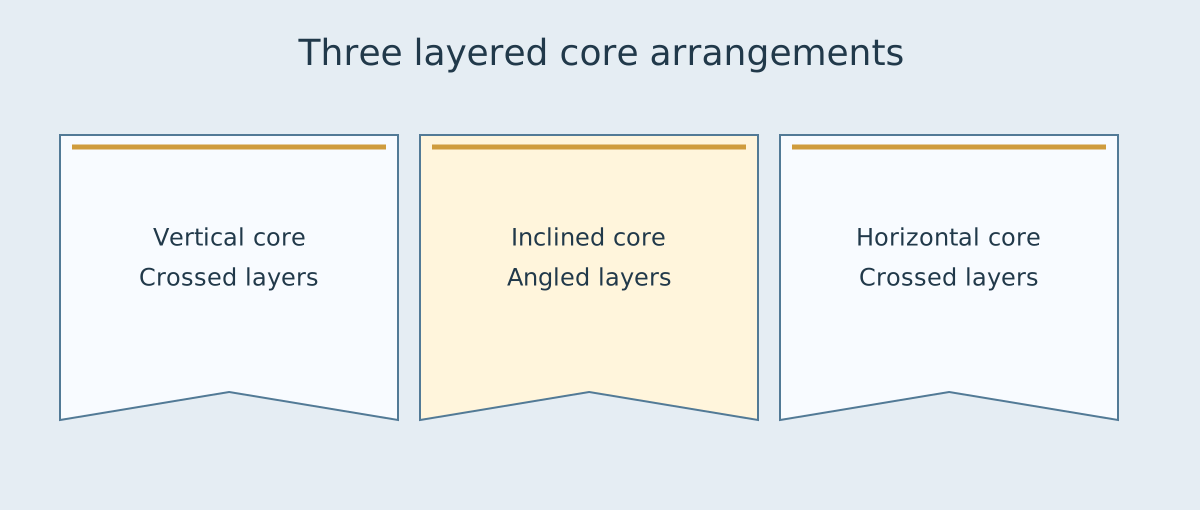
Illustration details
- Three layered core arrangements
- Vertical core
- Crossed layers
- Inclined core
- Angled layers
- Horizontal core
- Crossed layers
From a tap to a stiffness estimate
The researchers used free-vibration frequencies to calculate dynamic elastic and shear moduli. They also compared those results with calculations based on an Euler free-beam method and a free-plate torsional method. Each approach translates measured motion into a mechanical property through a particular mathematical representation of the specimen. The comparison connects a practical workshop measurement—a board being tapped—to quantities used in structural analysis. It also makes the shape and construction assumed by each calculation part of the interpretation.
The different approaches gave similar trends across the tested boards. Direction mattered: the relative resistance to bending in one panel direction differed from the ordering in the perpendicular direction. That finding follows the orientation of the wood within the specimens. A panel that is relatively stiff along one reference axis can be less stiff along the other. The layered panels redistribute that directional response through the grain angles of their faces and cores, rather than removing the wood’s directional properties.
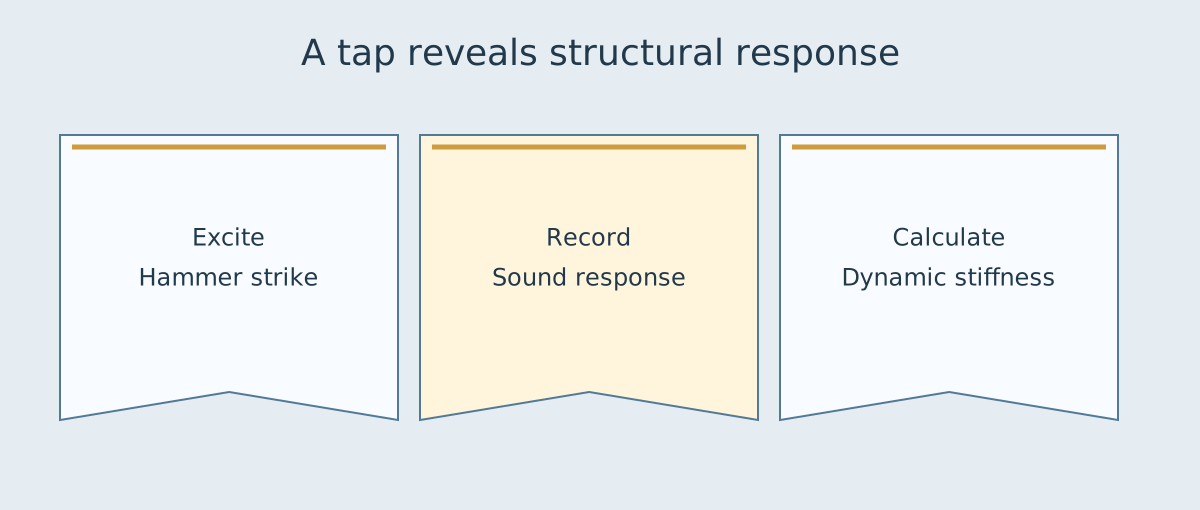
Illustration details
- A tap reveals structural response
- Excite
- Hammer strike
- Record
- Sound response
- Calculate
- Dynamic stiffness
Several details distinguish these measurements from a finished instrument. The specimens were rectangular, freely suspended panels; a piano soundboard is attached to a surrounding structure and connected to strings through bridges. The experiment concentrated on mechanical vibration and methods of estimating panel properties. Its results support comparisons of construction and measurement technique. Listening to the finished piano introduces the coupled action of hammer, strings, bridges and board, with the sound then travelling through the surrounding air to a listener.
Modelling the path from hammer to air
A separate study by Dóra Jenei-Kulcsár and Péter Fiala, published in April 2023, followed that coupled process numerically. Their model joined a felt-covered hammer, a vibrating string, a ribbed soundboard and near-field sound radiation. Different mathematical descriptions were used for the components: a string was represented along its length, while a finite-element model described the plate. The connections allowed the researchers to investigate how changing the board’s properties affected the calculated tone after the same initial strike.
The hammer model included elastic and dissipative behaviour in the felt. Compression stores and releases energy, while dissipation accounts for losses during the interaction. The string model included travelling waves, reflections and losses. At its connection to the soundboard, the string encounters a structure with its own frequency-dependent response. This connection links the excitation of the string to the movement of the board. The instrument’s sound emerges from that coupled system, with energy transferred and dissipated as the note develops.

For the board, the researchers used a grand-piano-like outline with ribs and bridges. The example had a uniform plate thickness of eight millimetres. The wooden surface was divided into small triangular elements, and the stiffening components were represented by beam elements. This numerical division allowed the calculation of many vibration modes while retaining the larger arrangement of the structure. The example then connected one middle-C string to the board and calculated the sound at a nearby listening position.
Ribs, edges and connection points
The conditions at a panel’s edge affect how it moves. A model can represent an edge as clamped, which restricts motion and rotation, or as simply supported, which allows a different pattern of movement. In the 2023 example, switching between these idealised boundary conditions shifted the calculated frequencies. The actual glued connection between a soundboard and a rim is a more complex physical arrangement. Comparing the idealisations reveals how much the assumed restraint can influence the predicted behaviour of the wooden plate.
Ribs had a strong stiffening effect in the simulations. Removing them lowered the first calculated natural frequency, while changing their angle relative to the wood fibres altered the modal behaviour. The relationship between ribs and grain was therefore part of the acoustic structure, alongside their physical dimensions. A rib adds material and restraint in a particular location and direction. Its effect depends on how that reinforcement interacts with the directional stiffness of the plate to which it is attached.
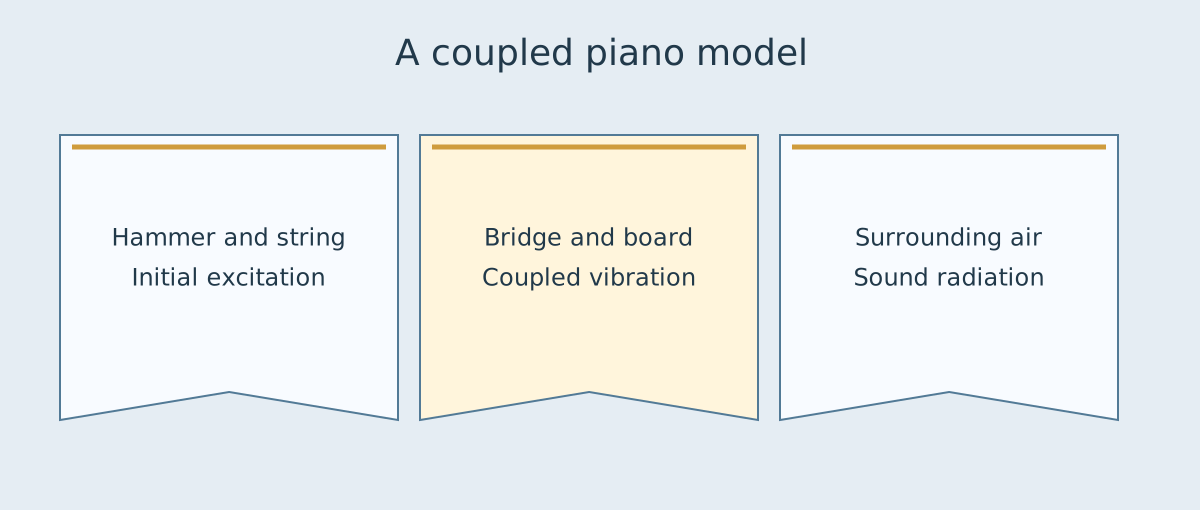
Illustration details
- A coupled piano model
- Hammer and string
- Initial excitation
- Bridge and board
- Coupled vibration
- Surrounding air
- Sound radiation
The string’s connection point introduced another local influence. The board has a different mobility at different positions and frequencies: the same changing force can produce a larger or smaller local velocity. A connection near a strongly moving region of one mode interacts differently from a connection near a relatively stationary region. The model’s response curves contained peaks and valleys associated with this modal behaviour. Moving the connection along a bridge changed the interaction between the string and the soundboard.
Attack, sustain and changing tone
A piano note develops over time. The model produced an initial rise and rapid decay associated with the hammer strike, followed by a more slowly fading part. Its harmonic components did not all lose energy at the same rate. At frequencies where soundboard mobility was higher, corresponding components could decay faster because of their interaction with the board. The relative balance of those components therefore changed during the note, connecting the mechanical response to the evolution of its tone.
The researchers described the calculated sound with several quantitative indicators. Harmonic ratio expressed the share associated with harmonic components; spectral centroid tracked the distribution of energy across frequencies; and spectral flux described changes in the spectrum over time. These indicators provide different views of a single decaying note. A change in material parameters can alter the balance between components, while a change in listening position affects the sound pressure received from the moving surface. Both influence the resulting listening experience.
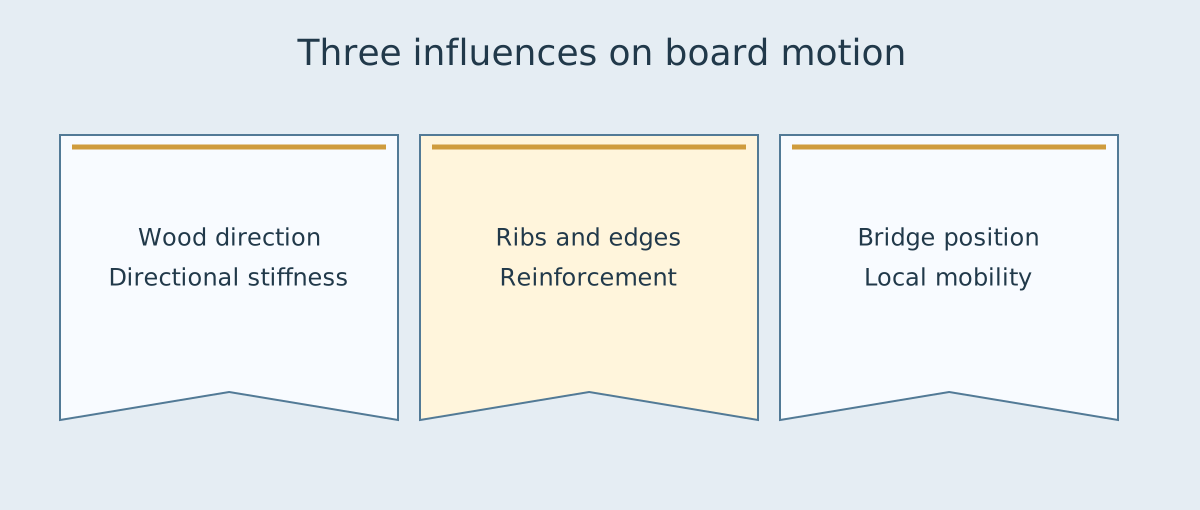
Illustration details
- Three influences on board motion
- Wood direction
- Directional stiffness
- Ribs and edges
- Reinforcement
- Bridge position
- Local mobility
Increasing the modelled wood density shifted natural frequencies downward. Increasing longitudinal stiffness shifted them upward. The changes also affected the decay of individual harmonic components, because they changed the relationship between the string and the board’s response. In the numerical example, different harmonics could become more prominent as the note faded. These were results from specified model adjustments, with the string excitation held consistent so that the influence of the changed board parameters could be examined.
Two complementary views of manufacturing
Vibration testing and numerical modelling address different parts of the same production problem. A measurement captures the response of a physical specimen with its actual joints, dimensions and material variation. A simulation allows a parameter to be changed while other inputs remain fixed. Together, these approaches connect the selection and assembly of wood to the motion of the completed sound-radiating structure. They also separate several decisions that can otherwise disappear inside a general description of a piano’s tone.
- Grain orientation determines how the wood’s directional properties align with the panel and its reinforcements.
- Panel construction combines faces, cores and joints into a structure with its own bending and twisting response.
- Excitation and measurement positions determine which vibration patterns are prominent during a physical test.
- Ribs, edge restraint and bridge connections influence how the soundboard interacts with the string.
Sound radiation adds the final spatial step. A moving soundboard sends pressure variations toward a listener, and different listening positions receive different combinations of contributions from its surface. In the 2023 simulations, shifting the listening position changed the received loudness while leaving the harmonic decay rates of the coupled mechanical system unchanged. The distinction places the listener within the manufacturing story: the instrument’s structure determines its motion, and the path from that moving surface determines the sound pressure that reaches the ear.
Manufacturing context: Saeed Saeed, The National, 10 October 2025. Technical explanation adapted and paraphrased from Lan He, Yuwei Liang, Liang Zhang, Jing Zhou, Ruofan Wang and Zhenbo Liu, Measurement and Analysis of the Vibration Responses of Piano Soundboards with Different Structures (2024, CC BY 4.0), and Dóra Jenei-Kulcsár and Péter Fiala, Piano Soundboard Analysis at Radiated Sound (2023, Creative Commons Attribution). New explanatory prose and illustrations; no source figures reproduced. CC BY 4.0 licence.




Leave a comment