Seaweed biomasonry: from aquaculture residue to prototype blocks
Ulva residue and oyster shells became exhibition-scale biomasonry through binder trials, drying work and mould development, with commercial testing still ahead.
Published Jun 14, 2025
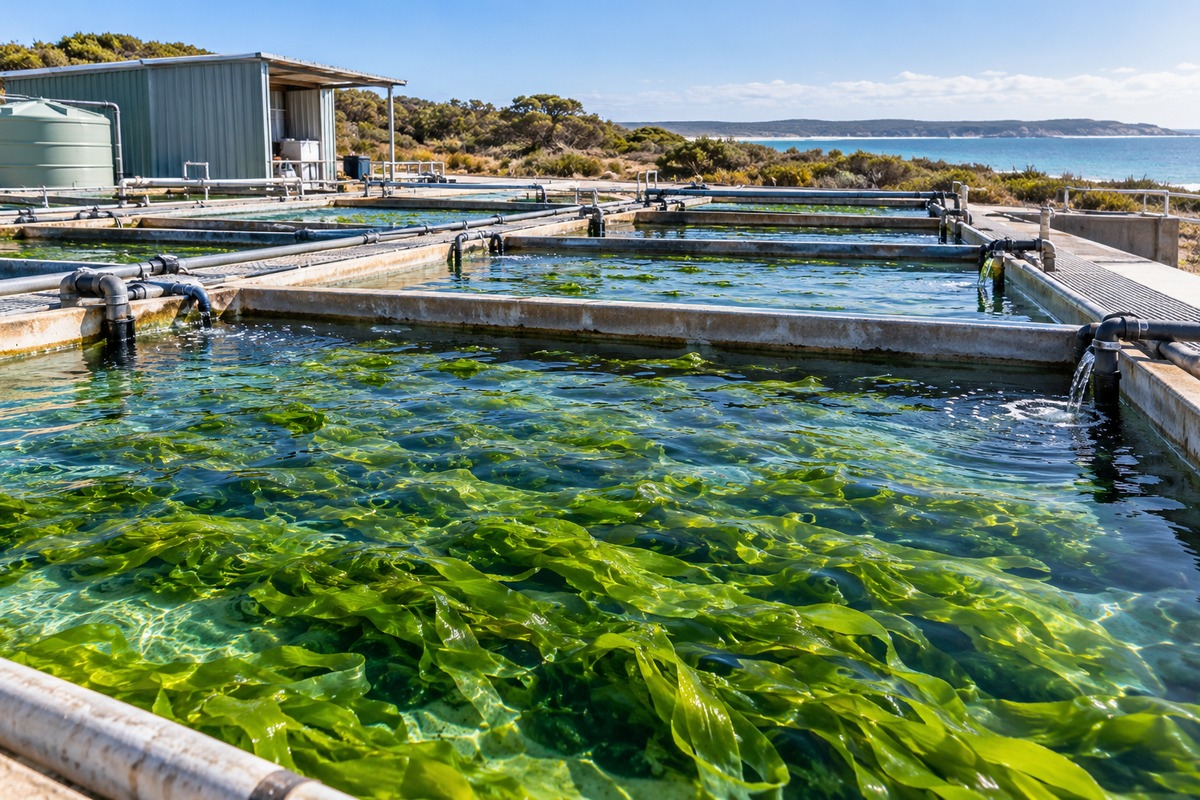
Sydney researchers are developing seaweed-and-shell building materials, featured in June 2025 coverage. The underlying design research followed a residue from algae cultivation through small specimens, larger moulds and an architectural exhibition. A team working across design, biotechnology and materials developed blocks using the green seaweed Ulva ohnoi and crushed oyster shells. The resulting pieces formed a full-scale demonstrator at the Art Gallery of South Australia, connecting aquaculture by-products with a possible use in the built environment.
The project involved Kate Scardifield, Nahum McLean, Unnikrishnan Kuzhiumparambil, Peter J. Ralph, Nicolas Neveux, Geoff Isaac and Tim Schork. Their study appeared online on September 30, 2023, before its April 2024 journal issue. The researchers developed the material through four design phases, moving from small binder specimens to full-size exhibition components. They recorded specimen sizes, masses, shrinkage and drying behaviour, and developed moulds suited to pressing and releasing the wet composite. The resulting pieces were fabricated for an architectural demonstrator at the Art Gallery of South Australia.
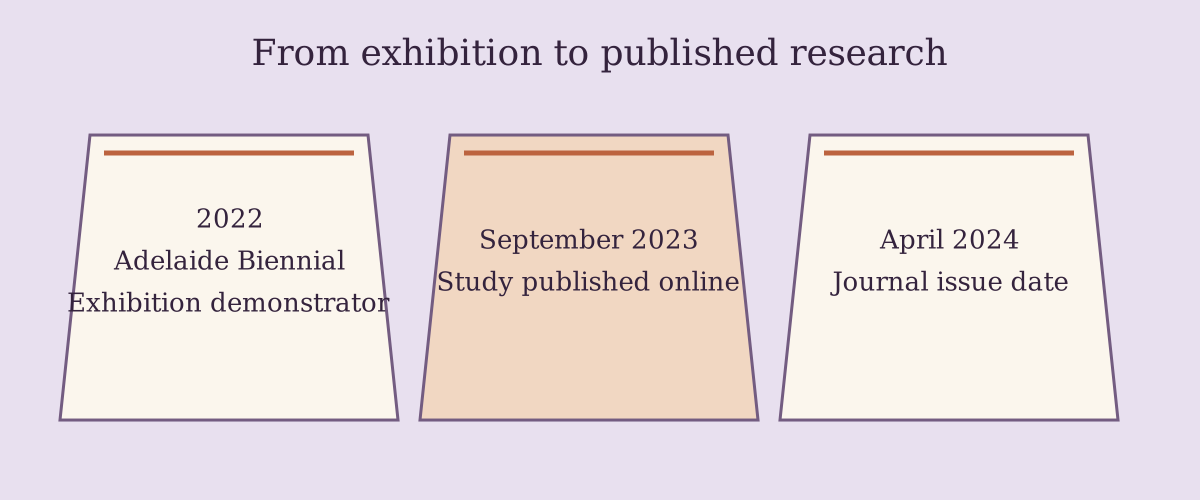
Illustration details
- From exhibition to published research
- 2022
- Adelaide Biennial
- Exhibition demonstrator
- September 2023
- Study published online
- April 2024
- Journal issue date
A residue from another commercial process
The Ulva residue came from a biorefinery process that produced a liquid plant biostimulant as its primary high-value commercial output. Extraction left a carbon-rich paste, which became the feedstock for the material project. Researchers combined this residual biomass with polysaccharide binders and potential fillers. The paste entered the work in wet form, while early tests also used dried and milled Ulva. Its moisture content became a recurring part of the mixing, drying and mould-development work as specimen sizes increased.
Seaweed cultivation for wastewater treatment provides a related supply of harvested biomass in Australia. Algae grow in nutrient-rich water and are harvested, after which useful compounds can be extracted and residual material recovered. The biomasonry project used Ulva ohnoi after biorefinery extraction. In the early dry-material trials, the team first dried and milled this residue. In the later wet-material trials, binders were incorporated directly into the paste remaining from the primary commercial process.
Four phases of design development
The team organised its work into four phases. The early specimens tested combinations of seaweed and binders; subsequent phases introduced wet paste, different fillers and larger geometries. The intended exhibition product was comparable in scale to a conventional masonry block. That required the researchers to move beyond a small flat sample: a larger pressed object also had to support its wet weight, retain its shape and dry throughout its thickness. Mould construction and access to air became part of the material-development work. The target scale was comparable to a conventional Besser brick measuring 390 by 190 by 190 millimetres.
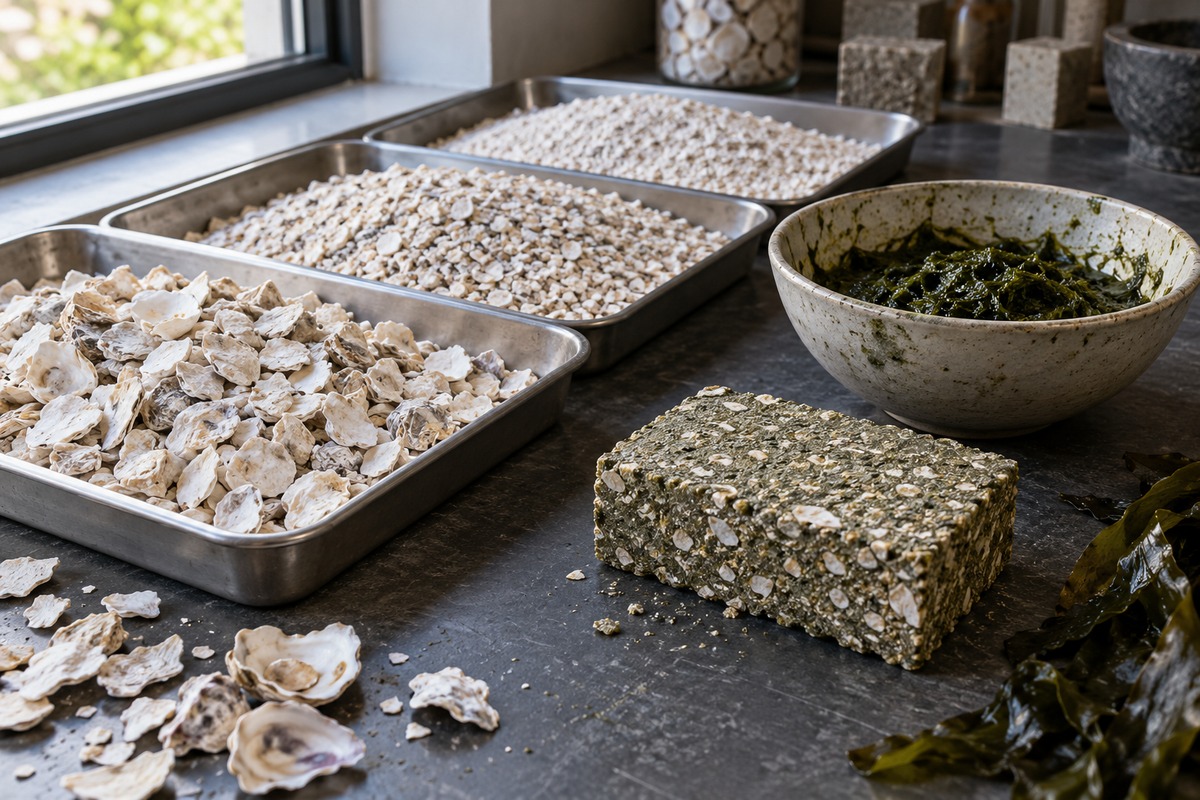
Fourteen initial tests explored combinations of dried Ulva with modified cellulose, starch, chitosan and carrageenan. The second phase selected carboxymethyl cellulose, calcium caseinate, starch and microfibrillated cellulose for work with wet paste. Calcium caseinate had a historical use as a water-resistant adhesive before the spread of cheaper petrochemical adhesives. The subsequent design phases examined hand pressing, aggregate content, larger mould geometries and controlled drying. Material handling and the shapes of the moulds developed together through these successive trials.
Dry powder and the first binder specimens
In the first phase, dried Ulva was milled into powder with particles smaller than one millimetre. Each test used 50 grams of Ulva powder. Researchers mixed the powder, selected binders and water into a dough, rolled it to a thickness of ten millimetres and cut it with a 35-by-35-millimetre square mould. The resulting specimens measured 35 by 35 by 10 millimetres. These small flat pieces were used to observe bonding and the reconstitution of the dried seaweed in the new mixture.
Carboxymethyl cellulose, abbreviated CMC, and starch produced specimens that dried comparatively uniformly, with reported shrinkage of 6–8%. Carrageenan and chitosan combinations showed greater shrinkage and some cracking. The CMC and starch specimens bonded strongly enough to be dragged across bitumen without snapping or crumbling during the team's handling observations. The researchers preferred CMC for further development. The later wet-paste work retained CMC among its selected ingredients, alongside starch, calcium caseinate and microfibrillated cellulose.
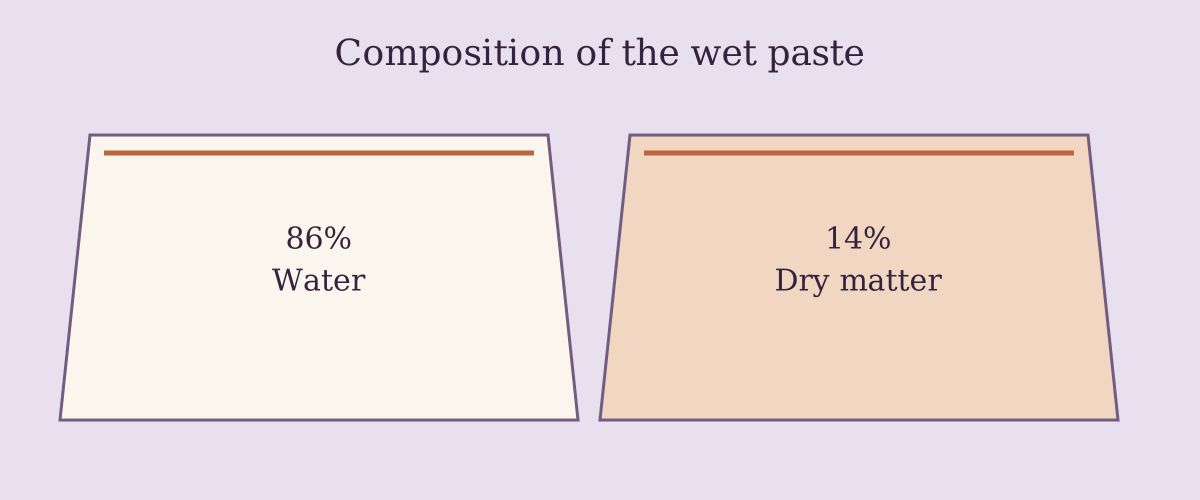
Illustration details
- Composition of the wet paste
- 86%
- Water
- 14%
- Dry matter
Wet paste introduced a different water balance
Wet Ulva paste contained approximately 86% water and 14% dry matter: drying 100 grams left about 14 grams of solid material. For the second-phase comparisons, 350 grams of wet paste supplied approximately 49 grams of dry Ulva biomass. The team increased specimen dimensions to 90 by 90 by 30 millimetres while normalising quantities for moisture content. Water was already present in the residual paste, and the binders were tested within this wetter mixture as the specimens moved beyond the smaller powder-based trials.
Each second-phase specimen was weighed on the day of pressing and removal from its mould. Mesh racks exposed all sides to airflow. The pieces were turned on day three and air-dried for 14 days at approximately 21–23°C. Their surfaces felt dry by day seven, after which drying continued for another seven days. The team weighed and handled the larger pieces while assessing shrinkage and deformation. Pressing, release from the mould, air exposure and turning formed successive steps in preparing these wet-paste specimens.
Fillers changed shrinkage and drying
The wet-paste trials included hemp fibres, wool fibres, brewers' spent grain, banana-leaf fibres, golden kelp and crushed oyster shells as potential fillers. The golden kelp was Ecklonia radiata. Brewers' spent grain came from a local brewing company, while oyster waste came from an oyster-farming cooperative. These aggregates were added to assist drying and fill the wet Ulva mixture. Their trial results included different amounts of shrinkage, distortion and mould growth, as well as differences in how quickly specimens dried.
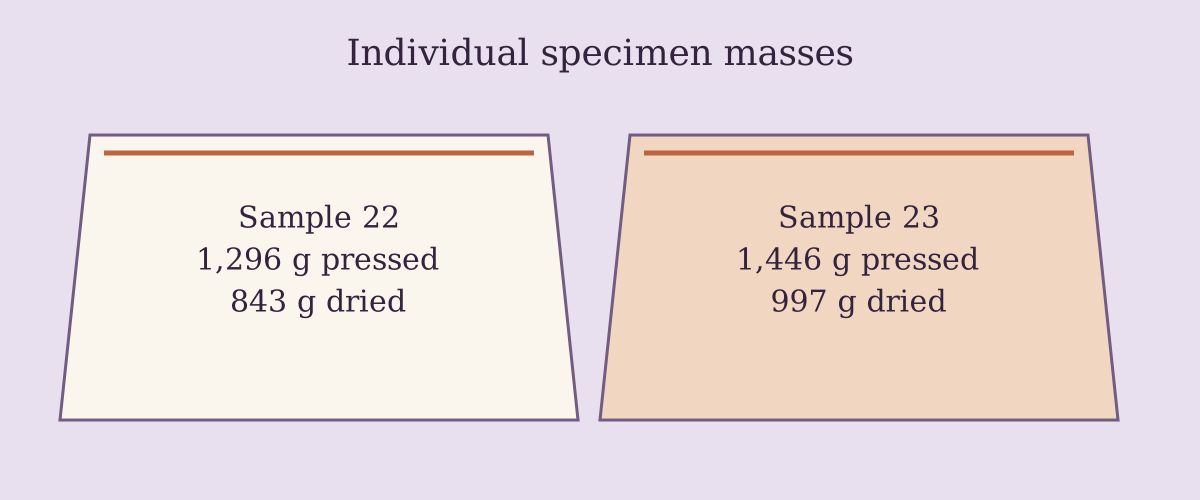
Illustration details
- Individual specimen masses
- Sample 22
- 1,296 g pressed
- 843 g dried
- Sample 23
- 1,446 g pressed
- 997 g dried
Some wet-paste mixtures using starch and CMC shrank by more than 30%. Brewers' spent grain showed approximately 3% shrinkage and was prone to mould growth during its longer drying period. The Ulva-and-oyster-shell composite showed negligible shrinkage and dried quickly in the trials. The researchers selected oyster shells for the exhibition demonstrator. Calcium caseinate, CMC and starch behaved similarly at the tested wet-paste scale in the team's assessments of handling, shrinkage and distortion.
Two shell deliveries required different preparation
The first shell supply comprised 500 kilograms from a commercial oyster dispatch centre. It included Pacific and Sydney Rock oysters, with the material consisting predominantly of lids left after cleaning, sorting and shucking for food retail. A second supply of 600 kilograms came directly from farms and contained more cups. These two source streams differed in the shell forms and attached material that needed cleaning. Acquiring a residue was followed by a substantial preparation stage before it could serve as an aggregate.
Cleaning removed residual tissue and marine growth from the oyster waste. The process included washing, rinsing and sunlight exposure. Farm material was rotated in a concrete mixer and subsequently pressure-washed. After drying and sorting, the shells were mechanically broken down and separated into grades ranging from below one millimetre to about seven millimetres. More than 1,100 kilograms of shells passed through the project's preparation work. The resulting grades could be mixed with Ulva paste and CMC during the development of the composite.
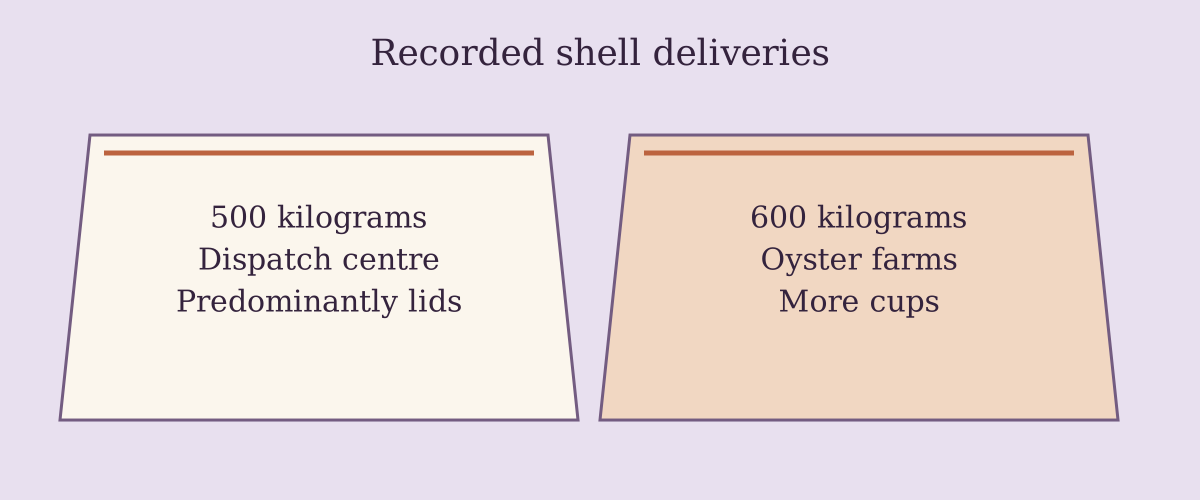
Illustration details
- Recorded shell deliveries
- 500 kilograms
- Dispatch centre
- Predominantly lids
- 600 kilograms
- Oyster farms
- More cups
Scaling the specimen changed its drying behaviour
The third phase used seamless cylindrical moulds 150 millimetres in diameter. Material was packed into each cylinder and compressed using an even hand-tamping action before release. Samples 22 and 23 were 50 millimetres high and dried in under seven days; the team drilled through sample 22 to check the interior. Sample 22 changed from 1,296 grams after pressing to 843 grams when dry. Sample 23 changed from 1,446 to 997 grams. These tests preceded the development of thicker pieces and more complicated mould geometries.
The team tested angular zigzag forms, curved surfaces, a 300-millimetre cube and rectangular-prism moulds as large as 400 by 1,150 by 80 millimetres. Wet pieces could slump under their own weight. The 300-millimetre cube mould therefore used centre palings that could be removed gradually, exposing more surface to air while corner sections continued to support the shape. This staged disassembly accompanied the larger volume of wet material and the need to let its interior dry while retaining the formed geometry.
Geometry and a controlled chamber
Final moulds limited the maximum thickness between edges to 100 millimetres and incorporated two voids to increase surface area. Binder was added directly to wet Ulva paste, without first hydrating the binder in additional water. An overly dry mix crumbled, while an overly wet mix slumped or deformed during drying. The team adjusted preparation around these observed behaviours. Larger geometries combined supporting mould sections with increased air exposure, while the two internal voids reduced the uninterrupted thickness of the pressed pieces.

Hot, wet and humid conditions during the 2021–22 New South Wales summer coincided with the larger-scale work. The team installed a drying chamber two metres long, 3.6 metres wide and 2.7 metres high. Builder's plastic lined and sealed the chamber, with foam sheeting providing additional insulation. A commercial Airrex ADH1000 dehumidifier operated inside. Pressed pieces dried there for 14 days and were turned on days five and ten. Once dry, they received a calcium-caseinate surface coating, with at least 12 hours of drying between coats.
The exhibition assembly
For the final moulding operation, material was packed into a mould recess and the assembly was flipped 180 degrees onto a board. Sections of the mould could then be detached and lifted away, leaving the pressed object on its drying board. The piece moved into the controlled chamber for the 14-day drying period. The mould shapes included angular components with recesses that also served the later assembly. Hand packing and pressing produced the individual units used for the exhibition installation.
The fabrication work produced 95 pressed and cured seaweed pieces. The column at the Art Gallery of South Australia measured 900 millimetres in outside diameter and 2.6 metres in height. Its fluted appearance referred to classical architectural columns, while angular components explored modular arrangements. Another three-piece design used pieces measuring 800 by 250 by 400 millimetres each. A six-piece arrangement measured 900 millimetres in outside diameter and 200 millimetres in height. Each column component had an average dry mass of approximately 9.5 kilograms.
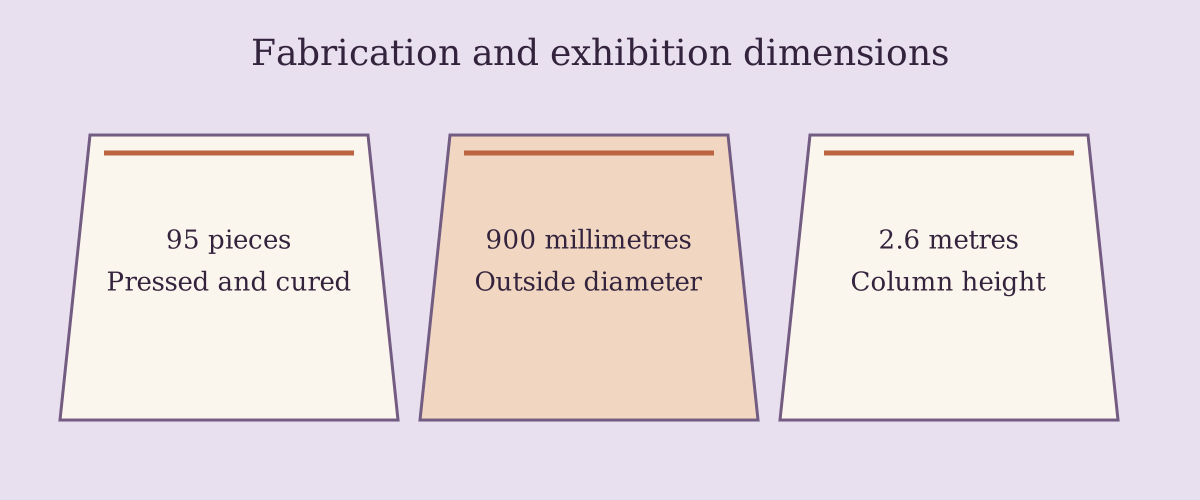
Illustration details
- Fabrication and exhibition dimensions
- 95 pieces
- Pressed and cured
- 900 millimetres
- Outside diameter
- 2.6 metres
- Column height
Polypropylene straps passed through recesses in the pieces and were tensioned to a central truss support. The assembly used no mortar or adhesive between the pieces. The demonstrator formed part of the 2022 Adelaide Biennial of Australian Art, which attracted more than 155,000 viewers over 95 days. Seaweed specimens loaned by the State Herbarium of South Australia accompanied the exhibition. The installation combined the pressed Ulva-and-shell components with the central support and the straps holding the units under tension.
Material observations and remaining research
Drying and milling Ulva powder demanded time and industrial machinery. Hand squeezing wet paste through a silkscreen bag increased its dry-matter content from approximately 14% to 25–30%. Specimens made with squeezed paste still showed about 20% shrinkage. The early dry-material recipes had approximately 40% dry matter. Researchers proposed partial drying to around 40–50% dry matter as a further development route, aiming to reduce shrinkage and the need for heavy milling machinery. They also proposed investigating whether partial drying could reduce the additional binder requirement.
Oyster-shell preparation required cleaning attached tissue and marine growth, followed by drying, sorting and grading. The researchers identified both the labour cost of this preparation and the availability of shell waste as constraints on development. They proposed investigating other aggregates for different or larger residual seaweed supplies. In the completed demonstrator, crushed oyster shells accompanied the Ulva residue and CMC binder. Differences in shell grades and hand packing produced visible variations among the pressed pieces.
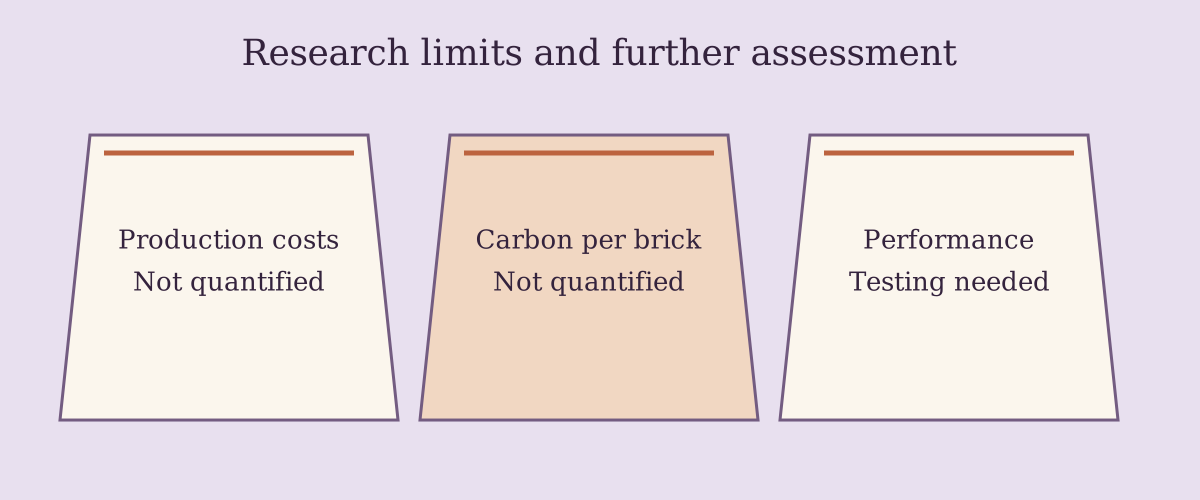
Illustration details
- Research limits and further assessment
- Production costs
- Not quantified
- Carbon per brick
- Not quantified
- Performance
- Testing needed
From initial tests to exhibition components
The fabrication work progressed through four linked design phases:
- Dry Ulva powder and binder specimens.
- Wet paste combined with selected binders and fillers.
- Cylindrical pressing trials and larger sample volumes.
- Larger moulds, controlled drying and exhibition fabrication.
The final brick geometries drew on interlocking corner profiles and joinery arrangements that allowed variation in the positions of the components. Each piece was hand-packed and pressed in form-ply moulds. Recesses accommodated the polypropylene straps used during assembly. After curing, a calcium-caseinate surface coating produced a tougher, more water-resistant surface in the team's observations.
The researchers identified mechanical performance, fire resistance, mould resistance, thermal properties and long-term durability as topics for further testing. Quantitative production-cost and embodied-energy comparisons with commercial clay bricks were outside the completed study. Carbon captured per brick also remained a proposed assessment. The demonstrated objects were 95 pressed and cured components assembled into a supported column. The next research tasks concerned the material's performance, its fabrication requirements and possible development for uses beyond the exhibition.
This account adapts and paraphrases the research of Scardifield, McLean, Kuzhiumparambil, Ralph, Neveux, Isaac and Schork, Journal of Applied Phycology, volume 36, pages 935–950, published online in 2023. The research is licensed under Creative Commons Attribution 4.0. The wording and organisation here are new; the project measurements and their limitations remain attributed to that research.
Leave a comment