Black tea processing: how withering, oxidation and drying change the leaf
A black tea’s character develops through a sequence of leaf changes. Withering, rolling, enzymatic oxidation, drying and storage each influence pigments, aroma and the final infusion.
Published Aug 5, 2025
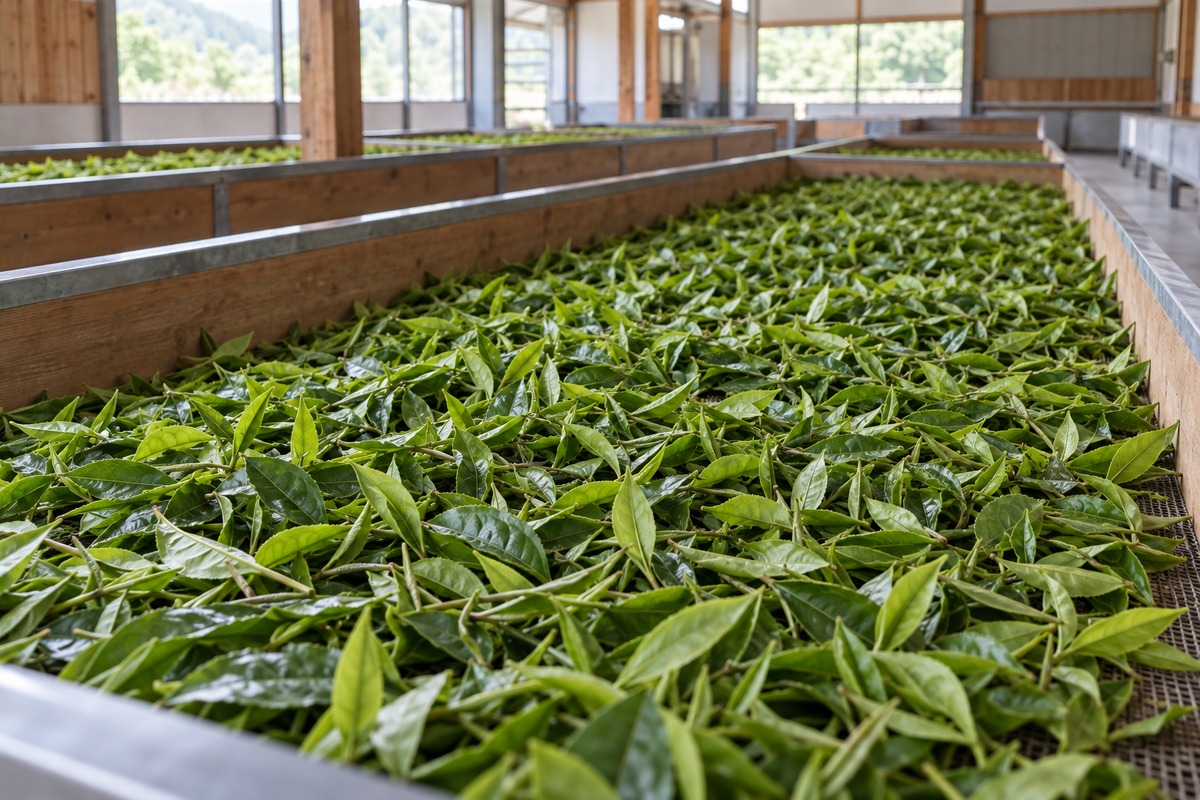
In August 2025, Xinhua reported on Panyong Congou black tea in Tanyang, a village in Fujian, China. Its account described producers combining established tea-making practices with changes in cultivation, handling and products. Wang Zhenkang, from the Fujian Academy of Agricultural Sciences, discussed research on processing conditions and the move from manual to machine-assisted leaf shaking. The report provides a concrete manufacturing context, but not a recipe for every black tea. The broader technical question is how a harvested green leaf acquires the colour, aroma and infusion characteristics associated with the finished product.
A review by Muhammad Aaqil, Chunxiu Peng, Ayesha Kamal, Taufiq Nawaz, Fei Zhang and Jiashun Gong, published in Foods on 13 December 2023, follows that transformation through harvesting, withering, rolling, oxidation, drying and storage. The authors bring together work from different tea-growing and processing systems. Their account shows why the stages should be understood as a connected sequence rather than independent treatments. It also preserves an important limitation: results obtained with a particular leaf material and set of conditions do not establish a universal manufacturing schedule. The review is technical background, not verification of the methods used by the producers in the later news report.

Illustration details
- Reporting and technical background
- 13 December 2023
- Tea-processing review
- 5 August 2025
- Fujian manufacturing report
The incoming leaf determines the starting material
Fresh tea leaves contain several groups of compounds that contribute to the eventual infusion. The review discusses polyphenols, amino acids, carbohydrates, lipids, caffeine and volatile flavour compounds. During manufacture, some constituents are retained, some are transformed and others are lost. Consequently, the final tea is not simply a dried version of an unchanged green leaf. Its character depends partly on the substances present at the start and partly on what processing does to them. This distinction is useful when comparing batches: differences in the harvested material and differences introduced by the factory can both contribute to the result.
Harvesting affects the material entering that sequence. The review distinguishes the picking method, the selection of shoots, the interval between harvests and the season. These variables influence the maturity and composition of the leaves available for manufacture. A processing comparison should therefore retain its description of the starting material. Findings from one selected shoot standard cannot automatically describe a mixed collection of leaves at different stages of development. The practical issue is consistency and identification of the input, rather than an assumption that every batch labelled black tea began with equivalent leaves and would respond identically to the same handling.
Withering changes moisture and leaf behaviour
Withering begins the postharvest transformation by allowing moisture to leave the harvested shoots. In examples summarised by the review, initial moisture around 70–80% falls towards approximately 60–70%, expressed on a wet basis. These ranges describe the discussed processing context, not a specification for every tea. As the leaves lose turgidity, they become more flexible for subsequent rolling or twisting. The physical change matters because the next operation acts mechanically on the leaf. Withering thus prepares material for a different kind of handling; it is not merely an early attempt to make the finished product dry.
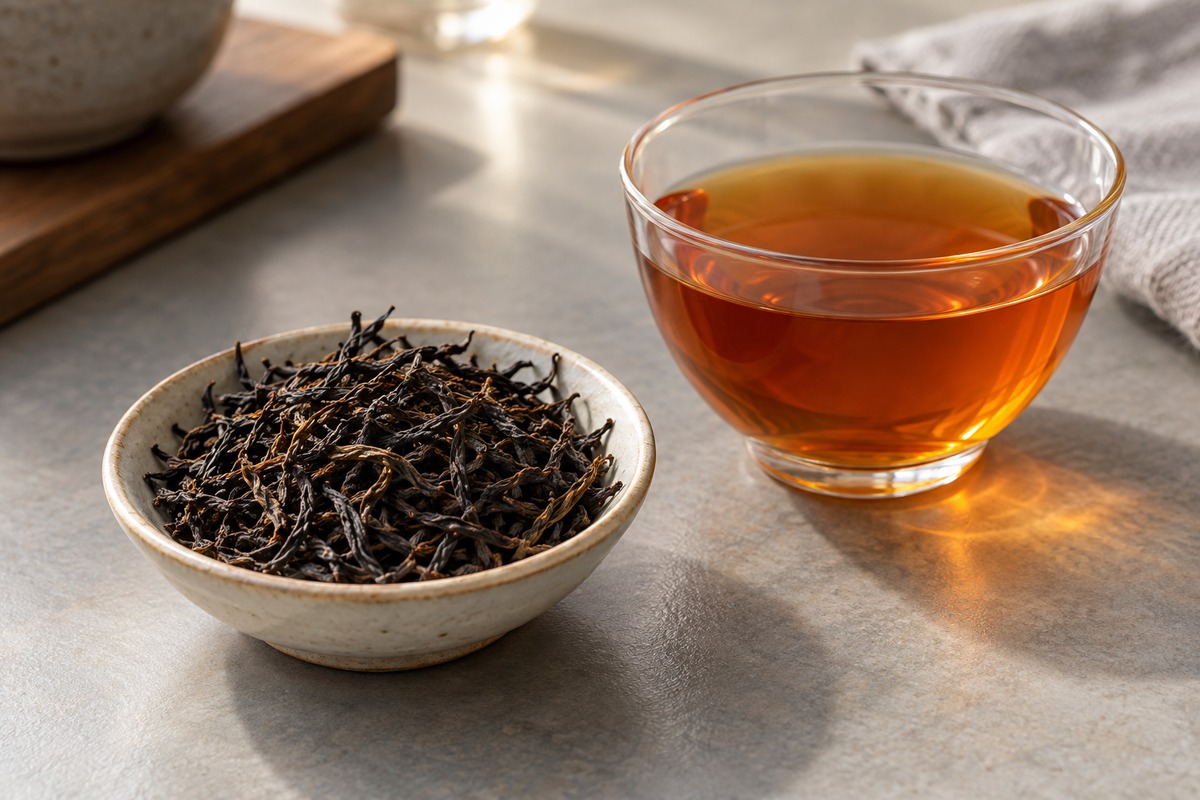
The authors distinguish this physical moisture loss from biochemical changes occurring during the same period. They discuss changes involving proteins, amino acids, sugars, lipids and volatile compounds. The leaf continues to change while it is losing water, so the moisture endpoint alone does not describe everything that has happened. This is why the review uses both physical and chemical perspectives on withering. A batch with a particular moisture content still has a processing history: the conditions and rate by which it reached that state can accompany a different chemical profile from one produced through another route.
Temperature, relative humidity, air movement and duration influence withering. The review describes controlled trough systems that regulate aspects of the air passing through the leaves. Their purpose is to manage the physical and biochemical changes together. Uniformity is important: a collection containing differently withered leaves provides an uneven input for the following stage. The authors also discuss how excessive moisture loss can impair later enzymatic behaviour, while leaves retaining too much moisture can be difficult to process. These are connected material-handling issues, rather than evidence that the fastest possible water removal is always the most useful manufacturing objective.
There is consequently no single clock setting that defines adequate withering for all systems. The review brings together studies using different durations and reports that leaf quality, ambient conditions and processing requirements matter. Those findings should retain their experimental context. A favourable outcome in one study identifies a result for its materials and conditions, rather than a universal best time. For a processor, this means interpreting duration alongside the state of the leaf and the operation that follows. Time is a useful process variable, but it does not replace information about moisture, handling and biochemical changes.
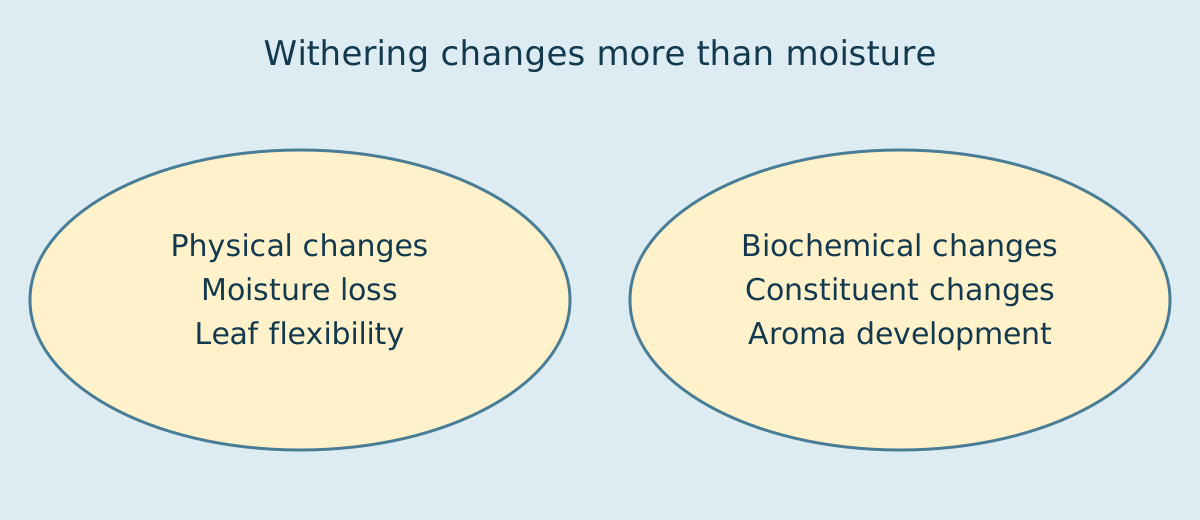
Illustration details
- Withering changes more than moisture
- Physical changes
- Moisture loss
- Leaf flexibility
- Biochemical changes
- Constituent changes
- Aroma development
Rolling opens the leaf to further reactions
Rolling or maceration disrupts the plant’s cellular structure. The review describes this as a way to bring catechins into contact with enzymes including polyphenol oxidase and peroxidase, while exposing material to air. The operation also changes particle size and can express juice onto leaf surfaces. These effects connect mechanical work to the chemical transformation that follows. Rolling is therefore more than a shaping exercise. The degree of disruption affects the material presented for oxidation, making the physical condition of the leaf part of the explanation for the eventual pigment and flavour profile.
The review distinguishes orthodox rolling from more intensive crush, tear and curl processing, commonly abbreviated CTC. These routes produce different forms of leaf material and different degrees of disruption. They should not be treated as identical operations with different machine names. Studies discussed by the authors report differences in pigments and volatile components between the resulting teas. Such comparisons belong to their particular processing systems; they do not make one route universally superior. Their value is in showing that the mechanical treatment influences chemical development as well as the appearance and size of the finished particles.
The material’s resistance to mechanical damage is another part of the comparison. A leaf that has been prepared differently during withering may respond differently when rolled or macerated. The review also considers rolling time, speed and temperature as variables affecting composition and sensory outcomes. These observations explain why a processing result needs more context than the name of the machine. The incoming leaf, its preparation and the mechanical treatment work together. A result attributed broadly to rolling may incorporate several of those differences, so it should not automatically be interpreted as the isolated effect of one equipment setting.
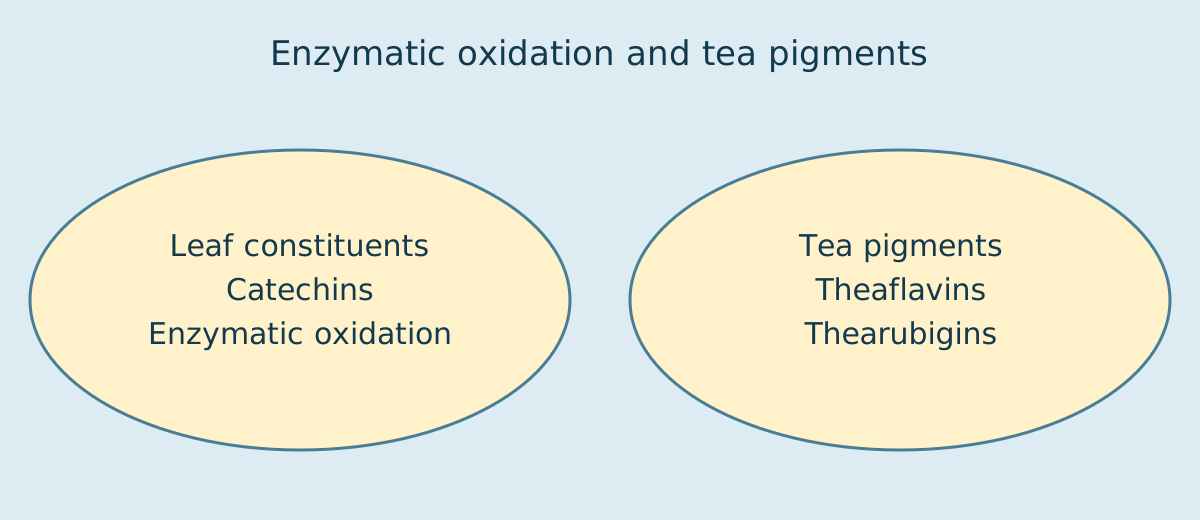
Illustration details
- Enzymatic oxidation and tea pigments
- Leaf constituents
- Catechins
- Enzymatic oxidation
- Tea pigments
- Theaflavins
- Thearubigins
Oxidation develops a changing mixture of pigments
In the black-tea processing literature discussed here, the stage often called fermentation concerns enzymatic oxidation. The review connects catechin transformations with the formation of theaflavins and thearubigins, two groups relevant to infusion characteristics. Theaflavins are associated with brightness and briskness, while thearubigins contribute to colour and mouthfeel. These are not the only constituents affecting the drink, but they help explain why processing changes are assessed chemically as well as by tasting. A darker infusion does not, by itself, reveal the entire balance of compounds or establish that every desirable sensory characteristic has increased.
Oxidation does not wait for a perfectly separate stage boundary. Cell disruption during rolling already allows enzymes, substrates and oxygen to interact, and the review follows these reactions into the subsequent oxidation period. Drying later changes their course by inactivating enzymes as heating proceeds. This continuity matters when interpreting processing times. The material entering a designated oxidation area has already experienced handling and biochemical change. A duration recorded for that area therefore describes one part of a longer history, rather than the total time during which every relevant reaction in the leaf has been occurring.
Longer oxidation is not a simple route to improvement in every attribute. The review describes formation and further transformation of pigment components, with different chemical and sensory measures reaching favourable points at different times. This makes the endpoint a question of the desired balance. An increase in total colour can coexist with a change in brightness or briskness that is less favourable for the intended product. The studies do not support treating all of those properties as one scale. Their separate responses help explain why extending the process can change the character of a tea rather than merely intensify it.
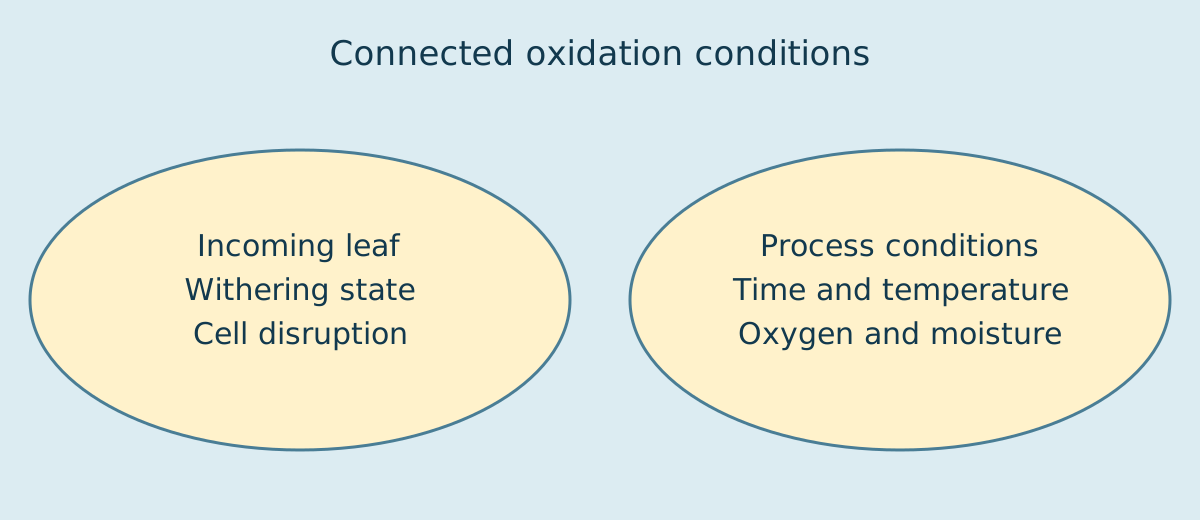
Illustration details
- Connected oxidation conditions
- Incoming leaf
- Withering state
- Cell disruption
- Process conditions
- Time and temperature
- Oxygen and moisture
Temperature influences enzyme activity and the rate of the transformations. The review discusses studies comparing oxidation conditions and notes that different teas have different favourable ranges. Heating also becomes relevant when the process moves towards enzyme inactivation. The important relationship is between temperature, time and the material being processed, rather than a single number that can be detached from its source. Comparisons made with different cultivars, leaf preparation or degrees of disruption need those distinctions preserved. A condition reported as favourable in one experiment does not establish a standard for every orthodox or CTC production line.
Oxygen availability and moisture conditions matter alongside temperature. Enzymatic oxidation requires access to oxygen, while the state of the disrupted leaf can affect aeration and temperature regulation. The review notes that excessive moisture in the processed leaf material can hinder these aspects of control. At the same time, unsuitable drying of the exposed material during oxidation can interfere with the process. These relationships make it misleading to discuss humidity as if more or less were always better. The relevant task is to maintain conditions appropriate to the leaf and the intended transformation, with aeration, temperature and moisture considered together.
Changes in the leaf’s appearance and aroma accompany oxidation. The review describes the transition towards coppery-brown material and discusses the development of volatile compounds. Such observations are useful manufacturing information, but they answer a different question from a measurement of a particular pigment or volatile substance. Neither a colour observation nor a single chemical result should be expanded into a complete assessment of the final infusion. The studies combine several kinds of evidence precisely because tea quality has multiple dimensions. Keeping those dimensions visible makes the connection between processing and the sensory result easier to interpret.

Drying removes water and redirects the chemistry
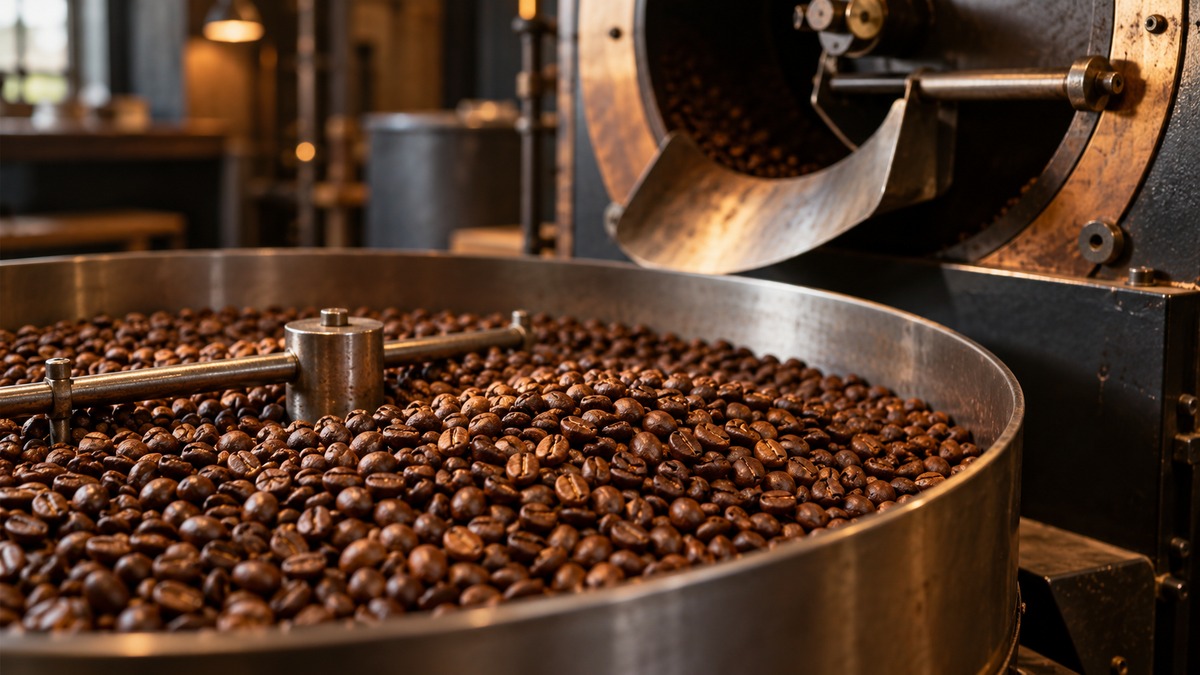
Drying has two connected tasks: lowering moisture and bringing the enzyme-driven processing phase to an end. The review also explains that heating can generate further chemical changes affecting aroma, taste and colour. This makes the drying stage more than a final reduction in weight. The material must move from the conditions supporting earlier reactions towards a state suitable for handling and storage. The outcome depends on heat and moisture transfer as well as on chemical transformations. A description limited to the temperature of the dryer omits how the leaf itself changes during that treatment.
Enzyme inactivation is a transition during heating rather than an instantaneous event at entry to the dryer. The review notes that reactions can continue during the early part of drying before the temperature becomes sufficient to deactivate the relevant enzymes. Thermal reactions can then contribute to the finished tea’s character. This sequence helps explain why the state of material leaving oxidation remains important to drying. A slowly heated, moist particle and one experiencing another heating history need not undergo the same progression, even if the equipment is ultimately operated to reach a comparable final moisture condition.
Too-rapid surface drying can create another problem. The review describes case hardening, in which the outside dries faster than the interior and moisture remains within the particle. The appearance of a dry surface is then an incomplete description of the material. At the other extreme, insufficient drying conditions can allow unwanted continuation of earlier transformations or an unsatisfactory final state. These examples show why both heat transfer and the movement of moisture through the leaf matter. The drying process must be evaluated through the resulting material, rather than solely through the intensity or duration of the supplied heat.
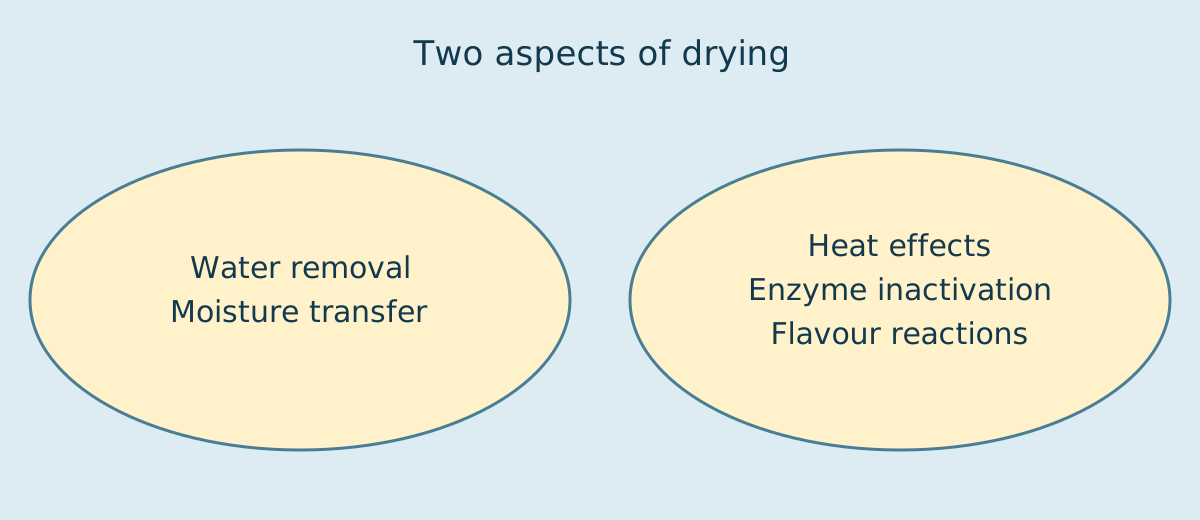
Illustration details
- Two aspects of drying
- Water removal
- Moisture transfer
- Heat effects
- Enzyme inactivation
- Flavour reactions
Heating also changes flavour chemistry. The review discusses reactions involving amino acids and carbohydrates, including Maillard chemistry, alongside loss or transformation of volatile substances. Drying can therefore create some aroma components while reducing others. An increase in heating intensity cannot be assumed to preserve every desirable feature already developed during withering and oxidation. Excessive exposure can introduce burnt characteristics. The practical question is the balance of transformations produced by a particular drying history. This explains why a favourable colour, a volatile profile and a tasting result may provide different information about the same processed sample.
The review describes several drying approaches, including fluidised-bed equipment, chain-based dryers and experimental alternatives. It also identifies spread thickness, airflow, temperature and duration as variables affecting drying and quality. Those descriptions should remain attached to their processing context. Air temperature at an inlet is not a complete account of the leaf’s thermal history, and a successful comparison between two dryers does not establish that all equipment of one category produces the same result. The study or production record needs to identify both the method and the material outcome being used to judge it.
One reviewed comparison of Congou black tea illustrates differences between hot-air and hot-roller drying. The authors report different volatile profiles, with hot-air drying favouring some sweet-floral characteristics and roller drying favouring some fruity-associated compounds. The example is useful because it describes different directions of change rather than a single universal improvement. It belongs to the tea and conditions examined in that research. It does not establish that every tea processed in either kind of dryer will acquire the same aroma, or that one profile is necessarily preferable for every intended product.
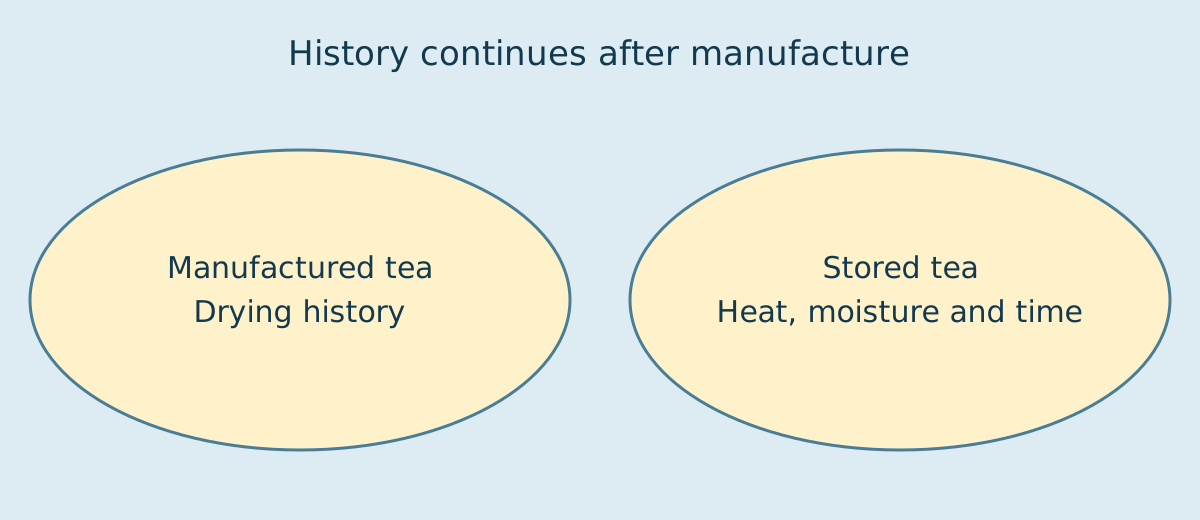
Illustration details
- History continues after manufacture
- Manufactured tea
- Drying history
- Stored tea
- Heat, moisture and time
Storage remains part of the material’s history
The review follows quality changes beyond manufacture into storage. Moisture, heat, air exposure and duration can influence the chemical and sensory state of black tea after drying. This is a different stage from the deliberate transformations used to manufacture the leaf. A batch assessed immediately after production and one assessed following transport or extended storage do not have the same history. The authors discuss changes in pigments, aroma and taste under different storage conditions. Those findings reinforce the need to identify when and under what circumstances a tea was tested, rather than treating the original manufacturing result as permanently fixed.
Across all these stages, chemical composition and sensory assessment provide complementary evidence. Measurements of selected pigments or volatile compounds help explain differences, while tasting examines the resulting infusion through attributes such as aroma, colour, briskness and mouthfeel. Neither should be converted into a universal numerical definition of quality without its measurement basis. The review gathers studies with different materials and conditions, so their reported favourable settings are best understood within those studies. The broader lesson is the connection between operations: a change introduced early in leaf handling can alter what the following stage receives and how its result should be interpreted.
A black tea’s processing description becomes more informative when it follows that sequence from harvested leaf to stored product. Withering changes moisture and biochemical conditions; rolling changes cellular structure and exposure; oxidation changes pigment and flavour chemistry; drying alters both water content and reaction pathways. Storage then adds further history. This connected view explains why the craft described in the Fujian report involves more than selecting one machine or extending one treatment. When comparing a production method or research result, the following questions help preserve the meaning of its evidence:
- What leaf material entered the process, and how was it selected and handled?
- What physical and biochemical state did withering produce before rolling?
- How did disruption, oxygen, moisture, temperature and time interact during oxidation?
- What drying route and resulting material condition accompanied the reported quality?
- Which chemical and sensory measurements were made, and after what storage history?
Industrial context: Xinhua, “Brewing new flavors of China’s time-honored tea that once scented world”, 5 August 2025; Gao Yuxin and Li Binbin contributed to the report. Technical explanation independently adapted from Muhammad Aaqil, Chunxiu Peng, Ayesha Kamal, Taufiq Nawaz, Fei Zhang and Jiashun Gong, “Tea Harvesting and Processing Techniques and Its Effect on Phytochemical Profile and Final Quality of Black Tea: A Review”, published 13 December 2023, DOI: 10.3390/foods12244467, licensed under CC BY 4.0. Wording and organisation have been changed; source prose, tables and figures are not reproduced. Research examples are reported through the review. The photographs illustrate generic processing materials and tea samples, not the reported businesses or particular experiments.

Leave a comment