Bamboo-fibre composites: why the polymer interface matters
Bamboo fibre can reinforce a polymer, but the result depends on the matrix, fibre preparation and their interface. Research examples show why stiffness, strength and impact behaviour need separate assessment.
Published Feb 27, 2026
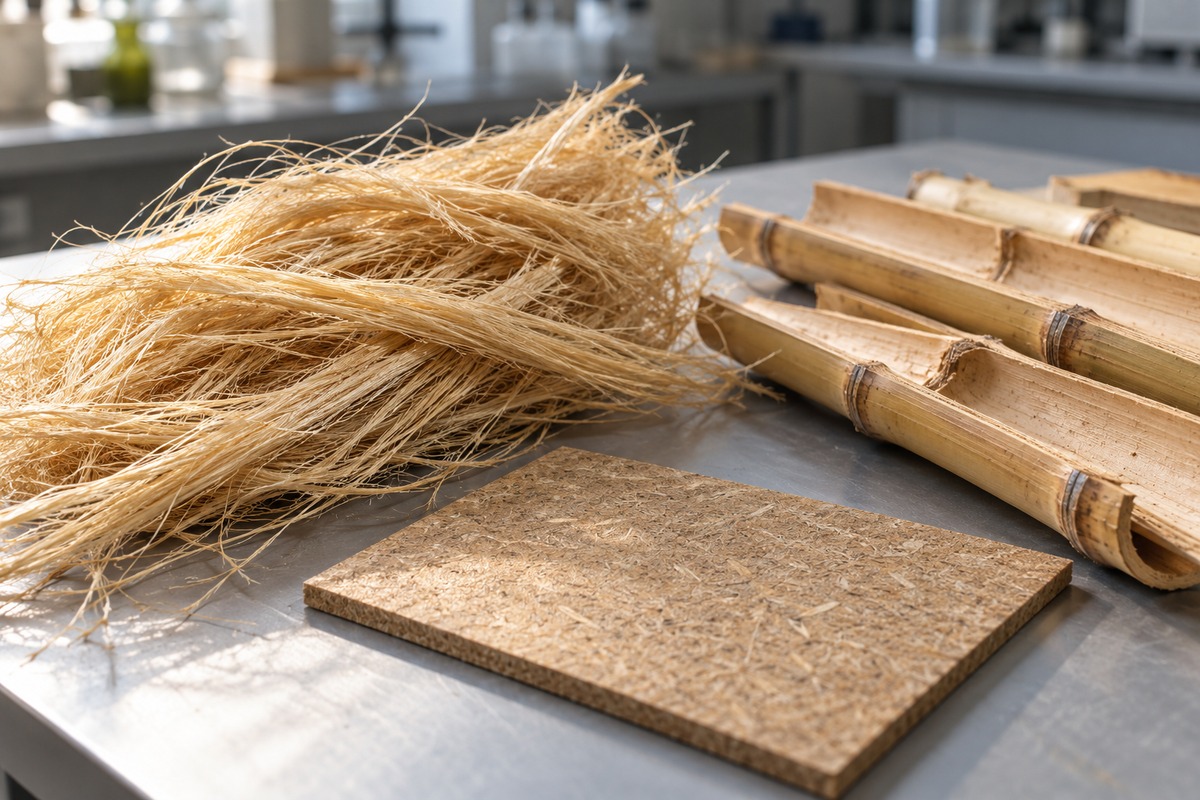
On 27 February 2026, Xinhua reported from Chishui in southwest China on businesses turning bamboo into products including tableware and swabs. Its wider account also described packaging and other manufactured goods. That range raises a materials question: what exactly does “bamboo-based” identify? A product shaped from a culm, an extracted fibre and a fibre embedded in a polymer are different material arrangements. The report provides a dated industrial context, but it does not establish the formulation or measured performance of every product mentioned. Understanding composite research requires a closer look at the constituents and their contact.
A review by Dandan Xu, Sheng He, Weiqi Leng, Yuhe Chen and Zaixing Wu, published in Polymers on 31 October 2023, examines bamboo-fibre-reinforced polymers. The authors are affiliated with the China National Bamboo Research Center and Nanjing Forestry University. Their account brings together preparation methods, interface treatments and mechanical results from different studies. It is useful for explaining why a fibre can improve one formulation without providing the same outcome in another. The review is not a test report for the businesses in Xinhua’s later article, and its individual examples should retain their identity as research findings for particular material systems.

Illustration details
- Dated reporting and research
- 31 October 2023
- Composite-materials review
- 27 February 2026
- Bamboo-industry reporting
Bamboo feedstocks do not all follow one route
The review distinguishes natural bamboo fibre from regenerated bamboo fibre. Natural fibre is separated from the bamboo material, while regenerated fibre involves processing bamboo pulp into a spinnable material. These routes should not be confused merely because both begin with the same plant. They change how the reinforcement is obtained before it ever reaches a composite manufacturer. The distinction also prevents a misleading shortcut: the word bamboo does not identify a single fibre structure or preparation history. When comparing studies, the starting description needs to say which kind of reinforcement was used, rather than treating all bamboo-derived fibres as equivalent inputs.
For fibre separation, the authors describe mechanical, biological and chemical approaches, as well as combinations of methods. Mechanical processing can involve crushing, disintegration or steam-assisted separation. Chemical treatment can remove components around the fibres, while biological approaches use enzymes to assist separation. Each route changes the material that becomes available for further processing. The review notes limitations involving fibre dimensions, damage and processing conditions. These observations concern the quality and consistency of the extracted reinforcement; they do not establish that every route is suitable for every application. Fibre preparation and fabrication of the final polymer composite remain connected but separate stages.
The reinforcement also varies with the bamboo itself. The review identifies species, age and the physical characteristics of fibres and fibre bundles as factors affecting composite properties. Consequently, a result from one selected feedstock cannot automatically describe all bamboo material. Even before a surface treatment is chosen, the manufacturer or researcher is dealing with a particular reinforcement rather than an abstract plant ingredient. This helps explain why reports should retain information about the material used. A fibre’s origin, form and preparation history provide context for subsequent processing, while the finished composite still requires its own mechanical assessment.
The polymer remains a constituent of the product
The second major constituent is the matrix. Xu and colleagues group the reviewed composites into thermoplastic and thermosetting systems. Their thermoplastic examples include polyethylene, polypropylene and polyvinyl chloride; thermosetting examples include epoxy, phenolic and polyester resins. These are different material families, not interchangeable names for a generic binder. A bamboo-reinforced polypropylene formulation therefore should not be described as if the polymer has disappeared from the product. The reinforcement and matrix both remain relevant to understanding the result. The review compares systems through their constituents and processing, rather than giving bamboo content alone as a complete description of a manufactured material.
Preparation can include treatment of the raw material, mixing, granulation and moulding. In the review, these operations connect the selected reinforcement to the polymer matrix and then to the final shape. They also show why obtaining a strong fibre is only part of the task. The fibre must be incorporated into a material that can be formed and tested. A formulation description without its processing route omits an important part of the comparison. Conversely, the name of a moulding process does not reveal the fibre preparation or matrix composition that entered it. Both sides of that description are needed.
Extrusion, hot pressing and compression moulding appear among the preparation methods discussed by the authors. The review also describes injection-moulded research examples. The method is therefore another feature that should remain attached to a reported result. Different studies may use different feedstocks, formulations and forming routes simultaneously. Comparing their final strength values as though only the bamboo percentage changed would erase those distinctions. A useful account preserves the actual system under consideration: the form of reinforcement, the matrix, any modification and the way the specimen was produced. That is more informative than ranking processes solely by a shared bamboo label.
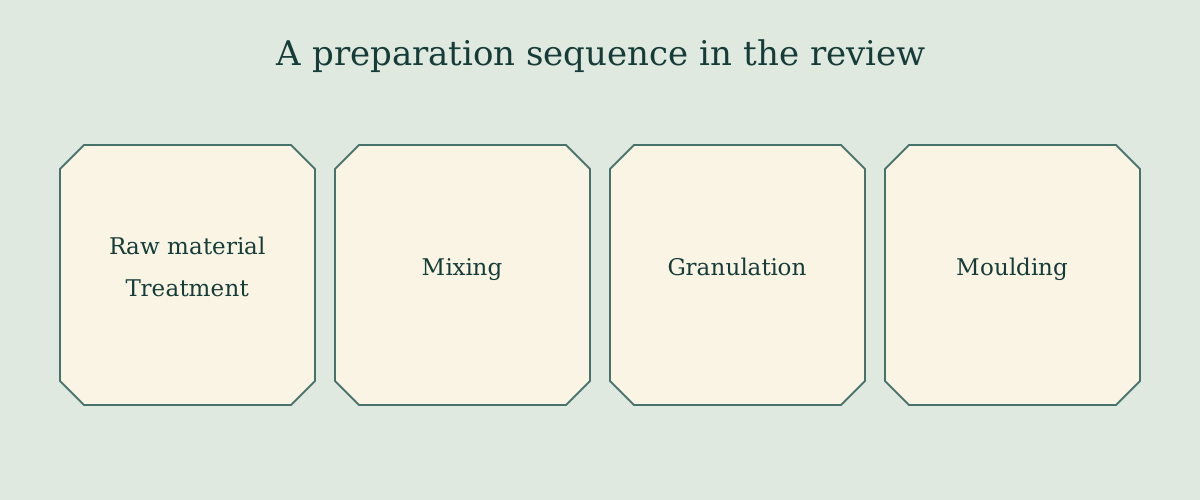
Illustration details
- A preparation sequence in the review
- Raw material
- Treatment
- Mixing
- Granulation
- Moulding
The interface connects reinforcement to matrix
A central difficulty is the compatibility between the fibre surface and the surrounding polymer. The review describes bamboo fibre as hydrophilic and discusses the mismatch with hydrophobic matrices in the systems examined. Hydroxyl groups on the fibre surface do not, by themselves, ensure effective interaction with such a matrix. The result can be weak adhesion and an uneven distribution of reinforcement. This is why adding a mechanically useful plant fibre is not enough to guarantee a mechanically useful composite. What happens at the contact between the constituents forms part of the material’s behaviour, alongside the properties of the separate ingredients.
Weak interfacial bonding can lead to debonding, which the authors identify as a problem for mechanical performance. Dispersion matters too: the reinforcement should not be understood simply as a quantity listed in the formulation. Its distribution and interaction with the matrix affect the composite that is actually formed. These issues explain the attention given to interface modification in the reviewed research. They also limit the interpretation of a fibre-content figure. The same nominal amount of reinforcement does not prove the same interfacial condition, particularly when treatment, mixing and moulding differ between the materials being compared.
The review groups interface interventions into physical or mechanical methods, chemical methods and combinations. Its examples include plasma treatment, heat treatment and particle filling, alongside several chemical approaches. These categories describe ways of changing the reinforcement or its interaction with the matrix; they are not a single universal finishing step. A treatment should be assessed through the material system in which it was used and the properties measured afterwards. The authors’ survey shows several possible routes, but their presence in the literature does not establish that applying all of them together would produce a better composite or a commercially suitable manufacturing process.
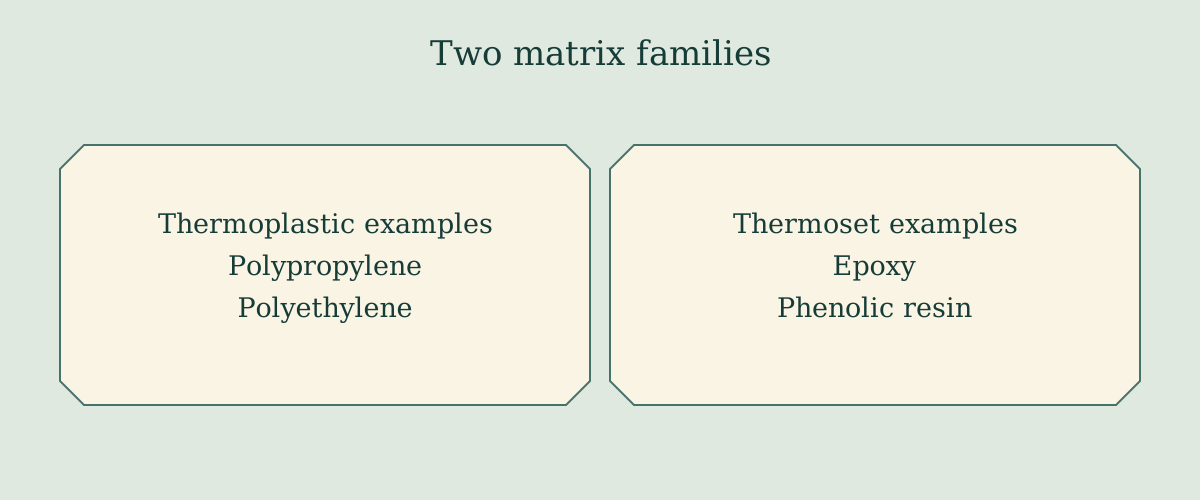
Illustration details
- Two matrix families
- Thermoplastic examples
- Polypropylene
- Polyethylene
- Thermoset examples
- Epoxy
- Phenolic resin
Chemical approaches include coupling agents, grafting and alkali or acid treatments. The review discusses removal or modification of surface-associated components and improvements in the contact with a selected polymer. That purpose differs from simply maximising fibre purity. The relevant question is whether the resulting reinforcement and matrix interact effectively in the finished material. A treatment can therefore be part of composite design rather than just a preliminary cleaning operation. Its name alone still does not establish performance: the reported outcome belongs to the particular fibre, polymer, processing route and treatment conditions examined in the associated study.
Some reviewed examples combine several interventions. The authors describe coatings and combined surface treatments intended to improve interfacial adhesion, including work with polydopamine and coupling agents. Such examples make the sequence of preparation important. A result for a combined treatment should not be attributed automatically to one ingredient when several aspects changed together. Nor should an improved interface be treated as proof that every relevant product property has improved by the same amount. The review connects interface design to mechanical behaviour, but it presents distinct measurements and formulations rather than a single transferable score for treatment quality.
Thermoplastic examples show different responses
One polypropylene example examined an elastomer modifier together with bamboo reinforcement. As reported in the review, introducing the modifier changed elongation and impact behaviour, while the choice between homopolymer and copolymer polypropylene also affected the comparison. This illustrates that the matrix formulation remains an active design variable. A change attributed broadly to a bamboo composite may actually involve reinforcement, polymer type and an additional modifier. Keeping those details together helps explain the observed behaviour without turning one research result into a general claim about bamboo. It also separates impact-related performance from other mechanical responses measured in the same research programme.
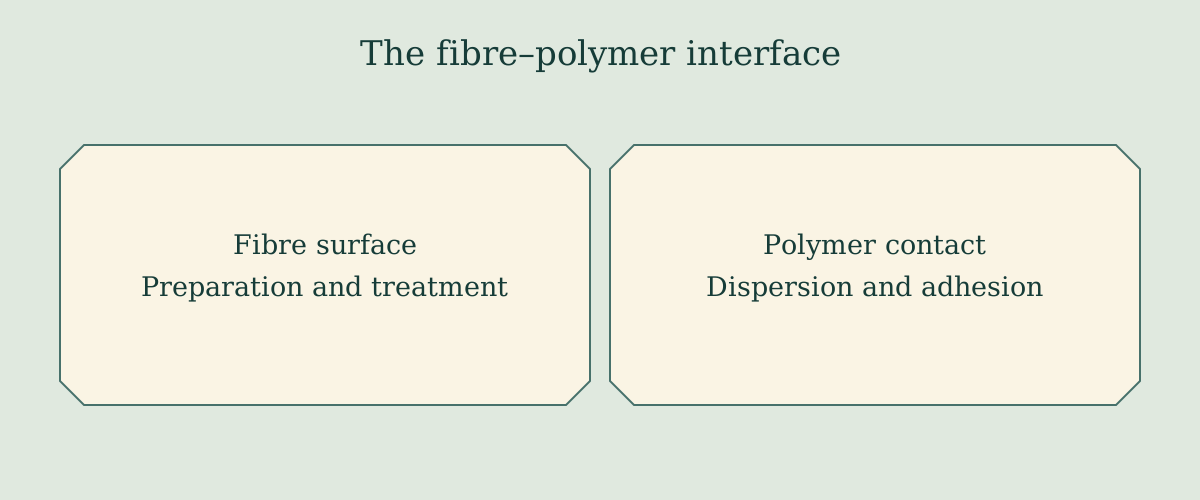
Illustration details
- The fibre–polymer interface
- Fibre surface
- Preparation and treatment
- Polymer contact
- Dispersion and adhesion
Another polypropylene example used bamboo fibres modified through alkali treatment and graphene oxide. The review reports tensile strength increasing from 31.9 to 35.9 megapascals and flexural strength from 42.9 to 53.1 megapascals relative to the untreated-fibre composite. Those are two different measurements from a specified comparison, not a universal percentage improvement for bamboo reinforcement. The preparation also involved microinjection moulding. Preserving that context matters: the values describe the examined formulations and processing route. They do not establish the strength of an unspecified commercial panel, nor do they isolate every individual contribution of the combined fibre-modification procedure.
High-density polyethylene examples provide another useful distinction. The review describes work in which adding bamboo pulp fibre improved flexural, tensile and impact properties, whereas adding white mud improved flexural properties while reducing tensile and impact strengths. The important point is the direction of the separate responses. A material can improve in one kind of test while becoming less favourable in another. Describing the change only as an overall improvement would conceal information that a product designer needs. The reviewed comparison supports assessment by property and formulation; it does not establish a general ranking of all fillers or polyethylene composites.
Polylactic acid, usually abbreviated PLA, appears in a further group of examples. The authors discuss work combining alkali treatment with dopamine-based modification to improve the interface between bamboo fibre and PLA. The reported changes in flexural, tensile and impact strengths were different in magnitude. This again makes the individual mechanical response important. The material should be identified as a particular modified-fibre and polymer system, rather than reduced to a natural-fibre percentage. The example explains the purpose of interfacial treatment; it does not establish the performance of every PLA product or confirm that a particular packaging manufacturer uses that preparation route.

Thermosetting systems bring their own variables
In epoxy-based systems, the review describes relationships involving fibre diameter and length. Individual studies found changes in tensile behaviour or fracture toughness when reinforcement dimensions changed. These results concern the geometry of the reinforcement within particular composites. They do not supply one best fibre size for every matrix and moulding process. The distinction is useful because extraction, refinement and composite fabrication can all influence the material eventually tested. When a study changes fibre dimensions, its findings should retain that experimental context instead of being recast as a universal purchasing specification for any bamboo reinforcement.
The amount of reinforcement is also important, but increasing it does not imply unlimited improvement. In a reviewed epoxy example, excessive fibre content weakened interfacial bonding and reduced mechanical properties. Another example involving bamboo particles in a hybrid polyester system described aggregation at higher particle additions and a corresponding deterioration in the interface. Together, these observations explain why reinforcement content needs evaluation rather than automatic maximisation. The findings belong to different systems and should not be merged into a shared numerical limit. They show a recurring design question: how the added material is distributed and bonded within the composite.
The review also reports an epoxy-composite study using nanoclay. In the cited comparison, tensile strength rose from 80 to 112 megapascals and flexural strength from 105 to 134 megapascals. These values describe the selected formulation compared with the study’s bamboo-fibre epoxy baseline, rather than with bamboo alone. The review notes that the investigation considered a range of nanoclay contents and identified a favourable result within that range. It would be misleading to turn that finding into a claim that any nanoclay addition improves any bamboo composite. The reference material and the property being compared remain essential parts of the result.
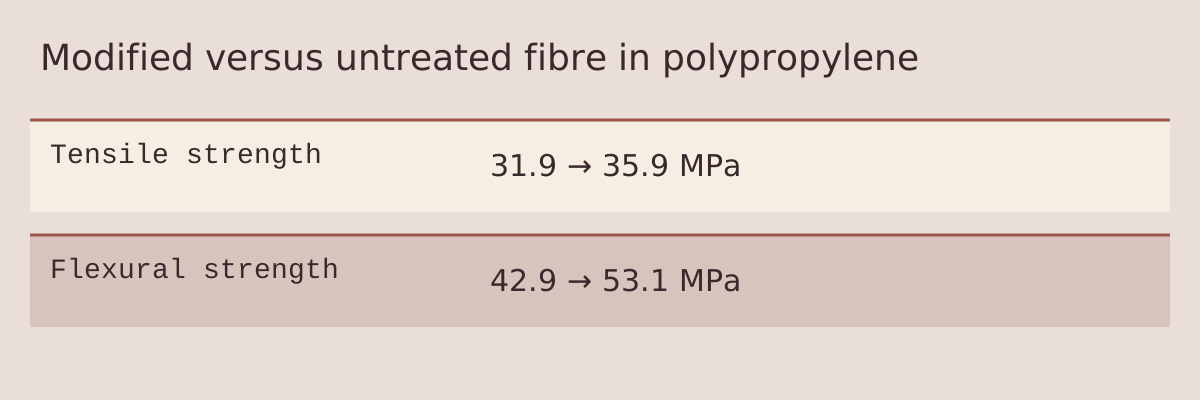
Illustration details
- Modified versus untreated fibre in polypropylene
- Tensile strength
- 31.9 → 35.9 MPa
- Flexural strength
- 42.9 → 53.1 MPa
Hybrid laminates add another level of organisation. The authors describe work combining bamboo and glass fibres in an epoxy system, with layer position influencing tensile and flexural strength. In that case, the material cannot be understood solely through its total bamboo content: the placement of different reinforcing layers also matters. The review additionally discusses inorganic fillers in these hybrid systems. Such examples expand the available design space while making the formulation more specific. A hybrid result should retain the identity of its additional reinforcement and filler, rather than being presented as a measured property of an entirely bamboo-derived material.
A measured property answers a particular question
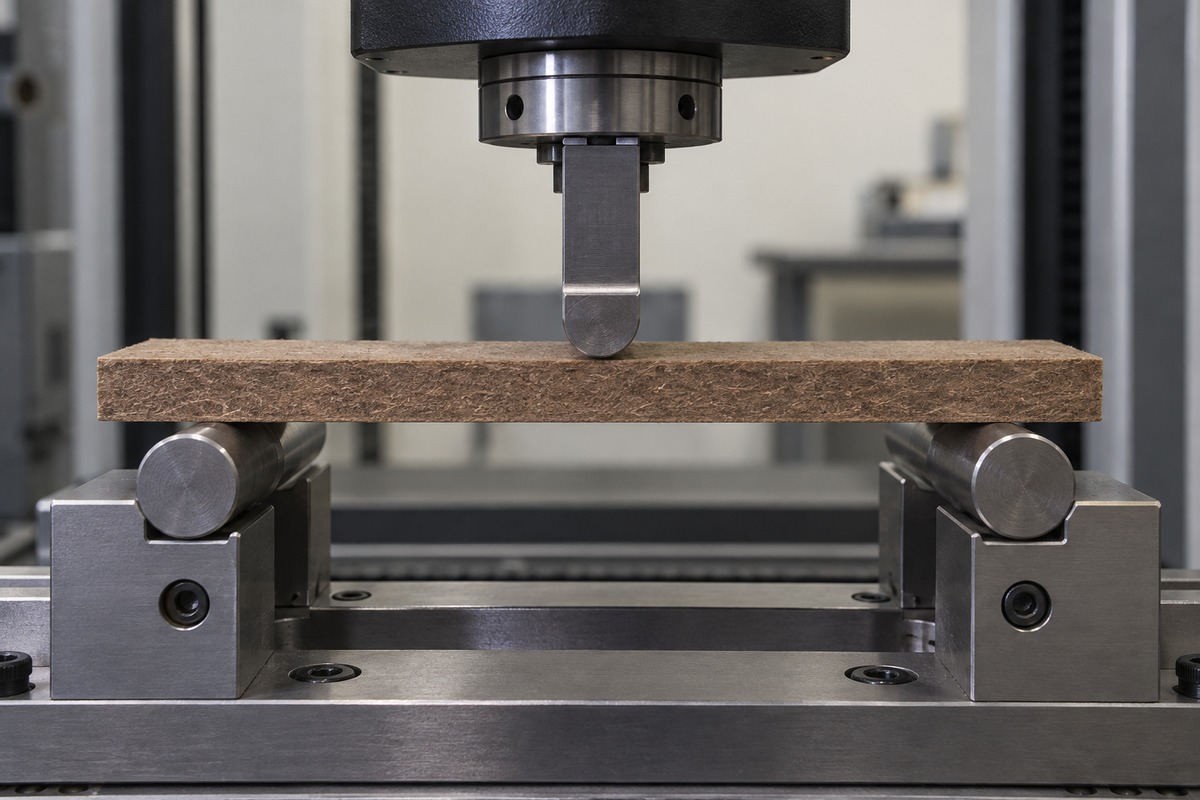
The review repeatedly separates tensile, flexural and impact responses, along with modulus and elongation where these are reported. The examples above show why that separation is practical. A change in formulation can produce different responses across those measures, and an increase in one does not establish an equal increase in another. A comparison should therefore state the property, the reference material and the preparation involved. This preserves the meaning of a reported improvement. It also prevents a numerical result from becoming a general promise that the material will withstand every kind of loading better in an eventual product.
Water-related behaviour introduces a further dimension. Interfacial modification studies discussed in the review consider wettability, water resistance or absorption alongside mechanical performance. These are related aspects of material behaviour, but they are not identical measurements. A formulation reported as mechanically improved still needs the relevant water-related evidence for its intended use. Conversely, an observation about reduced absorption does not by itself establish strength under all service conditions. The review’s examples make it useful to retain the individual test outcomes rather than compress them into an unqualified description of the composite as simply strong, durable or moisture-proof.
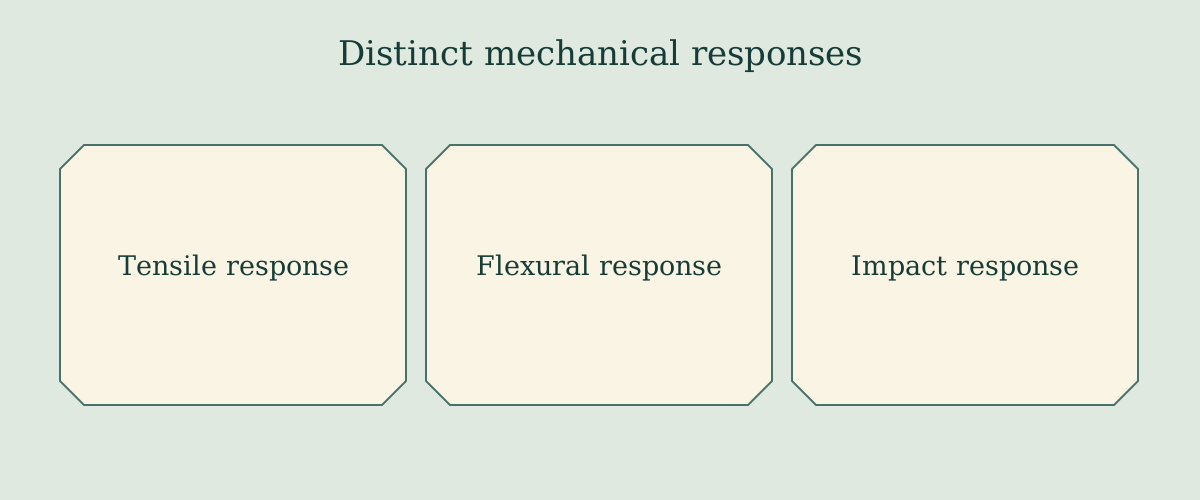
Illustration details
- Distinct mechanical responses
- Tensile response
- Flexural response
- Impact response
Packaging research demonstrates how different bamboo-derived products can coexist. The review discusses fibres combined with starch, modified-fibre PLA composites and drinking straws formed from bamboo sticks. These are distinct routes with different constituents and structures. A result from one cannot be assigned to all three simply because the products are associated with packaging. The same distinction applies to environmental descriptions: a bamboo reinforcement does not identify the complete composition of a polymer composite. The reviewed material examples establish particular research directions. They do not constitute evidence that every bamboo-labelled product shares a formulation, an end-of-life behaviour or a verified application approval.
The authors conclude that further experimental and manufacturing research is needed, particularly around preparation, interfacial compatibility and processing. That limitation belongs beside the promising examples. A tested specimen, a proposed application and a production process are different forms of evidence. The 2026 industrial report and the earlier technical review can therefore be read together without treating one as verification of the other. The report identifies a manufacturing context; the review explains material-design questions. Connecting them responsibly means retaining the boundaries of each source and looking for product-specific evidence when evaluating an actual composite or a proposed use.
A useful description of a bamboo-fibre composite follows the material through its preparation rather than stopping at the plant name. It identifies the reinforcement, the polymer, their interface and the processing route, then reports the properties actually measured. That sequence keeps favourable research results useful while preserving their limits. It also distinguishes a change in formulation from a claim about all bamboo products. When comparing future reports, the following questions help maintain those distinctions and make the evidence easier to interpret:
- Was the reinforcement natural bamboo fibre, regenerated fibre, particles or another specified form?
- Which polymer matrix and additional modifiers were present?
- How were the fibre surface, dispersion and interfacial contact addressed?
- Which forming route and reference formulation accompanied the reported result?
- Were mechanical, water-related and product-specific findings established separately?
Industrial context: Xinhua, “How bamboo is helping curb plastic pollution in China”, 27 February 2026. Technical explanation independently adapted from Dandan Xu, Sheng He, Weiqi Leng, Yuhe Chen and Zaixing Wu, “Replacing Plastic with Bamboo: A Review of the Properties and Green Applications of Bamboo-Fiber-Reinforced Polymer Composites”, published 31 October 2023, DOI: 10.3390/polym15214276, licensed under CC BY 4.0. Wording and organisation have been changed; no source prose, tables or figures are reproduced. Research comparisons are reported through that review and are not product specifications. The photographs illustrate generic materials and testing equipment, not the reported businesses or the reviewed experiments.

Leave a comment