Buckwheat milling: how grain fractions shape flour
Russia's 2025 harvest update leads into the mill: dehulling, grain fractions and starch condition explain why buckwheat flours behave differently in food production.
Published Oct 3, 2025
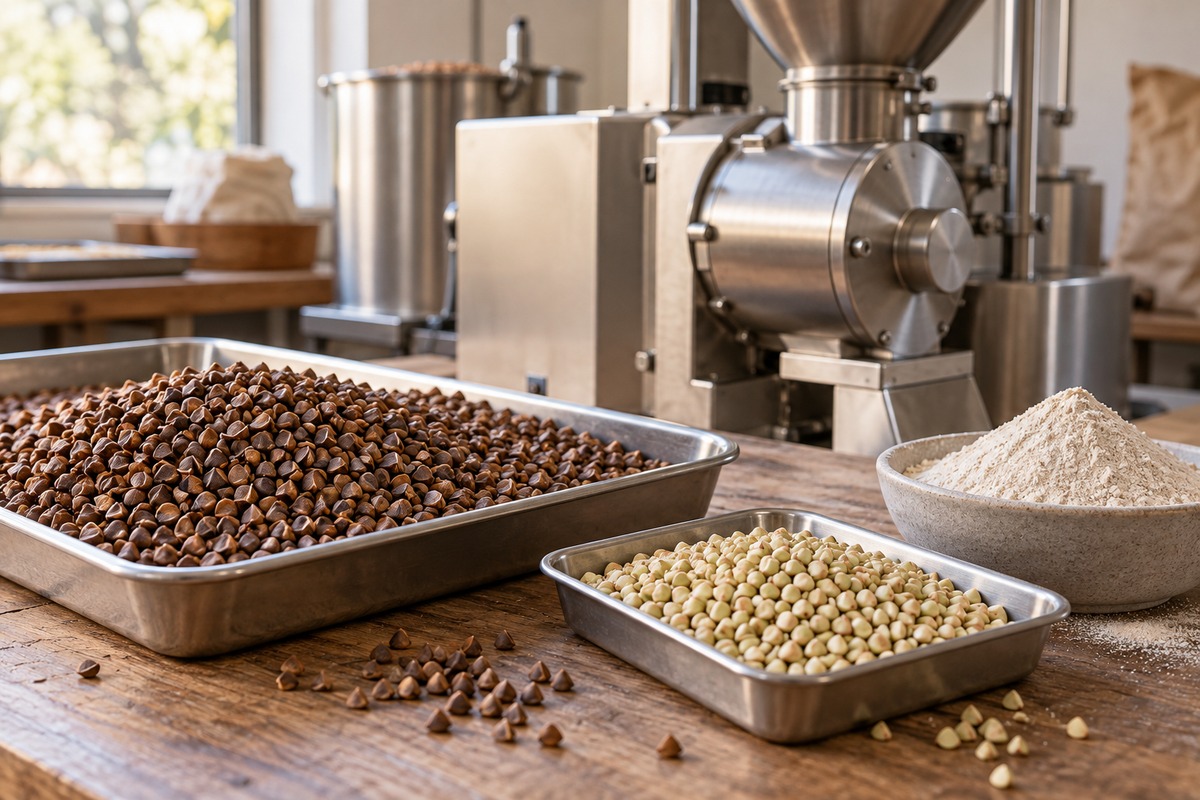
By 3 October 2025, Russia had harvested 430,000 tonnes of buckwheat, according to the Agriculture Ministry figures carried by Interfax. The reported yield was 13.4 centners per hectare, against 12.5 a year earlier. The ministry expected the eventual harvest to exceed annual domestic demand of about 900,000 tonnes, with carry-over stocks also available. Those were an interim harvest result and a forecast for the full season. The material reaching a processor still had another history ahead: separating the hard hull, sorting the edible kernel and producing the particular fractions required for groats or flour.
Buckwheat processing produces ingredients with different compositions and different behaviour in a food factory. A technical review by Pavel Skřivan, Diana Chrpová, Blanka Klitschová, Ivan Švec and Marcela Sluková, published in August 2023, describes the anatomy behind those differences. The review lists university affiliations in Prague, in the Czech Republic. Their account follows the crop from its outer coverings to starch condition and flour testing. Its processing descriptions provide the technical background here; they are not measurements of the Russian harvest or specifications for a particular Russian mill.

Illustration details
- Two dated sources for the article
- 15 Aug 2023
- Milling review published
- 3 Oct 2025
- Interim Russian harvest report
A triangular fruit with uneven maturity
Buckwheat belongs to the knotweed family, Polygonaceae. Its grain-like fruit is an achene, and the crop is classed as a pseudocereal because it can be milled and used in cereal-style foods while belonging to a different botanical family from the grasses. Common buckwheat, Fagopyrum esculentum, is one of the two cultivated species discussed in the review. The fruit's triangular shape and its hard outer covering are practical features in processing. A mill encounters that physical structure before it can turn the starch-rich interior into a usable flour.
Flowers and fruits develop progressively on a buckwheat plant. Ripening continues from the lower branches towards the upper parts, leaving harvested material with a mixture of maturity levels. The review associates this pattern with differences in seed size and composition. Sorting reduces some of that variation, although a size fraction can still include kernels at different stages of development. The starting material therefore carries biological variability into the milling process. The authors identify this uneven maturity again when discussing the difficulty of predicting flour performance from a small set of laboratory measurements.
The layers separated in the mill
The achene has a tough outer pericarp, commonly called the hull or husk. Beneath it lie the testa and the aleurone layer, followed by the endosperm. The germ is enclosed within the interior. These parts differ in structure and chemical composition. Endosperm cells contain closely packed starch granules, while the hard outer covering has substantial cellulose and lignin. Removing the hull consequently separates a material with different properties from the kernel that remains. Further abrasion can remove different amounts of the layers immediately beneath that hull.
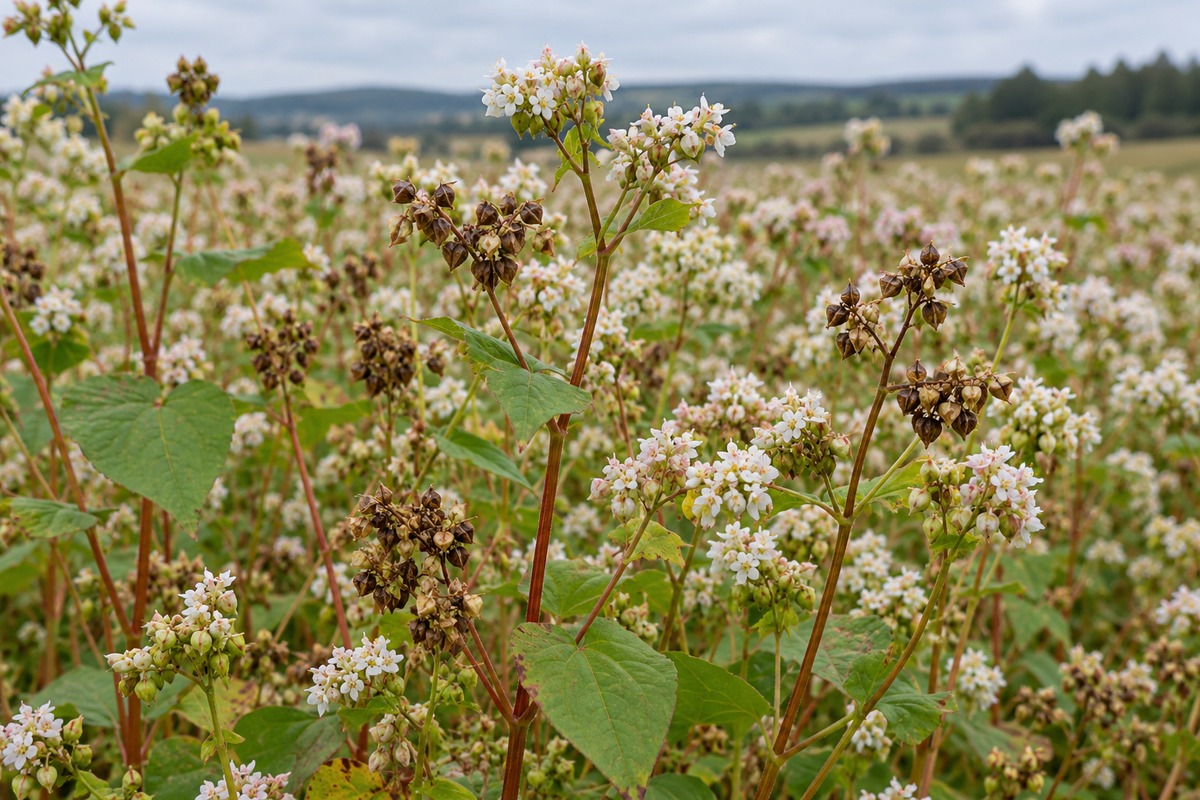
The broad milling sequence comprises reception, storage, cleaning, dehulling, grinding and finishing. Before milling, screens separate achenes into size groups. The review describes screen openings in a range of 3.2–5 millimetres and relates uniform size to processing yield and reduced waste. It also identifies very small achenes as susceptible to crushing during hulling. These descriptions concern the processing literature surveyed by the authors. They explain why classification precedes dehulling, rather than establishing a universal screen setting for every variety, crop year or piece of equipment.
Storage changes the material before grinding
Storage belongs to the processing history of the kernel. The review describes losses of characteristic aroma and flavour during prolonged storage, together with changes from light green towards pinkish or brown tones in hulled material. Oxidation contributes to these changes. Temperature and the surrounding atmosphere can influence their progress, and the authors discuss cooler storage and controlled-atmosphere approaches. The description makes the condition of the incoming material part of flour quality: a kernel has already experienced a period of storage before the mill begins its mechanical work.
Colour and taste are important quality characteristics of buckwheat groats, and both can also be affected by the dehulling route. The traditional sequence removes the hard pericarp and processes the kernel underneath it. The degree to which the testa and aleurone remain on that kernel then influences the composition of later fractions. Two batches described simply as hulled buckwheat can thus enter grinding with different amounts of these layers attached. Their shared product name does not specify every anatomical component retained after primary processing.
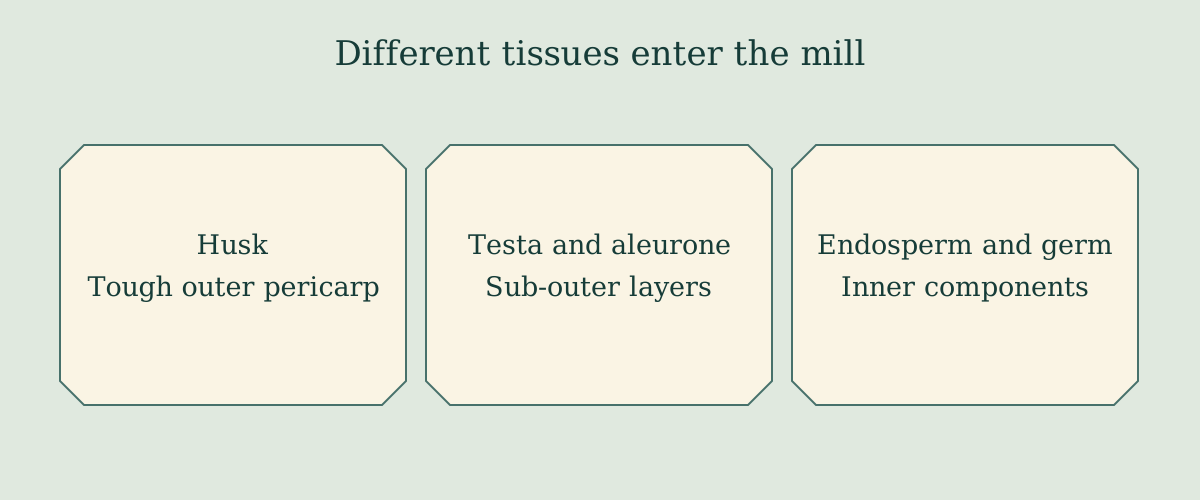
Illustration details
- Different tissues enter the mill
- Husk
- Tough outer pericarp
- Testa and aleurone
- Sub-outer layers
- Endosperm and germ
- Inner components
Mechanical and hydrothermal dehulling
Cold mechanical dehulling uses contact with abrasive surfaces to remove the hull. The review describes traditional grinding stones and rough-surfaced dehulling machinery. This route avoids the separate steaming stage of hydrothermal processing and retains different sensory characteristics. The operation produces a hull fraction and hulled grain, with some variation in how much of the underlying tissue remains. Its role is distinct from the later disintegration of the kernel into flour: the first operation separates a covering, while the next reduces the size of the edible material.
Hydrothermal dehulling introduces moisture and heat before separation. Achenes are steamed in chambers or steamers and then dried, allowing the pericarp to break and separate more readily from the interior. The treatment also changes sensory and physical characteristics. The review describes a shift towards pinkish-brown colour and discusses the influence of heat and moisture on taste and composition. Mechanical and hydrothermal routes can have modifications and combinations, so their names describe broad approaches. They do not identify a single processing programme applied throughout the buckwheat industry.
From hulled grain to several fractions
After dehulling, impact mills, roller mills or combinations of the two can disintegrate the kernel. The resulting material is divided into fractions rather than emerging as one chemically uniform powder. Some fractions contain more endosperm, while others carry more germ and sub-outer tissue. The review describes flour, semolina and bran among the products of this sequence. The amount and composition of each depend on the material retained during hulling and on subsequent milling. Flour colour therefore has a connection to the tissue mixture entering that particular fraction.
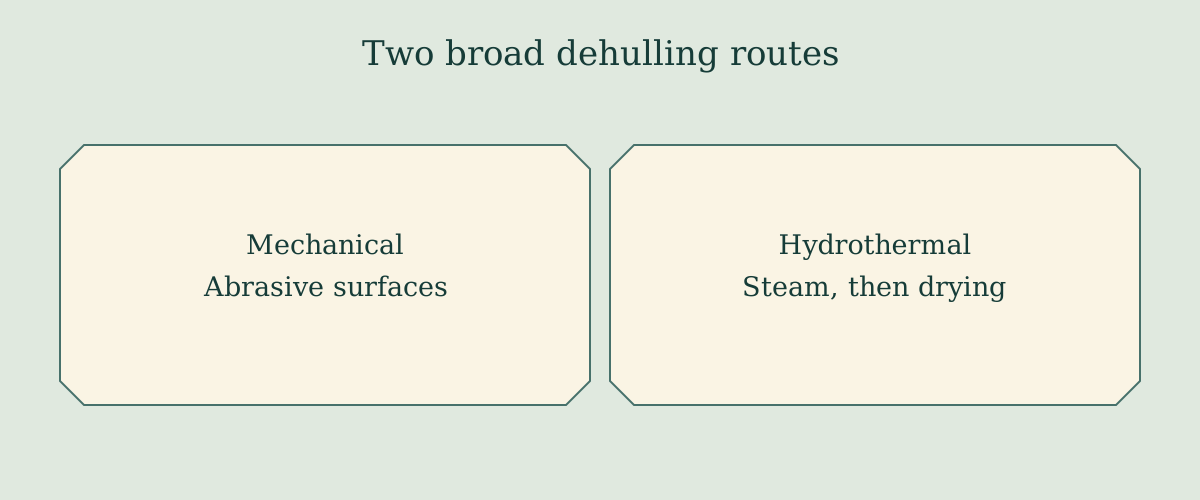
Illustration details
- Two broad dehulling routes
- Mechanical
- Abrasive surfaces
- Hydrothermal
- Steam, then drying
Light buckwheat flour consists mainly of endosperm. Darker flour retains a greater contribution from the layers immediately beneath the removed hull, while semolina contains relatively coarse pieces of endosperm. Bran contains sub-outer layers and germ. The terms distinguish products with different physical and chemical characteristics, even though they originate in the same achene. They also distinguish the bran fraction from the separated hard hull. Combining those two by-products under one loose label can hide the difference between the outer pericarp and the tissues beneath it.
What the word wholegrain leaves unresolved
The review questions the use of cereal-style terminology for buckwheat flour. The authors argue that, by strict analogy with wholegrain cereal flour, all anatomical parts of the achene would need to remain present, including the pericarp. In practice, dark flour made from carefully hulled kernels is also often described as wholegrain. That flour can retain substantial testa and aleurone while lacking the tough outer hull. This is the authors' discussion of terminology and composition; it is not a statement about the legal labelling requirements of any particular country.
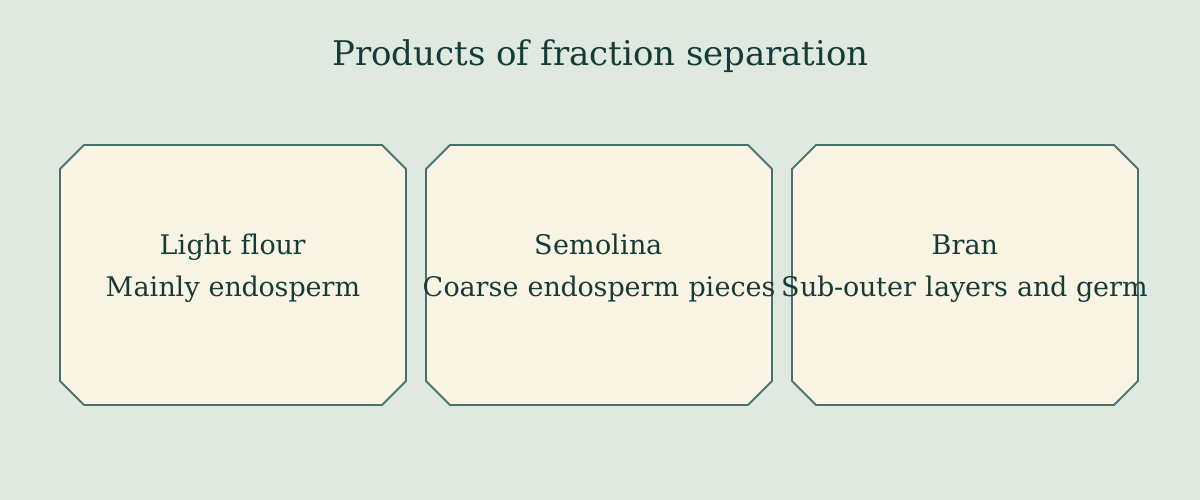
Illustration details
- Products of fraction separation
- Light flour
- Mainly endosperm
- Semolina
- Coarse endosperm pieces
- Bran
- Sub-outer layers and germ
Grinding an entire achene presents a different physical problem from grinding a hulled kernel. The hard pericarp, including the pointed parts of the triangular fruit, must be broken down sufficiently. At the same time, the process should control damage to the starch granules inside. The review treats this combination as technically demanding and explains why removing the hull first is common. The distinction links a product description to the actual preparation route: retained outer material and the intensity of disintegration jointly affect the flour that reaches secondary processing.
Wet milling follows another sequence
Dry grinding is not the only route described in the literature. In wet milling, achenes are first macerated in water. The hydrated mass is ground and centrifuged, then dried and ground again to produce flour. This sequence gives the material a different combination of water exposure, separation and mechanical treatment. The review notes that such differences influence physicochemical and functional properties. A flour's production history therefore includes more than the final grinding step: it can also include hydration and intermediate separation before the powder takes its finished form.
Across these routes, the component distribution provides a useful way to describe the output. Starch dominates the endosperm, whereas the germ and outer tissues contribute different proportions of protein, lipids, fibre and minerals. The composition of a flour changes as these tissues are separated or retained. The review reports broad ranges and variation between buckwheat materials, rather than one composition applicable to every powder. Describing the fraction and its preparation gives a food producer more information than treating all buckwheat flour as an interchangeable ingredient.

Starch granules have their own structure
Buckwheat starch granules are small, polygonal structures that frequently occur in clusters. The review gives a size range of 2–14 micrometres and describes a compact arrangement within flour particles. Starch itself contains amylose and amylopectin, whose structures contribute to its behaviour during processing. A flour particle and a starch granule are consequently different levels of organisation. Milling breaks larger structures into particles while also exposing or damaging some of the granules within them. Both particle formation and granule condition matter when considering the properties of the finished flour.
Heating a flour-and-water system reveals another aspect of that structure. The review reports gelatinisation onset temperatures ranging from 57 to 67 degrees Celsius between flour samples and a peak viscosity temperature of approximately 90 degrees. It links variation to starch structure, crop genetics and milling history. These are descriptions of material behaviour under measurement conditions, rather than a prescribed factory temperature programme. They illustrate why a flour's response to heat and water depends on the sample being tested and on the method used to observe it.
Proteins and lipids follow different fractions
The storage proteins of buckwheat endosperm differ from those prominent in wheat. The review describes globulins and albumins as the dominant fractions, with only a small contribution from glutelins and very little prolamin. These proteins do not form the same viscoelastic structure associated with wheat dough. The authors therefore place particular emphasis on starch condition and amylase activity when considering buckwheat flour's technological quality. A wheat-style protein assessment alone does not describe the complete set of properties that governs the behaviour of a buckwheat dough or suspension.
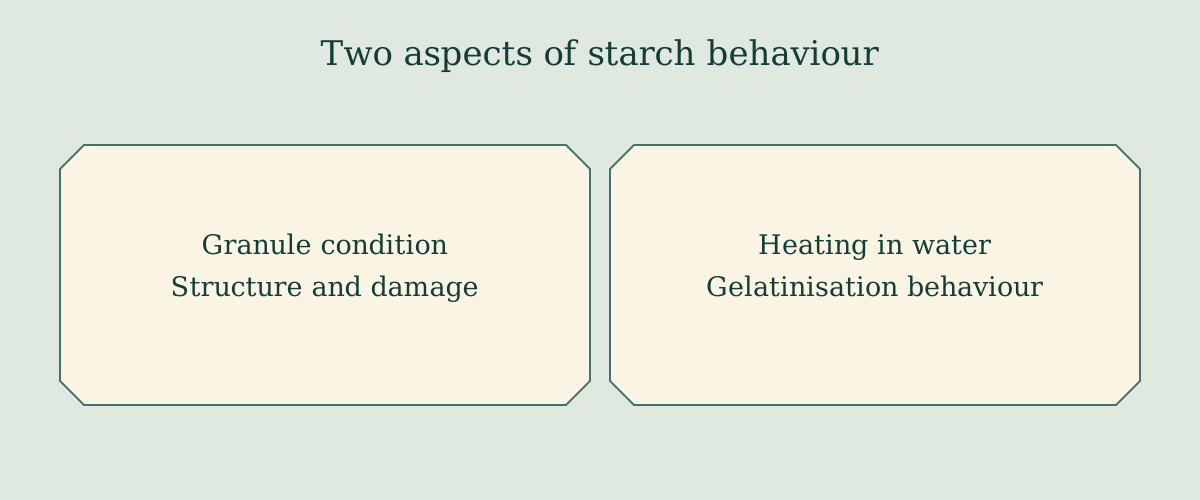
Illustration details
- Two aspects of starch behaviour
- Granule condition
- Structure and damage
- Heating in water
- Gelatinisation behaviour
Lipids are unevenly distributed within the achene. The review reports an average lipid content of about 6.5% in the germ, compared with less than 0.4% in endosperm. Those values refer to the respective tissues, rather than the lipid content of every finished flour. Neutral lipids include triacylglycerols, and oleic, linoleic and palmitic acids are prominent fatty acids. Retaining different amounts of germ changes the contribution of this component to a milling fraction. The anatomical description thus helps explain one source of compositional differences between powders.
Fibre, minerals and phenolic compounds
The hard pericarp contributes cellulose and lignin, while other non-starch polysaccharides occur in the inner material. The review distinguishes fibre measurements that include resistant starch from those that exclude it, so the stated basis matters when comparing values. Mineral substances are also concentrated unevenly, with substantial contributions from germ and outer layers. Phosphorus, potassium and magnesium feature among the principal elements discussed. Removing or retaining these tissues changes the mixture reaching a flour fraction, independently of the colour or fineness by which that flour is described.
Phenolic compounds add another dimension to that mixture. Rutin is among the compounds discussed in the review, alongside quercetin and several other polyphenols. Their occurrence varies between plant organs and milling fractions, and phenolics can occur in free or bound forms. The processing explanation concerns where these components are distributed and which tissues remain in the product. It does not turn a flour's darker colour into a quantified chemical assay. Specific component measurements and a description of the sampled fraction are needed to characterise a particular material.
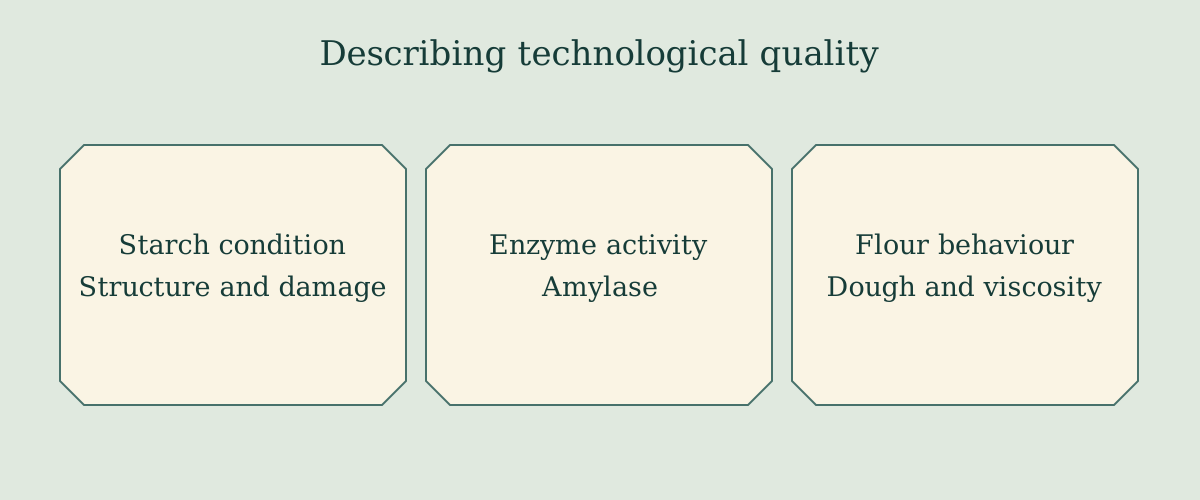
Illustration details
- Describing technological quality
- Starch condition
- Structure and damage
- Enzyme activity
- Amylase
- Flour behaviour
- Dough and viscosity
Starch condition records the processing history
Starch condition begins with the developing grain and continues to change through harvesting, storage and milling. The review describes the influence of maturity and partial enzyme activation before grinding, followed by mechanical and thermal effects during disintegration. Damaged granules can have disturbed surfaces, fissures or depressions in place of their original structure. The authors also note that some starch damage can assist water binding and fermentation in bakery processing. Damage is therefore a variable to characterise in relation to the intended process, rather than a sufficient quality judgement on its own.
Several milling variables can influence the degree of damage. The review lists mill type, rotor speed, milling time, temperature rise and the way the raw material is prepared before grinding. Roller-milling conditions also matter. These variables connect an equipment operation with the condition of the starch in the resulting fraction. Two flour samples can consequently share a crop name while differing in the intensity and sequence of treatment they experienced. A technological assessment needs to capture those material differences, alongside the fraction's anatomical and chemical composition.
Testing flour for its intended use
Wheat processing has established analytical, rheological and viscosity-based methods for assessing suitability for different products. The review argues that buckwheat lacks an equivalently settled set of technological optimum ranges. Methods for assessing starch condition and amylase activity can be applied, but sample amounts and the interpretation of results require attention. Uneven maturity and the diversity of milling routes complicate prediction. The authors call for practical characterisation methods that connect measured flour properties with behaviour in secondary production, including bread, pastry and other buckwheat foods.
- Identify the flour fraction and the anatomical tissues it retains.
- Record dehulling, hydration and milling treatments before comparing samples.
- Assess starch condition together with the associated enzyme activity.
- Relate measured properties to the intended dough or food process.
Harvest context: Interfax, 3 October 2025. The technical explanation is adapted and reworded from Pavel Skřivan, Diana Chrpová, Blanka Klitschová, Ivan Švec and Marcela Sluková, their review of buckwheat flour production and quality, published 15 August 2023 in Foods, under the Creative Commons Attribution 4.0 licence. Wording and illustrations were created anew. The review's reproduced third-party figures and tables are not reused.

Leave a comment