Copper foil: grains, texture and bending fatigue
A copper-foil experiment connects rolling history, annealing and repeated bending. Its layer-specific results show why grain size, crystal orientation and the test conditions must remain beside any reported fatigue-life number.
Published Jun 5, 2024
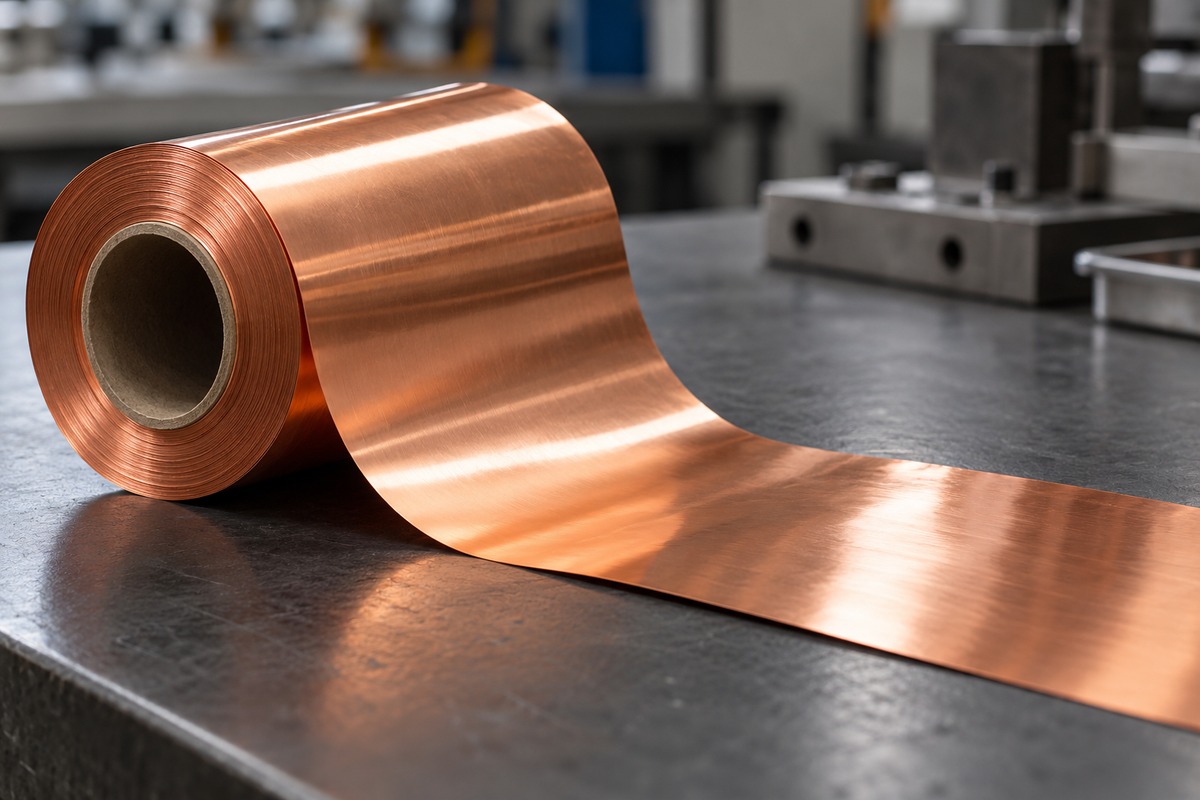
Copper-foil production and copper-foil performance require different kinds of evidence. On 5 June 2024, Xinhua reported construction of an industrial park connected with People and Technology’s Next Advanced Material project in Qianxian, Shaanxi, China. The report described plans for copper foil and advanced battery materials. That dated construction account does not establish how a particular foil responds to repeated bending. A separate experiment on stacked-rolled copper examines that technical question, connecting the material’s processing history with its grain structure, crystal orientations and measured fatigue life.
The distinction matters because a foil’s thickness alone does not describe its internal structure or response to cyclic loading. In the experiment considered here, copper of the same starting grade was rolled in a three-layer stack, then annealed for different times. The researchers compared material positions and surfaces as well as heat treatments. Their findings concern repeated bending under a defined laboratory arrangement, with additional tensile and microstructural measurements. They are not tests of the industrial park’s products, and they do not establish battery capacity, vehicle range or the service life of a finished electronic device.
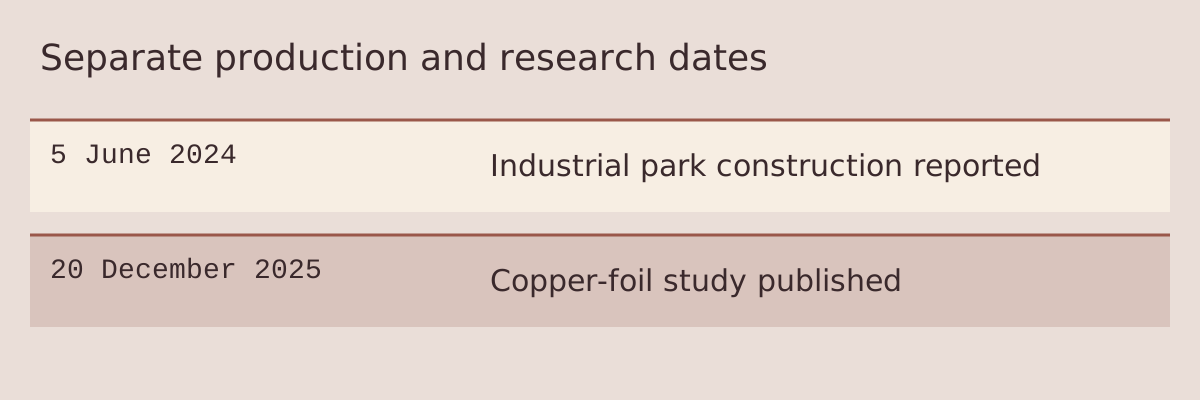
Illustration details
- Separate production and research dates
- 5 June 2024
- Industrial park construction reported
- 20 December 2025
- Copper-foil study published
Processing history and surface position
Tong Wu, Guohao Liu, Di Liu, Bingxing Wang, Bin Wang and Yong Tian published the study of copper-foil texture and flexural fatigue on 20 December 2025. The work therefore follows the 2024 production report as separate technical evidence. Its central comparison concerns how the structures formed by rolling evolve during annealing and how those changes relate to bending-test results. The authors examined both grain size and crystallographic texture, rather than treating either one as a complete description of the foil.
The starting copper was reported as 99.99 percent pure, with belts 0.15 millimetres thick. After stacked rolling, the individual foil thickness was 0.024 millimetres, or 24 micrometres. Those dimensions define the tested material more clearly than a general description such as “thin copper.” They also prevent results from being assigned automatically to every commercial foil thickness or copper alloy. The experiment did not compare all possible purity grades, alloy additions or thicknesses. It followed one starting material through the selected rolling route and subsequent treatments, then assessed the resulting structures and mechanical responses.
Three layers were stacked and rolled together under the same overall processing conditions. Their locations nevertheless created different interfaces: the outside of the stack interacted with the rolls, while internal faces contacted neighbouring copper layers. The authors used these differences to investigate how deformation varied with position. This is a useful feature of the comparison because equal overall thickness reduction does not necessarily produce identical local structures. The stack arrangement forms part of the material history. A result for its centre layer cannot be assumed to describe an outer surface without checking how that surface was prepared and tested.
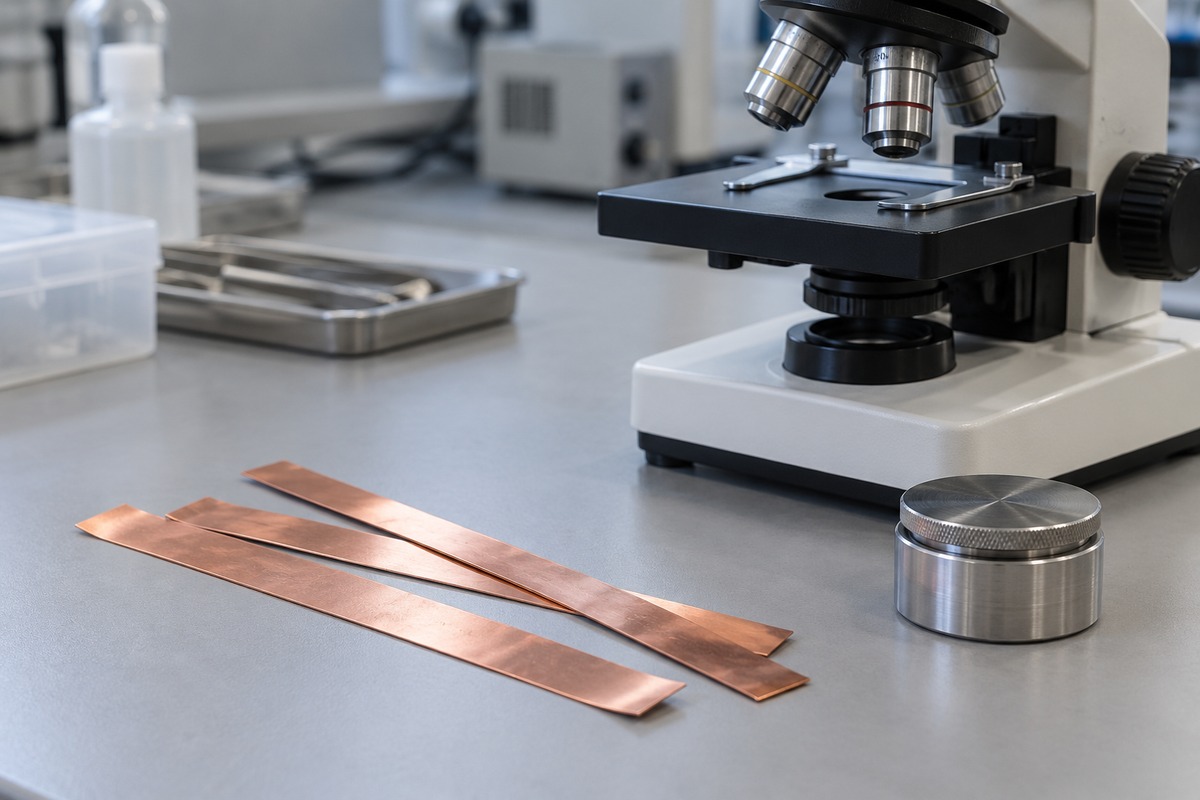
The paper identifies the centre-interface specimen as TR-C-M and the outer bright and matte surface conditions as TR-O-B and TR-O-M. These labels also matter in the bending test. For the outer foils, the designated bright or matte surface was placed on the inside of the bend; the opposite face was an interface surface. The centre foil had similar interface-type surfaces on both sides. Consequently, the comparison includes bending orientation as well as the microstructure observed on a named face. It is not simply a test of three unrelated bulk materials differing in chemical composition.
After rolling, specimens were annealed at 600 degrees Celsius under flowing argon for 7.5, 15, 30, 60 or 120 minutes, then quenched. The temperature was held constant while treatment duration varied. This creates a defined set of comparisons, rather than a universal annealing curve across all temperatures. It also means that “annealed” is not a sufficient label for an individual result: a short treatment and a two-hour treatment produced different structures. The study’s selected times belong beside the reported properties, and they should not be presented as a ready-made manufacturing programme for another foil or application.
What counted as bending failure
The cyclic-bending specimens were rectangular strips tested over a fixed radius of 2.5 millimetres. The machine used a 25-millimetre stroke and a frequency of 175 cycles per minute. These conditions define the repeated mechanical loading associated with the reported fatigue life. A cycle count is therefore meaningful only with its test arrangement. It does not directly translate into years of use, folds of a complete product or a guaranteed number of operations in a different mechanism. Changing the bend radius, orientation or loading conditions would create a different comparison that this experiment did not establish.
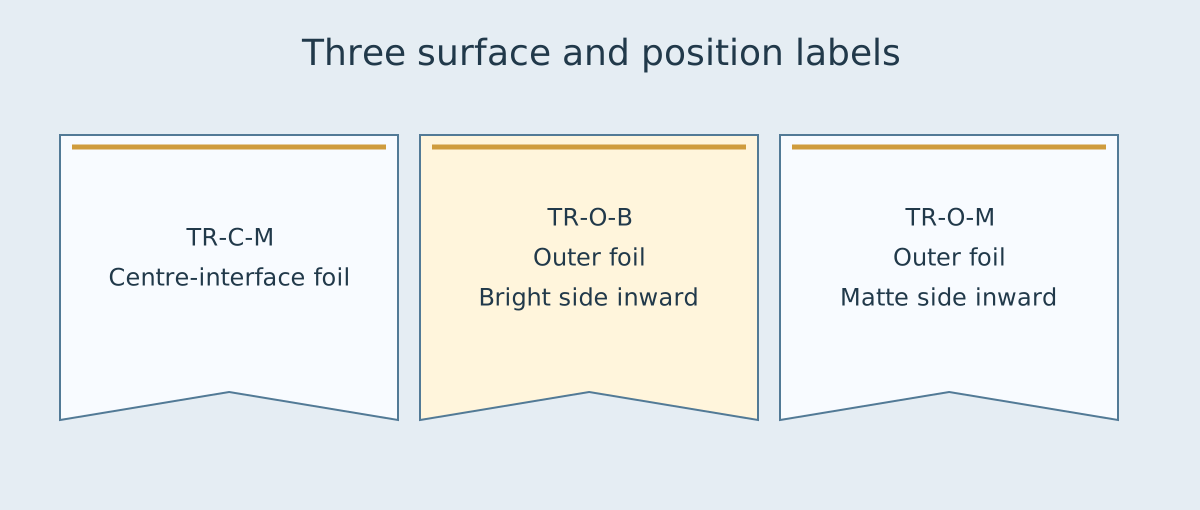
Illustration details
- Three surface and position labels
- TR-C-M
- Centre-interface foil
- TR-O-B
- Outer foil
- Bright side inward
- TR-O-M
- Outer foil
- Matte side inward
Both ends of each foil were electrically connected during testing. Failure required an open-circuit event together with a visually confirmed fracture. The researchers tested five specimens for each condition and defined fatigue life as the arithmetic mean of their cycles to failure. This endpoint is more specific than the first visible mark or the beginning of an unspecified loss of flexibility. It also defines what the approximate reported cycle counts summarize. They are averages under the stated failure criterion, rather than guarantees that every specimen survived exactly that many cycles or evidence about unreported production batches.
Tensile testing supplied another mechanical measurement. Here the specimens were grouped as centre and outer foils, rather than the three surface-orientation conditions used for bending. The tensile tests were conducted in triplicate, using their own specimen geometry and loading rate. Keeping these groupings separate is important: a tensile curve for an outer foil does not independently provide three surface-specific fatigue results. The two tests ask different questions about the material. One follows deformation under a single tensile loading sequence, while the other counts repeated bends until the combined electrical and fracture endpoint is reached.
Grain size and texture are different descriptions
The researchers used electron backscatter diffraction, or EBSD, to map grain orientations and calculate related statistics. Measurements were taken on foil surfaces in plan view. Reported grain sizes therefore describe the mapped surface geometry; they are not measurements of grains extending by the same distance through the foil thickness. This distinction becomes especially important when an in-plane grain size exceeds 24 micrometres. The work compared several mapped faces and inferred position-dependent deformation from their differences. It did not replace those surface measurements with a continuous, directly measured cross-sectional map of every point through the stack.
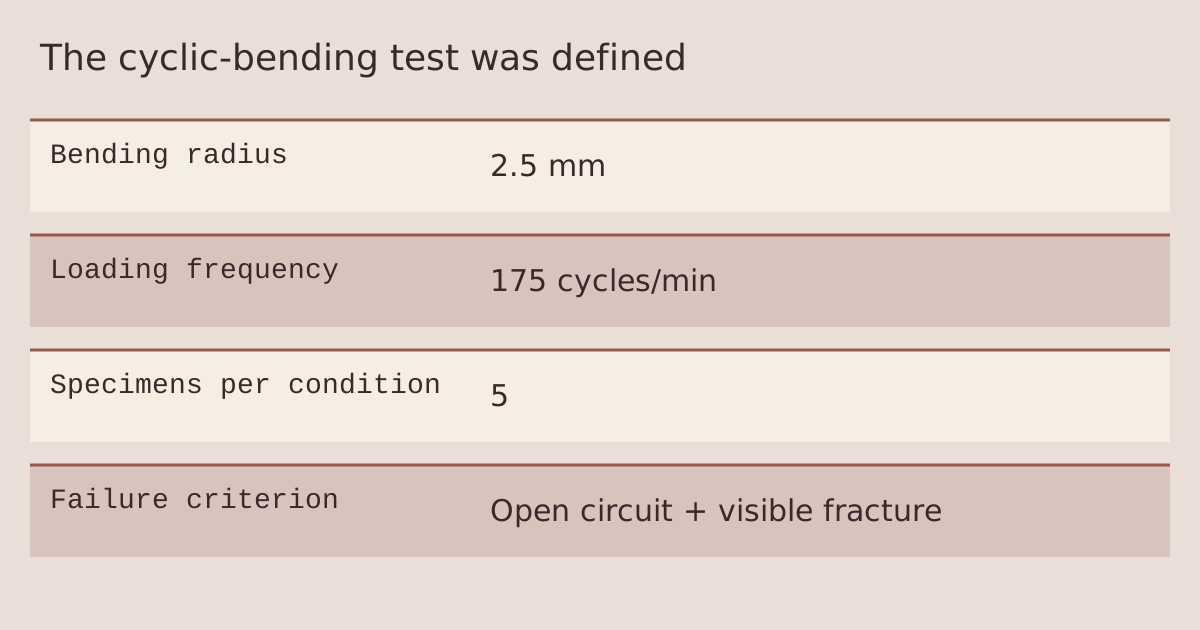
Illustration details
- The cyclic-bending test was defined
- Bending radius
- 2.5 mm
- Loading frequency
- 175 cycles/min
- Specimens per condition
- 5
- Failure criterion
- Open circuit + visible fracture
Crystallographic texture describes the distribution of crystal orientations. The study used names such as cube, copper, S and brass for selected orientation components. In this context, “cube” does not mean that every grain is physically cube-shaped. Grain size and orientation distribution are separate descriptors, even though both changed during the treatments. A material can therefore have a larger fraction of cube-oriented grains and also a different grain-size distribution. The research question concerns their combined relationship with bending behaviour, rather than a simple choice between large and small grains or between textured and untextured copper.
In the rolled state, the authors described elongated grains and position-dependent differences in local lattice misorientation. The centre-interface region showed more strongly aligned grains and indicators of greater local deformation heterogeneity than the outer bright surface. Such observations provide a starting point for understanding subsequent annealing: the different locations did not enter the heat treatment with identical stored deformation structures. The paper also calculated geometrically necessary dislocation densities from EBSD-related information. Those estimates support comparison between the mapped conditions, but should not be interpreted as a direct count of every dislocation throughout an entire foil.
Short annealing changed both boundary statistics and orientation patterns. The authors reported a rapid increase in the high-angle grain-boundary fraction within the first 7.5 minutes, with cube-oriented regions appearing as deformation-related components weakened. Their interpretation was that recrystallization had begun, with the centre-interface material developing more rapidly than the outer conditions. This is an account of the measured maps and their analysis. It does not imply that the same duration would produce an identical state in a foil with another rolling history, thickness or temperature. The starting deformation structure remains part of the explanation.
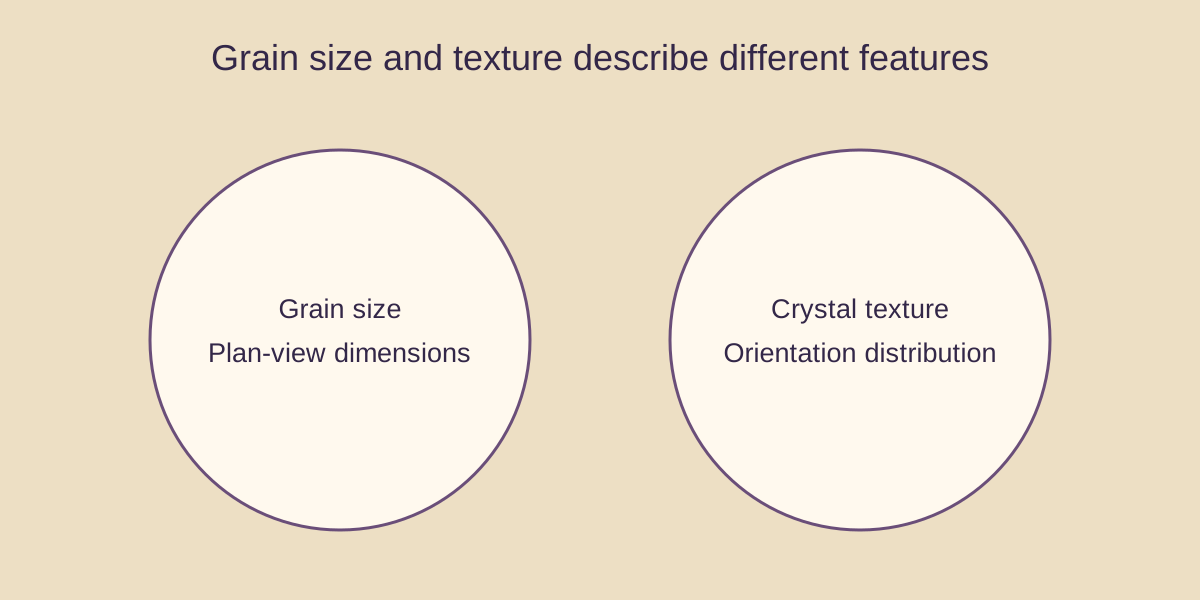
Illustration details
- Grain size and texture describe different features
- Grain size
- Plan-view dimensions
- Crystal texture
- Orientation distribution
Longer annealing produced particularly strong changes in the centre layer. The paper reports pronounced coarsening there, reaching an average in-plane grain size of about 520 micrometres after 120 minutes, while the outer conditions remained below 100 micrometres. Cube texture also became increasingly dominant in the centre material. These results show why longer treatment cannot be described merely as “more of the same” short-annealing response. It changed the size and orientation populations substantially. The centre layer’s later condition had to be assessed through the fatigue test rather than assumed to retain every advantage of its earlier recrystallized state.
Grain growth and texture evolution occurred together. That gives the experiment a rich processing–structure comparison, but also limits a simple causal ranking. It did not independently hold grain size fixed while changing only cube fraction, or hold texture fixed while changing only size across every condition. The authors combined the observed trends with mechanistic interpretations to explain the fatigue response. A careful reading can recognize the association without claiming that the entire improvement or decline was isolated to one variable. The named surface, its prior deformation and the annealing time remain attached to each point in the comparison.
The fatigue response was not monotonic
The centre-interface condition reached a reported maximum fatigue life of approximately 80,000 cycles after the 7.5-minute anneal. Further annealing was followed by a sharp decline. This is the clearest reason not to equate longer heat treatment or a more dominant cube texture with universally better performance. In the tested material, the favourable early condition did not persist as the grains coarsened strongly. The approximate count comes from the authors’ narrative summary of the experiment. It should remain linked to the five-specimen mean, bend radius, specimen orientation and combined failure criterion defined in their method.

The outer bright and matte conditions followed a different pattern: fatigue life increased more gradually and then tended to stabilize with annealing. Thus, one treatment-duration rule did not describe every position in the original stack. These surface-dependent results also need to retain the bending orientation described earlier. They do not establish that a bright appearance alone causes a particular lifetime or that polishing an unrelated foil would reproduce the result. The paper links the performance to the structures produced by its rolling and annealing route, evaluated with the designated face on the inside of the bend.
In discussing the correlation, the authors highlighted a combination of moderate grain sizes and cube texture, including a region around 40–60 micrometres and roughly 30–45 percent cube fraction associated with high fatigue life. This describes an experimental region, not a sharp acceptance threshold for all copper foils. Their wider discussion also considers a broader moderate-size range. The useful point is that neither the finest nor the most strongly coarsened state supplied the best result in this comparison. Selecting only a texture percentage without its grain structure and loading conditions would remove essential parts of the reported relationship.
Transmission electron microscopy added observations from the centre-interface material before bending and after fracture. The authors described dense dislocation structures in the rolled material, fewer dense tangles after annealing, and new intragranular slip features after cyclic loading. These observations informed their explanation of how deformation was accommodated. They are descriptions from the paper, rather than reproduced micrographs in this article. They also do not directly measure every proposed internal stress mechanism. Microscopy supports the structural interpretation while the measured fatigue outcome remains the cycle count obtained from the separate bending test.
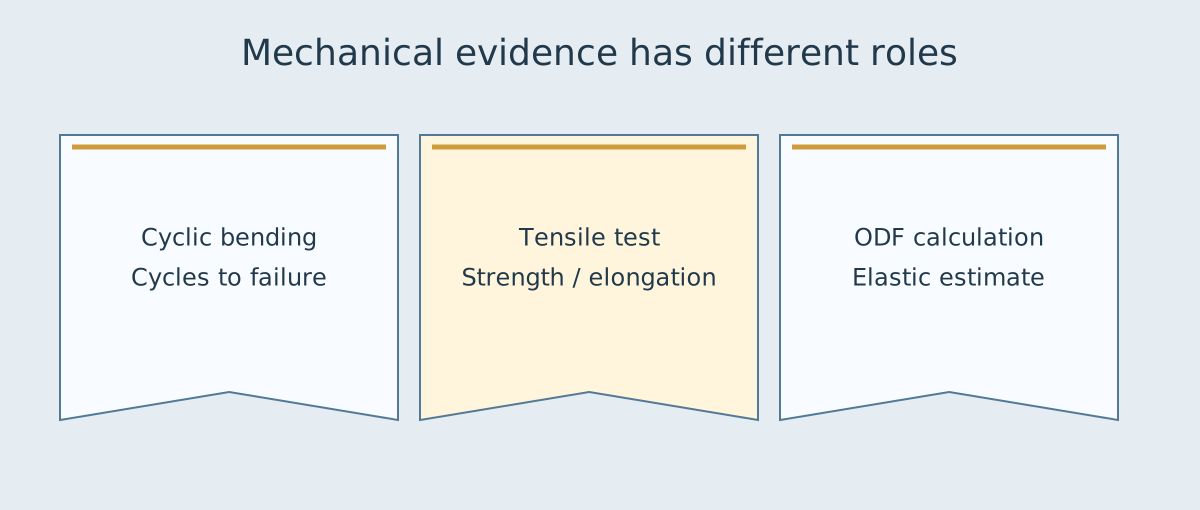
Illustration details
- Mechanical evidence has different roles
- Cyclic bending
- Cycles to failure
- Tensile test
- Strength / elongation
- ODF calculation
- Elastic estimate
The tensile results supplied another useful contrast. With further annealing, the foils generally softened and became more ductile: strength decreased while elongation increased. That trend does not make maximum tensile strength, maximum elongation and maximum bending life equivalent objectives. The centre-interface fatigue maximum occurred at a particular early treatment, while continued annealing changed the tensile response and microstructure further. Reading the tests together therefore gives a more complete description than selecting the largest value from one curve. It also prevents a tensile result from being presented as proof of repeated-bending endurance under conditions that were not tested.
The paper additionally estimated an orientation-averaged Young’s modulus along the rolling and bending direction from measured orientation distributions and copper elastic constants. This was a calculated quantity, rather than an independent direct modulus measurement for every condition. The authors used it to discuss why orientation-dependent elastic response could relate to the fatigue results. That distinction should remain visible: the calculation helps interpret the observations, but does not establish a validated prediction of device lifetime. No single computed stiffness value replaces the tested material state, bending geometry or the grain-size changes that occurred during annealing.
The proposed mechanisms include more compatible deformation between neighbouring grains and redistribution of strain in partially recrystallized material. These interpretations connect the orientation maps, grain populations, microscopy and mechanical tests. They are useful explanations to investigate, not direct measurements of every local back stress or slip-transfer event throughout the foil. The study’s evidence is strongest when those levels remain separate: measured structures, measured mechanical responses and the mechanisms proposed to connect them. Combining them thoughtfully is different from assuming that a named texture component automatically guarantees the same fatigue resistance in another processing route.

Keeping the result within its test conditions
The experiment provides a detailed comparison within one selected material and processing programme. Its scope does not cover all copper alloys, foil thicknesses, bend radii, environments or device assemblies. The five-specimen bending means and triplicate tensile tests are also not evidence of every possible manufacturing campaign. The work remains informative because it preserves differences between surfaces and treatment times instead of averaging them into one generic property of copper. For a reader assessing a production claim, the next step would be to establish whether the material and test conditions are comparable before assigning the reported cycle count to another product.
A useful record of the comparison keeps the processing history beside the microstructure and test endpoint. The following checklist captures that approach. It prevents foil thickness from becoming a complete material specification, a cube percentage from becoming a lifetime guarantee or a tensile curve from replacing a bending test. It also preserves the difference between a construction report and experimental evidence. The industrial project described at the beginning supplies context for why copper processing matters; the laboratory study supplies a bounded set of observations about how one family of rolled specimens behaved under repeated loading.
- Record copper grade, foil thickness, stack position and the surface placed inside the bend.
- Keep annealing temperature and duration attached to each measured condition.
- Distinguish plan-view grain size from crystal-orientation distribution and through-thickness dimensions.
- Retain the bend radius, loading frequency, failure criterion and specimen count with the fatigue result.
- Separate tensile measurements, calculated elastic properties and proposed mechanisms from the observed cycle life.
The principal finding is a combined processing and structure effect. The centre-interface foil performed best after a short anneal, while longer treatment produced pronounced grain growth and lower bending life; the outer conditions followed different trends. Texture mattered alongside grain size, surface position and test orientation. This makes the study a useful example of why improving one structural descriptor is not the same as improving every mechanical outcome. Its reported fatigue life remains meaningful within the defined experiment, providing questions for further comparison rather than a universal recipe or a promise about the performance of a finished battery or electronic device.
Production context: Xinhua, 5 June 2024. Technical discussion adapted in original English from Tong Wu, Guohao Liu, Di Liu, Bingxing Wang, Bin Wang and Yong Tian, published 20 December 2025, DOI 10.3390/nano16010011, under CC BY 4.0. Wording, structure and explanation have been changed; source figures are not reproduced.

Leave a comment