Olive paste malaxation: extraction, pigments and taste
Two short mixing trials at a Spanish olive mill produced different extraction and composition results. Their Royal-cultivar oils show why fruit batches, sampling points and expert tasting belong beside the processing time.
Published Dec 5, 2024
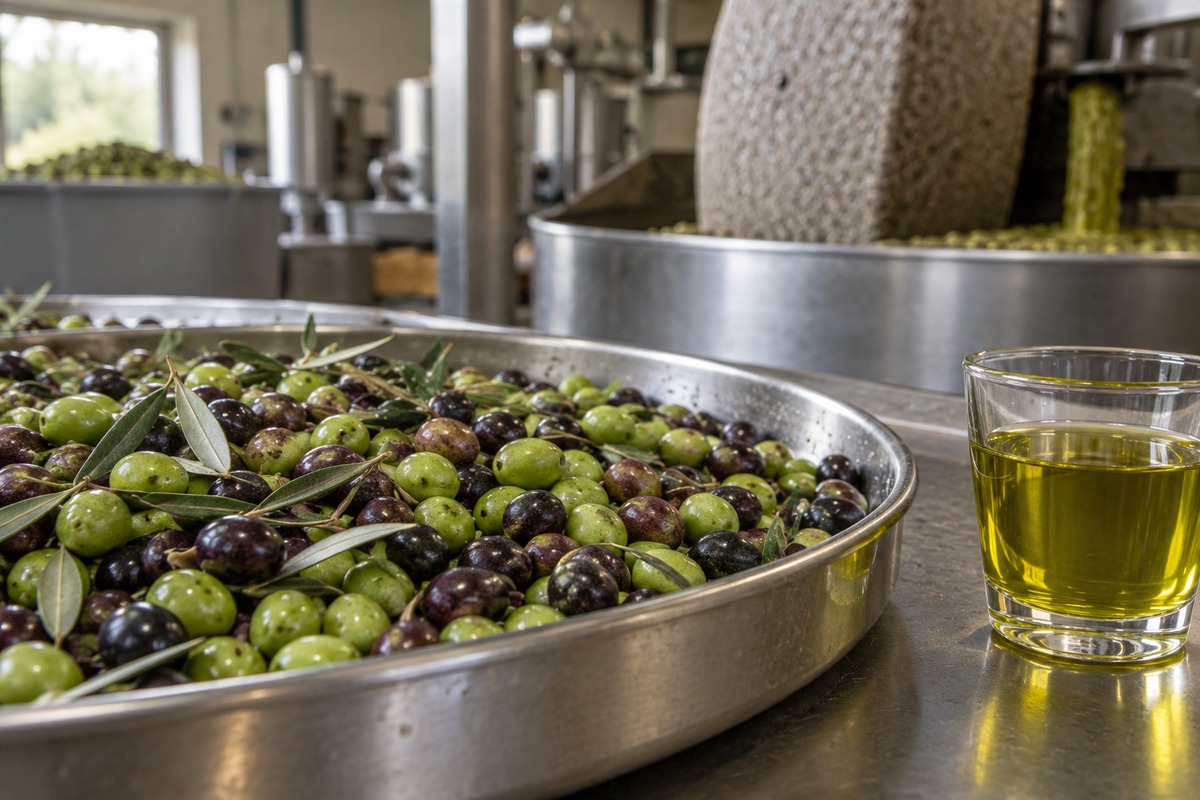
A larger olive harvest and more efficient oil extraction describe different parts of the same industry. On 5 December 2024, Xinhua reported an industry forecast for a record olive-oil season in Türkiye. That dated expectation concerned national production, rather than a controlled comparison of mill settings. At the mill, another question remains: how much of the oil already present in a fruit batch is recovered, and what characteristics does the recovered oil have? A study of short olive-paste mixing times provides a detailed way to examine that question without turning a harvest forecast into a processing result.
Malaxation is the mixing or kneading of crushed olive paste before centrifugal separation. In the experiment considered here, the researchers compared 15-minute and 30-minute treatments and sampled oil at two subsequent points. Their results covered extraction efficiency, pigments, phenolic compounds, volatile compounds and expert tasting. These measurements belong together because an increase in recovered oil does not, by itself, describe everything that changed in the product. Nor does a higher concentration of one compound establish the best processing condition. Reading the comparison requires keeping the fruit, the treatment, the sampling point and the type of measurement visible throughout.

Illustration details
- Harvest, experiment and industry report
- October 2023
- Royal olives harvested
- 18 August 2024
- Mill study published
- 5 December 2024
- Turkish industry forecast reported
Two industrial trials with Royal olives
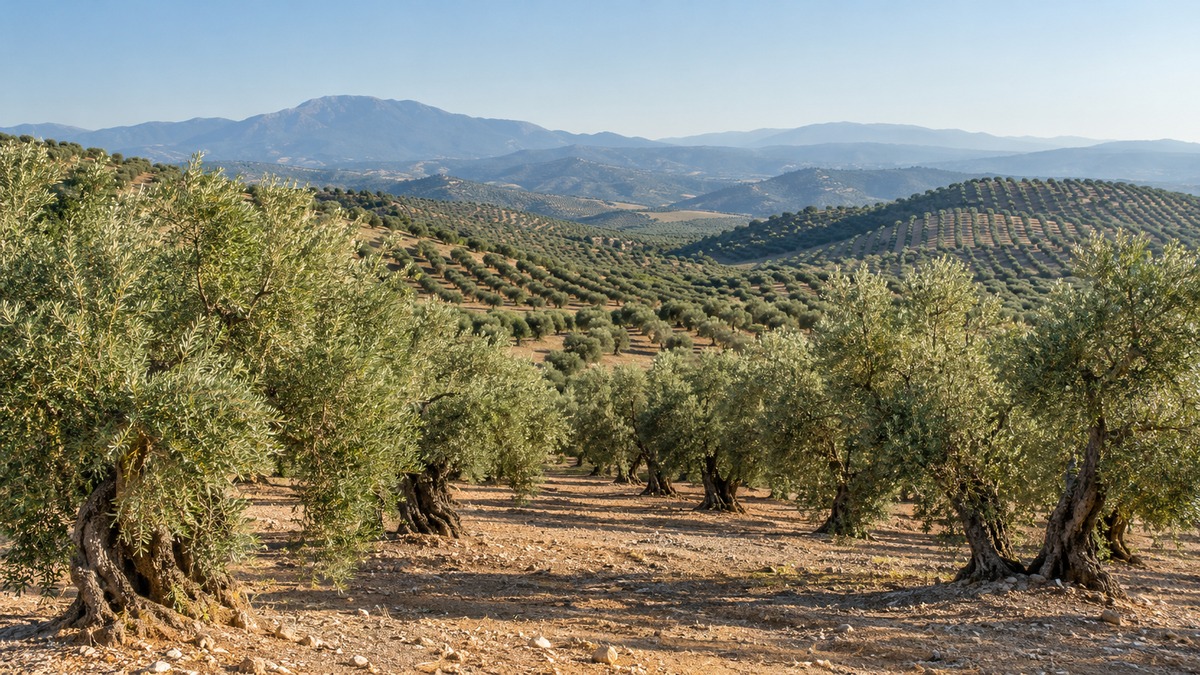
Raúl Peralta, Francisco Espínola, Alfonso M. Vidal and Manuel Moya published the Royal-cultivar mill study on 18 August 2024 in Foods. Their material came from Sierra de Cazorla, Jaén, in Spain. Royal is the cultivar investigated, rather than a name for a general olive-oil grade. The researchers wanted to characterize oils produced from early-picked fruit under short mixing conditions at an industrial plant. This scope is narrower than deciding how every olive variety should be processed: the particular fruit and the particular sequence of mill operations form part of the result.
The olives were mechanically harvested in mid-October 2023 from irrigated, organically grown, ten-year-old trees and transported directly for milling. Their maturity indices were close to one in both trials, which the authors describe as a very early stage. These details matter because the experiment begins with a specified raw material, rather than with oil of an unspecified history. The 2023 harvest date also differs from the paper’s 2024 publication date. Keeping both dates prevents a later reader from treating the results as a measurement of the subsequent harvest season discussed in the Xinhua report.
Two batches of approximately 5,900 kilograms were processed over two days. Although the authors considered their fruit broadly homogeneous, the initial oil contents differed: 14.33 percent in the first trial and 13.52 percent in the second. The reported paste temperatures also differed, at 32.6 and 31.6 degrees Celsius respectively. Consequently, this is not a comparison in which one identical batch was subjected to two times while every other condition remained unchanged. The observed results can be associated with the two industrial trials, but assigning their entire difference to mixing time alone would hide meaningful differences in the starting material and operating conditions.
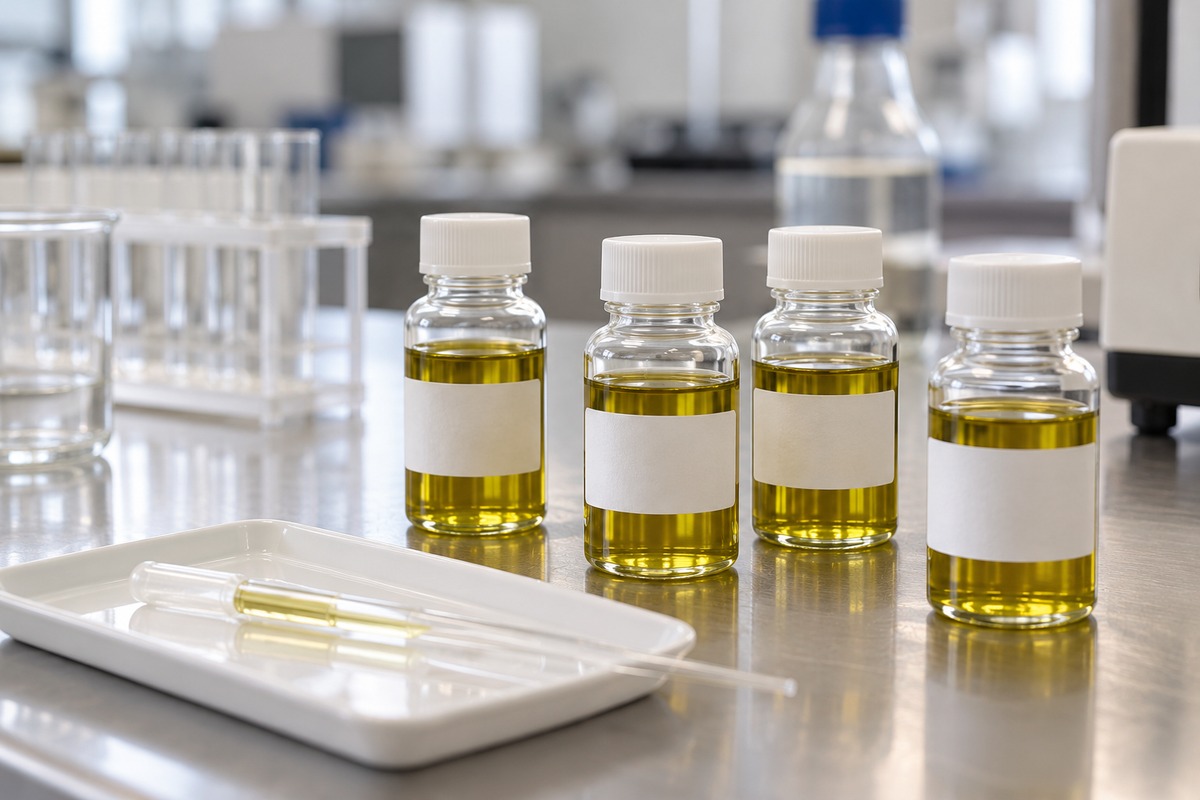
The mill used a hammer crusher with a six-millimetre screen, a vertical-vessel thermomalaxer, a two-phase centrifugal decanter and a vertical centrifuge. Average processing capacity was reported as 3,500 kilograms of olives per hour. No water or processing aid was added in the malaxer. These are features of the experimental line, not instructions for reproducing its performance on another machine. The distinction between the two separation stages is especially useful: oil leaving the decanter was sampled before the subsequent vertical centrifugation, allowing the researchers to compare material at successive points within each trial.
The resulting design therefore has two processing times and two oil sampling points. A value labelled “15 minutes, decanter” should be compared carefully with a value labelled “15 minutes, centrifuge” when asking about the next separation stage. Comparing the two centrifuge samples instead asks about the oils obtained at the same sampling point in the two different trials. Both comparisons are useful, but they do not hold the same factors constant. Removing those labels from a table would make it easy to attribute a stage difference to mixing time, or a difference between fruit batches to the centrifuge.
Extraction efficiency has a specific denominator
The study defines extraction efficiency as the percentage of oil extracted relative to the total oil present in the olive samples. It does not mean the mass of oil obtained as a percentage of the entire fruit mass. To assess extraction, the researchers collected paste and pomace samples at specified points, including after crushing and at the decanter. This definition is essential when interpreting a figure above 70 percent: it describes recovery of the available oil. It is not a claim that most of the mass of the harvested olives became bottled oil.
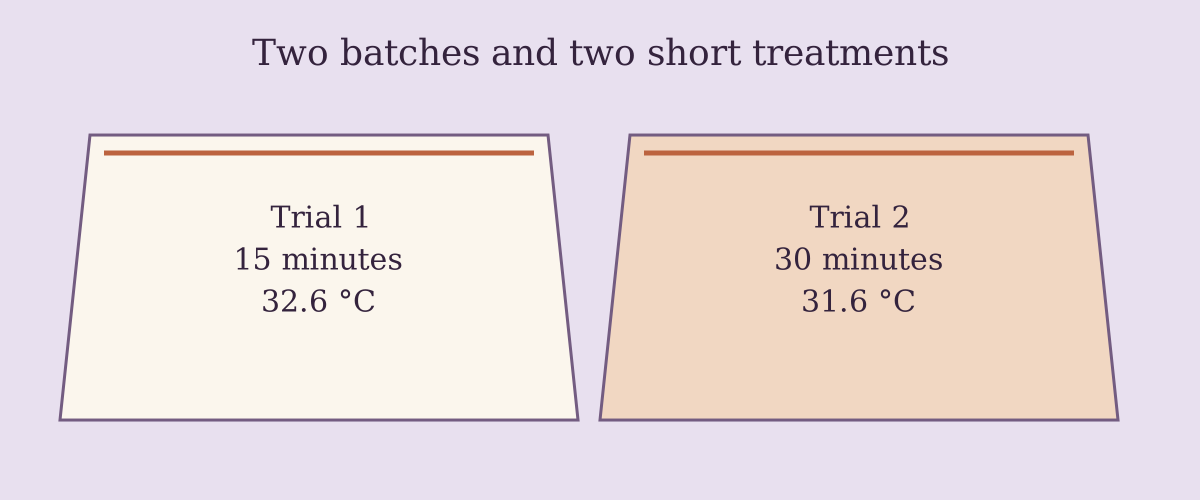
Illustration details
- Two batches and two short treatments
- Trial 1
- 15 minutes
- 32.6 °C
- Trial 2
- 30 minutes
- 31.6 °C
Reported extraction efficiency was 73.13 percent for the 15-minute trial and 74.98 percent for the 30-minute trial. The difference is 1.85 percentage points on the study’s efficiency scale. The authors report a statistically significant difference for these observations. That supports their description of different extraction outcomes in the two trials, while the separate batches remain relevant to interpretation. The result does not establish the entire shape of a time-response curve: only two short treatments were compared. It cannot identify what would happen at every intermediate time or determine a maximum across a wider range of conditions.
This distinction also separates the mill result from national production statistics. A harvest forecast concerns the amount of oil a country expects to produce across many orchards and processors. The experimental efficiency concerns the fraction of oil recovered from specified material on one line. Applying the 1.85-point difference directly to a country’s forecast would require assumptions about fruit composition, equipment and operating conditions that the study did not test. The practical value of the experiment lies in its detailed account of a processing comparison, rather than in an unsupported estimate of how much additional oil an entire industry could obtain.
Composition depends on the sampling point
The researchers measured acidity, peroxide values and ultraviolet absorption indices alongside extraction. Their results did not form a simple pattern in which every indicator moved in the same direction. For example, acidity in the 15-minute trial was 0.31 percent at the decanter and 0.30 percent after vertical centrifugation; in the 30-minute trial it was 0.28 and 0.24 percent. These are reported characteristics of the sampled oils. They should not be expanded into a general claim that vertical centrifugation always produces a particular improvement, because the observed changes depended on the trial and on the indicator being considered.

Illustration details
- Oil recovered relative to available oil
- 15-minute trial
- 73.13 %
- 30-minute trial
- 74.98 %
The ultraviolet indices illustrate the same point. K232 was lower after vertical centrifugation in both trials, whereas K270 showed little variation across the four samples. The study therefore supplies several analytical views of the oils, rather than a single interchangeable quality number. These measurements also have a different role from tasting: an analytical difference does not specify how strongly a person perceives fruitiness or bitterness. The discussion here concerns the experiment’s measured comparisons; it does not offer a current legal classification of an oil, certify a commercial product or replace a complete assessment under applicable marketing rules.
Pigments gave a clearer pattern across the reported samples. The authors determined chlorophylls and carotenoids using spectrophotometric measurements, reporting concentrations per kilogram of oil. Both pigment groups were higher in the longer-time trial and at the vertical-centrifuge outlet within each trial. That makes the sampling labels central to the observation. A pigment concentration measured after one operation cannot simply be substituted for the concentration before it. The authors discuss possible explanations for the stage differences, but the concentration measurements themselves should be distinguished from a complete material balance showing where every pigment molecule moved during separation.
For chlorophylls, the 15-minute trial gave 29.51 milligrams per kilogram at the decanter and 40.57 at the centrifuge outlet. The corresponding values in the 30-minute trial were 46.70 and 71.31. Thus, the paper’s largest chlorophyll value belongs to a particular combination: the longer trial, sampled after vertical centrifugation. It is not the concentration of every oil produced with a 30-minute treatment. Nor does a higher chlorophyll concentration, on its own, prove a longer commercial shelf life. The experiment reported composition, while a shelf-life claim would require evidence about the oil’s behaviour during storage.
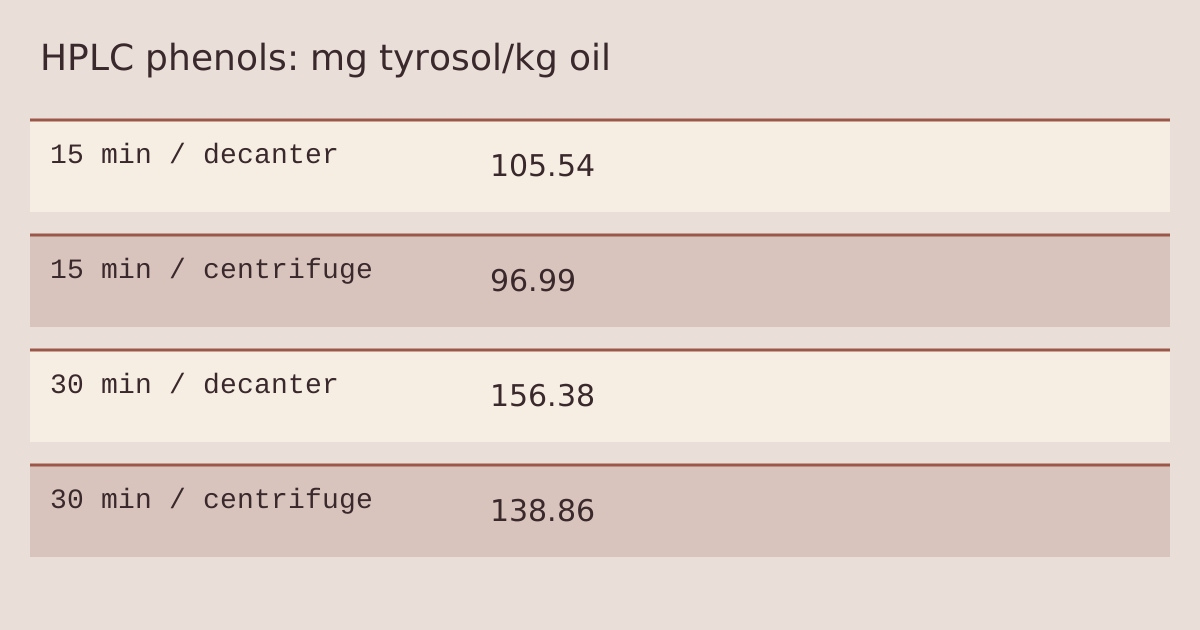
Illustration details
- HPLC phenols: mg tyrosol/kg oil
- 15 min / decanter
- 105.54
- 15 min / centrifuge
- 96.99
- 30 min / decanter
- 156.38
- 30 min / centrifuge
- 138.86
The carotenoid values followed a similar reported sequence: 14.47 and 17.63 milligrams per kilogram in the first trial, then 21.32 and 27.98 in the second, with each pair referring to decanter and centrifuge samples. Having two pigment groups move in a similar direction strengthens the descriptive account of these samples. It does not make pigments a substitute for every other property. In particular, the same processing comparison must still be examined through the phenolic and volatile measurements and the tasting results. Different measurements describe different components and responses, even when some of their numerical patterns agree.
Phenolic compounds were examined by high-performance liquid chromatography after extraction from oil samples. The method reports the results as milligrams of tyrosol per kilogram of oil. That reporting basis should remain attached to the numbers: it is an analytical expression of the measured phenolic response, rather than permission to interpret every listed value as an independently established mass of a pure compound. The paper also notes limits in resolving some related phenolic forms. A careful account can therefore describe the reported totals and selected comparisons without claiming that every underlying molecular form was separately and unambiguously quantified.
The total HPLC phenol values were 105.54 at the decanter and 96.99 after the centrifuge in the 15-minute trial. For the 30-minute trial, they were 156.38 and 138.86, on the same reporting basis. Two patterns are visible: the second trial had higher reported totals, while vertical centrifugation was followed by lower totals within each trial. This differs from the pigment pattern, where the later sampling point had higher concentrations. It shows why the process cannot be described simply as concentrating all minor components together. The direction of the observed stage difference depends on which measured group is being discussed.

Selected individual phenolic results also varied. The table reports higher oleacein values in the second trial than in the first at both sampling points, and its oleocanthal entries also differ between the two trials. Other entries show different or smaller changes. These observations support a composition-specific description rather than a claim that every phenolic compound responds identically. The authors discuss transfer between phases and possible oxidation as explanations for changes around centrifugation. Those interpretations are useful context, but the experiment does not provide a complete measurement of each transfer pathway or assign the entire observed difference to one mechanism.
Chemical profiles and expert tasting
The composition data are relevant to understanding the oils, but they are not a health trial. Neither the comparison of extraction times nor a higher phenolic result demonstrates a medical benefit from consuming one of these samples. The study also did not establish a commercial storage life for each processing condition. Keeping those boundaries allows the measured results to remain useful without attaching outcomes that were not tested. For a processor reading the work, the immediate questions concern recovered oil, composition at each sampling point and the recorded sensory profile, all linked to the stated fruit and equipment.
Volatile compounds were investigated through headspace sampling with solid-phase microextraction, followed by gas chromatography and flame-ionization detection. The method used an internal standard and external standards for identification and quantification. This analytical route differs from the liquid extraction used for phenolic compounds: it samples and measures another set of components. It also differs from asking a tasting panel to evaluate an oil. A chromatographic concentration records an analytical result for a particular compound, whereas the panel responds to the combined sensory experience. Neither measurement automatically supplies all the information contained in the other.
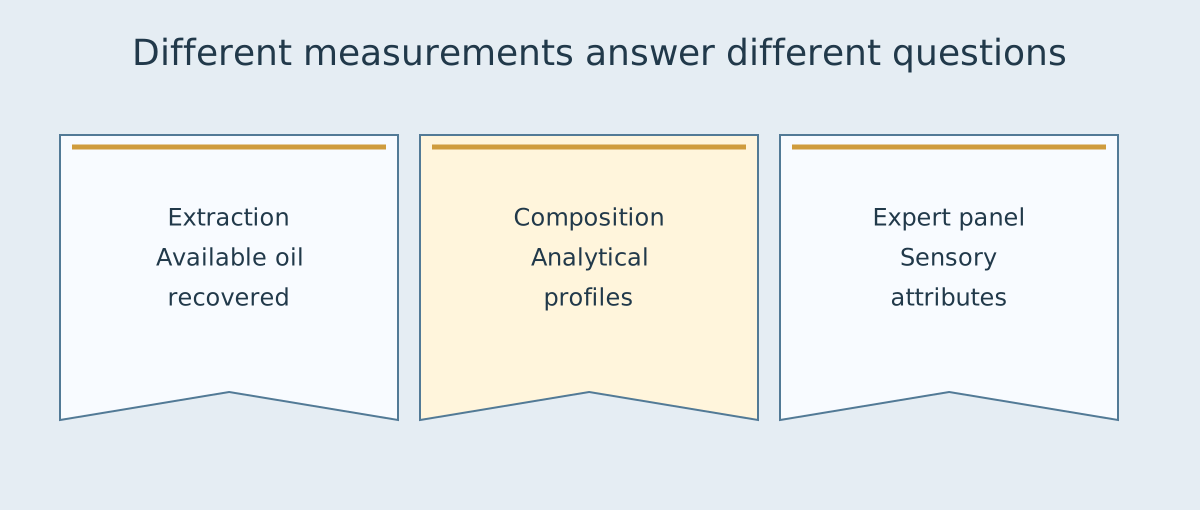
Illustration details
- Different measurements answer different questions
- Extraction
- Available oil
- recovered
- Composition
- Analytical
- profiles
- Expert panel
- Sensory
- attributes
The paper identifies several volatile components associated with the lipoxygenase pathway, including aldehydes, alcohols, a ketone and an ester. Their individual profiles did not change uniformly across every sample. For instance, the table gives different patterns for hexanal and for the major component (E)-2-hexenal, rather than one common response for the entire group. The useful conclusion is therefore component-specific. Summarizing the oils as having simply “more aroma” would erase both the analytical distinctions and the role of perception. The amount of a measured volatile compound does not, by itself, describe the complete intensity or character experienced by a taster.
Eight expert tasters evaluated fruitiness, bitterness and pungency, as well as checking for defects. The researchers report that the panel belonged to the Agrifood Laboratory in Granada. These observations are an expert sensory assessment of the experimental oils, rather than a consumer preference survey. A stronger fruitiness score does not say how many shoppers would choose the product or what price they would pay. It describes the panel’s evaluation under the reported method. Retaining that distinction is important because the research combines chemical measurements with human assessment, while neither part constitutes a market test.
Fruitiness medians were 6.0 and 7.1 for the decanter and centrifuge samples in the 15-minute trial, and 6.5 and 7.3 for those in the 30-minute trial. The authors describe greater fruitiness at the later sampling point. The table’s statistical groupings, however, should be preserved when comparing particular pairs: not every numerical difference establishes a separate effect. In particular, the figures do not justify calling the longer treatment a universally superior route to fruitiness. The two trials produced oils with their own measured profiles, and the sampling stage remains part of each observation.
Bitterness medians were 2.7 and 2.6 in the first trial, compared with 3.4 and 3.2 in the second. Pungency varied less, and the authors did not report a significant overall difference for that attribute. They also explored a preliminary relationship between volatile compounds and sensory descriptors through odor activity values, which relate concentration to an odor threshold. Such groupings do not independently predict bitterness or pungency: the paper explicitly discusses contributions from phenolic compounds and the limits of its volatile grouping. The panel results and chemical profiles therefore work as complementary evidence, rather than two equivalent scoring systems.
Reading the comparison as a mill experiment
The most useful record of these trials keeps the processing and measurement labels together. That prevents an efficiency percentage from becoming a fruit-mass yield, a pigment concentration from becoming a storage guarantee, or an expert sensory score from becoming a sales prediction. It also preserves the study’s main limitation: the two times were tested with separate industrial batches that differed in initial oil content and measured temperature. The following checklist captures the information needed to interpret the reported comparison. It describes the experiment’s boundaries, rather than a universal recipe for selecting a mill setting.
- Identify the cultivar, harvest date, maturity and initial oil content of each fruit batch.
- Record mixing time together with measured temperature and the equipment sequence.
- Keep decanter samples separate from samples taken after vertical centrifugation.
- Use the stated denominator for extraction efficiency and the stated reporting basis for chemical results.
- Distinguish expert sensory attributes from consumer preference and untested commercial outcomes.
The Royal trials show why a mill comparison needs more than the amount of oil recovered. The longer-time trial had higher reported extraction efficiency, pigments and total HPLC phenols, while individual composition and sensory results supplied a more detailed picture. Sampling before and after vertical centrifugation revealed changes that depended on the component examined. Those findings are informative within the recorded fruit batches and operating conditions. They provide a basis for further processing comparisons, with raw-material differences made explicit, and keep the technical question separate from the national harvest expectations that first drew attention to the industry.
Business context: Burak Akinci, Xinhua, 5 December 2024. Technical discussion adapted in original English from Raúl Peralta, Francisco Espínola, Alfonso M. Vidal and Manuel Moya, Foods, 18 August 2024, DOI 10.3390/foods13162588, under CC BY 4.0. Wording, structure and explanation have been changed; source figures are not reproduced.

Leave a comment