Nanofibres in moulded pulp: strength versus drainage
Cellulose nanofibres strengthened experimental pulp sheets but made water removal slower. A comparison of wood pulps, moulded test pieces and bowls shows why reinforcement must be assessed together with drainage and shape.
Published Apr 23, 2025
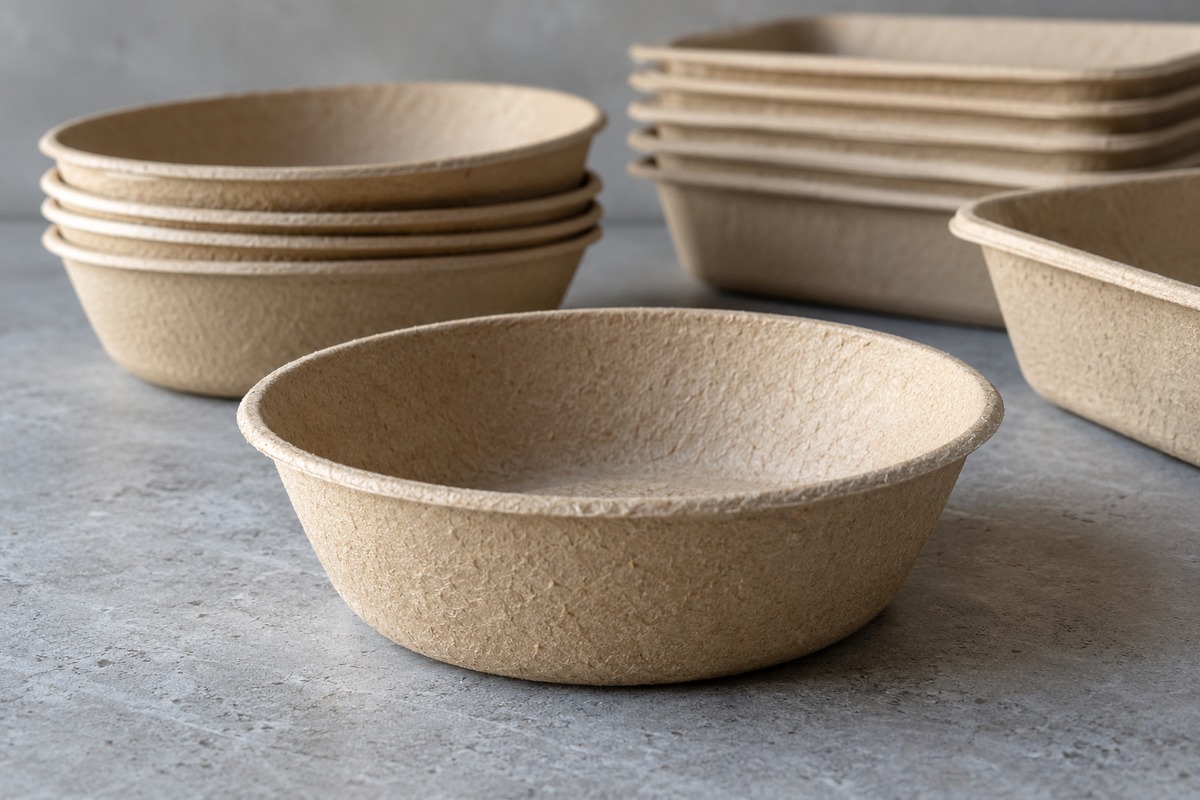
A fibre bowl begins as a material-processing problem before it becomes a finished product. On 23 April 2025, Xinhua reported on bagasse tableware production in Gengma, Yunnan, China. The report described Ecocycle New Materials (Yunnan) establishing production there in 2019 and processing sugarcane residue into moulded products. That business example concerns bagasse. A separate wood-pulp experiment examines a question relevant to understanding fibre forming: what happens when an additive strengthens a dry sample but also makes water harder to remove during its manufacture?
The experiment’s answer depends on more than a tensile-strength number. Wet forming first creates a fibre structure from a suspension, while later pressing and heating produce the final specimen. An additive can affect those stages differently. Cellulose nanofibres improved the strength of experimental sheets, but they also prolonged drainage and complicated the preparation of thicker moulded pieces. The study therefore follows a useful sequence from flat sheets to shaped test specimens and bowls. Its findings remain specific to the tested wood pulps; they do not establish the formulation, drainage behaviour or performance of the bagasse products described by Xinhua.
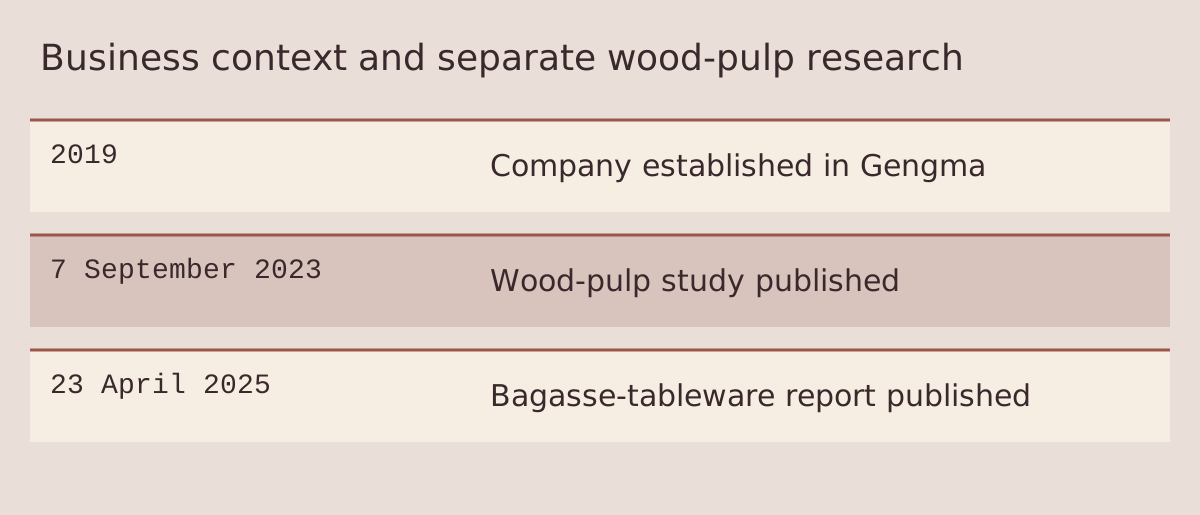
Illustration details
- Business context and separate wood-pulp research
- 2019
- Company established in Gengma
- 7 September 2023
- Wood-pulp study published
- 23 April 2025
- Bagasse-tableware report published
Two wood pulps and a nanofibre addition
Eirik Ulsaker Jacobsen, Simen Prang Følkner, Jørgen Blindheim, Dag Molteberg, Martin Steinert and Gary Chinga-Carrasco published the study of nanofibres, dewatering and thermoformed pulp on 7 September 2023 in Nanomaterials. They assessed thermomechanical pulp, abbreviated TMP, and bleached Kraft pulp. The programme combined fibre characterization, sheet testing, moulded tensile specimens and bowl demonstrators. This arrangement makes the work particularly informative: the researchers did not assume that a promising sheet result would automatically resolve the difficulties of making a thicker three-dimensional object. They tested the next geometry and recorded the processing limitations that emerged.
The materials were supplied or prepared by Norske Skog Saugbrugs in Halden, Norway. The TMP came from spruce, while the commercial Kraft pulp was based on a spruce-and-pine blend. The cellulose nanofibres were produced from the same Kraft pulp used in the study. These details define the comparison more closely than the broad phrase “plant fibres.” The feedstock and its processing history were specified, and the reinforcing material had a known relationship to one of the two pulps. None of these materials was reported as sugarcane bagasse, so the experiment cannot be read as a direct test of the Chinese factory’s products.
Before further processing, the Kraft pulp underwent additional refining in a PFI mill. The researchers used this treatment to increase fibre binding and the strength of formed products. That preparation step matters when comparing the two pulps: the results describe TMP and refined Kraft under the stated conditions, rather than a universal ranking of every mechanical and chemical pulp. The nanofibre additions were then introduced at selected proportions. Separating the base-pulp preparation from the later additive series makes it possible to see which comparisons concern the original fibre systems and which concern adding nanofibres within each system.
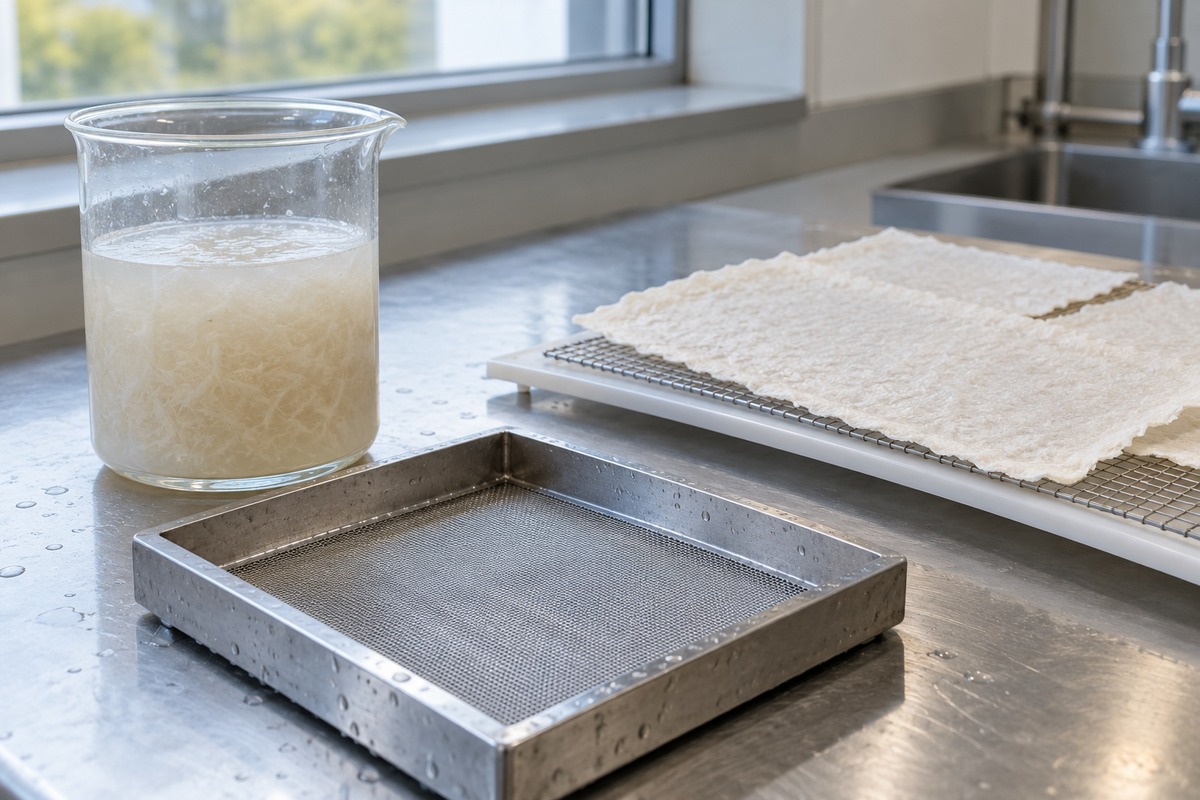
Fibre characterization showed that the TMP fibres were shorter and wider and had a larger fraction of fine material than the Kraft fibres. The authors also described differences in fibre surfaces using electron microscopy, including lignin-rich areas on TMP fibres and a more fibrillated surface appearance around the Kraft material. Those observations supplied context for interpreting network formation and binding. They did not turn every later difference into the effect of a single surface feature. Fibre morphology, refining and water retention all belong to the material history, and their contributions need to be considered together when following the forming trials.
Stronger sheets, slower drainage
The first forming stage used flat sheets with a grammage of 200 grams per square metre. Sheets from each pulp were hot-pressed under common trial conditions and conditioned before mechanical testing. Kraft sheets had higher reported strength and elongation at maximum strength than the TMP sheets. The researchers associated this performance with the additional refining and the resulting fibre network. Flat sheets provided a useful screening format because they allowed the team to compare formulations before committing to more complicated moulded shapes. Their results, however, remained measurements of that particular specimen geometry and preparation route.
The team next added cellulose nanofibres at 2, 4 and 6 percent by mass. Each addition level was assessed through the same general sheet-forming approach, with attention to both reinforcement and water removal. This is an important feature of the experimental design: drainage was not treated as an unrelated production issue to be investigated only after mechanical optimization. The additive was being evaluated as part of a wet process. A stronger finished sheet could still be less straightforward to manufacture if the suspension took longer to drain or retained more water before the later pressing stage.
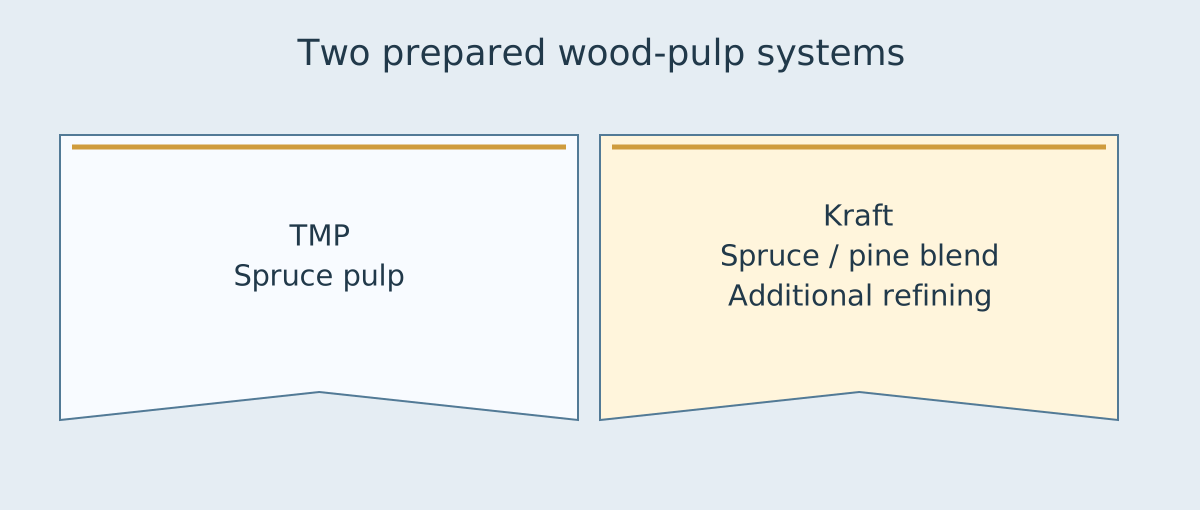
Illustration details
- Two prepared wood-pulp systems
- TMP
- Spruce pulp
- Kraft
- Spruce / pine blend
- Additional refining
At the 2-percent addition level, the paper reports a strength increase of approximately 16 percent for TMP sheets and 24 percent for Kraft sheets relative to their respective controls. These percentages apply to the sheet comparison. They are not the gains measured in the final moulded tensile specimens, and they should not be attached to the bowl demonstrators. The authors suggest that the greater Kraft response might relate to compatibility with nanofibres made from the same pulp, while surface lignin could affect TMP binding. These are proposed explanations for the observed difference, rather than independently isolated tests of each mechanism.
Drainage time increased as the nanofibre content rose, with the effect particularly pronounced for Kraft pulp at the highest addition. Thus, the same additive series produced two linked results: reinforcement of the dry material and increased resistance to water removal during forming. The paper also reports that additions above 2 percent did not make a major further contribution to the tested samples’ mechanical properties. This does not establish a universal optimum for nanofibre use. It explains why, within this screening programme, the researchers chose the smaller addition for their next moulded-specimen trials instead of simply maximizing the reinforcing fraction.
Water removal connects the early and late stages of the process. A wet-formed network must reach a condition that allows subsequent pressing and drying to produce the intended dimensions and surface. If the furnish retains more water, the later operation has to accommodate that different starting condition. In this experiment, the drainage measurements and the subsequent moulding observations together show why the final strength cannot be assessed independently of preparation. The study does not calculate a factory’s production cost or cycle-time saving, but it identifies a processing constraint that a strength-only comparison would have missed.
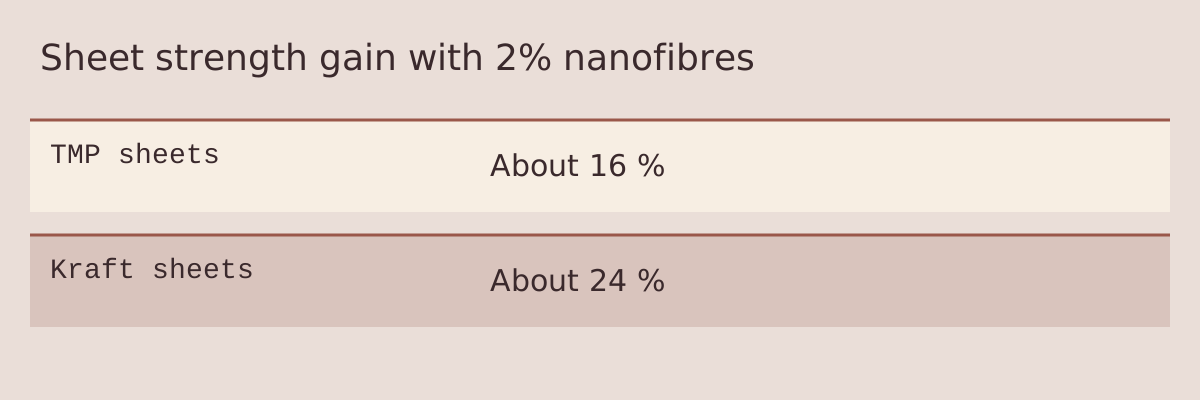
Illustration details
- Sheet strength gain with 2% nanofibres
- TMP sheets
- About 16 %
- Kraft sheets
- About 24 %
Moving from sheets to moulded test pieces
The next specimens had a dogbone shape, with wider ends and a narrower central section for tensile testing. The researchers initially investigated a 2-percent nanofibre addition in this format. Their target thickness was about 3.2 millimetres, substantially changing the forming task from that of flat sheets. The experiment therefore tested whether the screened formulation could be converted into a consistent moulded body. This step is more informative than assuming that the sheet’s percentage improvement would persist unchanged: geometry, water escape and the distribution of material inside the mould could all affect the quality of the specimen subsequently loaded in tension.
For the moulded pieces, pulp suspensions were poured into a dewatering box, and vacuum drainage left wet fibre specimens in the mould. The researchers used different amounts of TMP and Kraft pulp to obtain the desired thickness. This is another reason to preserve the complete specimen description when comparing results. The experiment did not define equivalence simply as pouring an identical mass of every furnish into the same tool. It aimed to make comparable test geometries, then examined how each fibre system behaved during the operations required to obtain them.
Hot pressing followed a sequence rather than one constant force. The specimen was first compressed; during heating, the force was reduced to allow evaporated moisture to escape while limiting expansion; it was then raised again for the final stage. This sequence shows that removing water and maintaining shape were managed together. It is a description of the research procedure, not a validated industrial recipe for other moulds or products. The paper’s reported forces also should not be confused with pressures: converting between them would require the relevant loaded area and a clearly defined contact condition.
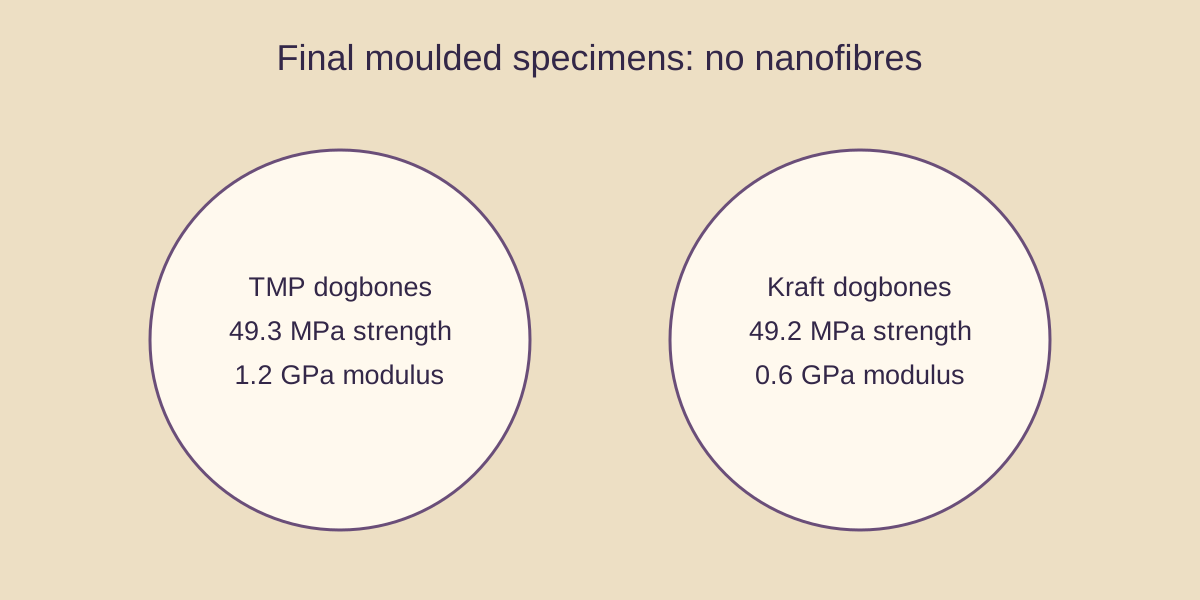
Illustration details
- Final moulded specimens: no nanofibres
- TMP dogbones
- 49.3 MPa strength
- 1.2 GPa modulus
- Kraft dogbones
- 49.2 MPa strength
- 0.6 GPa modulus
Kraft specimens were more difficult to compress to the target thickness than TMP specimens in these trials. The researchers observed greater water retention in the Kraft material and considered it a likely contributor to the longer compression stage. They also found longer dewatering times for Kraft. These observations connect the drainage problem to the later shaping difficulty without proving that water retention was the only cause. The useful result is the consistency across several parts of the experiment: the furnish that was harder to drain also required more attention during pressing to obtain the intended geometry.
Adding nanofibres made the shaping problem more visible. Kraft dogbones containing 2 percent nanofibres developed wet areas around the narrow test section, and the retained moisture required further air drying. The researchers described wrinkling and a tendency towards a thinner centre with thicker edges, producing an undesirable concave cross-section. Such defects matter to both appearance and measurement. If the cross-section is not consistent, the mechanical calculation becomes less straightforward. The study therefore assessed the quality of the test piece itself, rather than treating every moulded object as an equally valid specimen simply because it could be removed from the mould.
The team consequently manufactured the final dogbone series for mechanical analysis without nanofibres. This decision is central to interpreting the results that follow. The reported mechanical values belong to nanofibre-free moulded specimens, while the earlier reinforcement percentages belong to sheets containing the additive. Combining the two would create a formulation that the study did not report as its accepted mechanical test series. The authors discuss improved filtration as a possible way to alleviate the problem, but that suggestion was not demonstrated as a completed solution within this programme. The selected route reflects the processing evidence actually obtained.

What the mechanical results describe
The moulded specimens had reported densities of approximately 0.76 grams per cubic centimetre for TMP and 0.74 for Kraft. These were higher than the corresponding sheet densities reported in the discussion. Density helps describe the resulting fibre network, but it does not make sheet and dogbone tests interchangeable. Their preparation, thickness and testing arrangements differed. The paper also links the stronger moulded pieces to their denser structures as an interpretation of the comparison. It does not establish a universal equation that predicts tensile strength from density alone across different pulps, processing routes and specimen geometries.
The final dogbones had similar tensile strengths: 49.3 megapascals for TMP and 49.2 for Kraft in the reported table. The associated variations were also provided by the authors, so the near-identical central values should not be used to rank one material narrowly above the other. What is informative is that the substantial sheet-strength difference did not appear in the same form in this moulded comparison. The progression through specimen types changed the observed relationship between the pulps. This is a concrete reason to evaluate a furnish in the geometry and forming process relevant to the next stage of development.
Young’s modulus supplied a different comparison. The moulded TMP value was 1.2 gigapascals, whereas Kraft was 0.6. Strength and modulus therefore did not tell the same story: similar maximum tensile stress coexisted with different reported stiffness. The authors also described different shapes and variability in the stress–strain curves. These details help explain why a single peak value is an incomplete account of mechanical performance. They do not justify assigning every pulp product the same stiffness or comparing values from different testing geometries without considering how the specimens were prepared and how the response was measured.
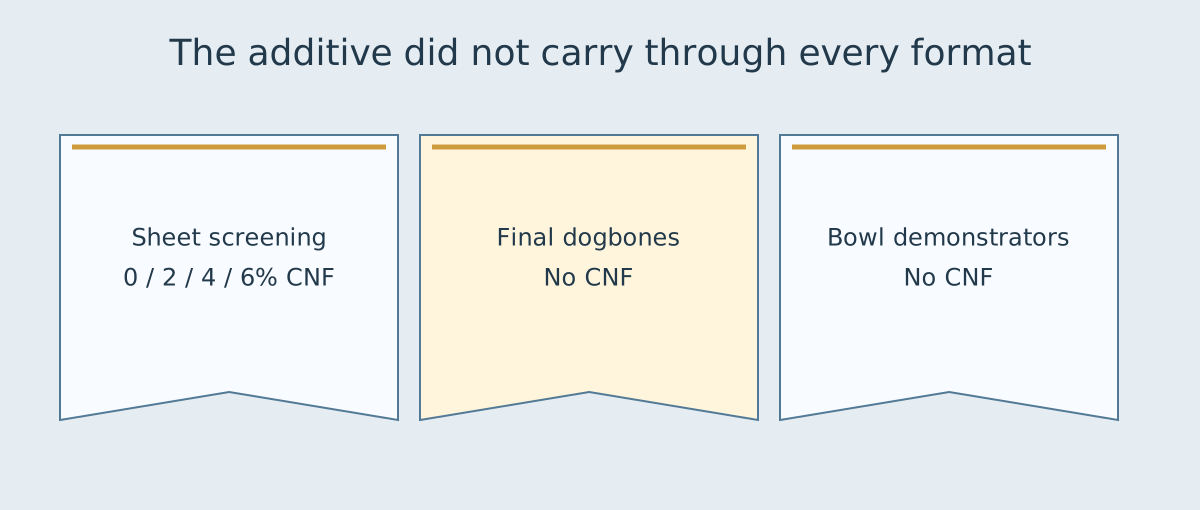
Illustration details
- The additive did not carry through every format
- Sheet screening
- 0 / 2 / 4 / 6% CNF
- Final dogbones
- No CNF
- Bowl demonstrators
- No CNF
Elongation was another distinct result: the table reports 5.6 percent for TMP dogbones and 8.6 percent for Kraft. Thus, the Kraft pieces showed greater elongation in this test while having lower modulus and similar tensile strength. These properties must remain separate. Greater elongation is not automatically greater strength, just as higher stiffness is not an overall product-quality score. For a development programme, the combination defines a mechanical profile that can be compared with the intended requirements. The experiment itself does not select a final commercial application by these three values alone.
The sheet-to-dogbone comparison also involved different tensile-test arrangements. Sheets were tested as strips, while the thicker moulded specimens were tested in a separate tensile machine and at a different loading rate. Those differences belong beside the results when interpreting the change in apparent behaviour. The work demonstrates the usefulness of screening and then making shaped specimens; it does not show that one can substitute an individual sheet result directly into a product model. Likewise, comparisons with published plastic properties do not establish complete interchangeability, because an application may depend on properties that this mechanical screening did not measure.
Bowls demonstrated shape, with limits
The researchers also made three-dimensional bowl demonstrators from the two pulps without nanofibres. The preparation included vacuum forming, partial drying and hot pressing at 150 degrees Celsius using staged pressure. Their observations showed a rougher surface and greater shrinkage for the Kraft bowl than for the TMP bowl, with the TMP demonstrator appearing smoother. These findings concern the manufactured demonstrators and their observed surfaces. They provide a further check on how the fibres behave in a shaped object, but do not turn the bowl into a certified commercial package or establish the performance of an unrelated factory product.
The demonstrators had no surface modification intended to provide a liquid barrier. This leaves a separate development question after strength and shape have been demonstrated. The ability to form a coherent bowl does not establish resistance to prolonged liquid contact, and a successful tensile test does not supply that missing result. The study discusses possible barrier strategies, but it did not demonstrate them as tested additions to these bowls. It also did not provide a food-contact certification, a measured biodegradation time for the demonstrators or a complete environmental comparison. Those outcomes should remain separate from the forming and mechanical evidence.
A useful reading of the programme follows the material through each experimental stage. This keeps the additive’s sheet-strength benefit connected to its drainage penalty and prevents the final nanofibre-free dogbone values from being attributed to a reinforced formulation. It also preserves the difference between a laboratory specimen, a shaped demonstrator and a commercial package. The following checklist captures those distinctions for this study. Its purpose is to make the evidence usable without removing the conditions that gave each result its meaning or assigning the wood-pulp findings to the bagasse business described at the outset.
- Record the pulp source and refining history before comparing formulations.
- Keep the nanofibre percentage attached to both strength and drainage observations.
- Distinguish sheet screening from the moulded dogbone series selected for testing.
- Read strength, modulus, elongation, density and specimen geometry together.
- Treat bowl formation and surface appearance separately from untested barrier or certification outcomes.
The central finding is a processing trade-off, not a rejection of nanofibre reinforcement. The additive strengthened experimental sheets, while slower dewatering and defects complicated the next moulded format. The researchers therefore selected nanofibre-free pulps for the final mechanical series and bowl demonstrators. Following that decision through the paper explains why material development requires both a property test and a forming test. Within the specified wood pulps and procedures, the work shows how water removal, geometry and reinforcement interact, and why a promising result at one stage must be checked again when the material is made into a different shape.
Business context: Wu Yan and Chen Xinbo, Xinhua, 23 April 2025. Technical discussion adapted in original English from Eirik Ulsaker Jacobsen, Simen Prang Følkner, Jørgen Blindheim, Dag Molteberg, Martin Steinert and Gary Chinga-Carrasco, Nanomaterials, 7 September 2023, DOI 10.3390/nano13182511, under CC BY 4.0. Wording, structure and explanation have been changed; source figures are not reproduced.
Leave a comment