Silk degumming: removing sericin while preserving fibroin
Removing silk’s outer protein coating can also affect its fibroin core. A comparison of four enzyme treatments separates mass loss, estimated residual sericin and regenerated-protein measurements, showing why one number cannot describe the process.
Published Apr 22, 2025
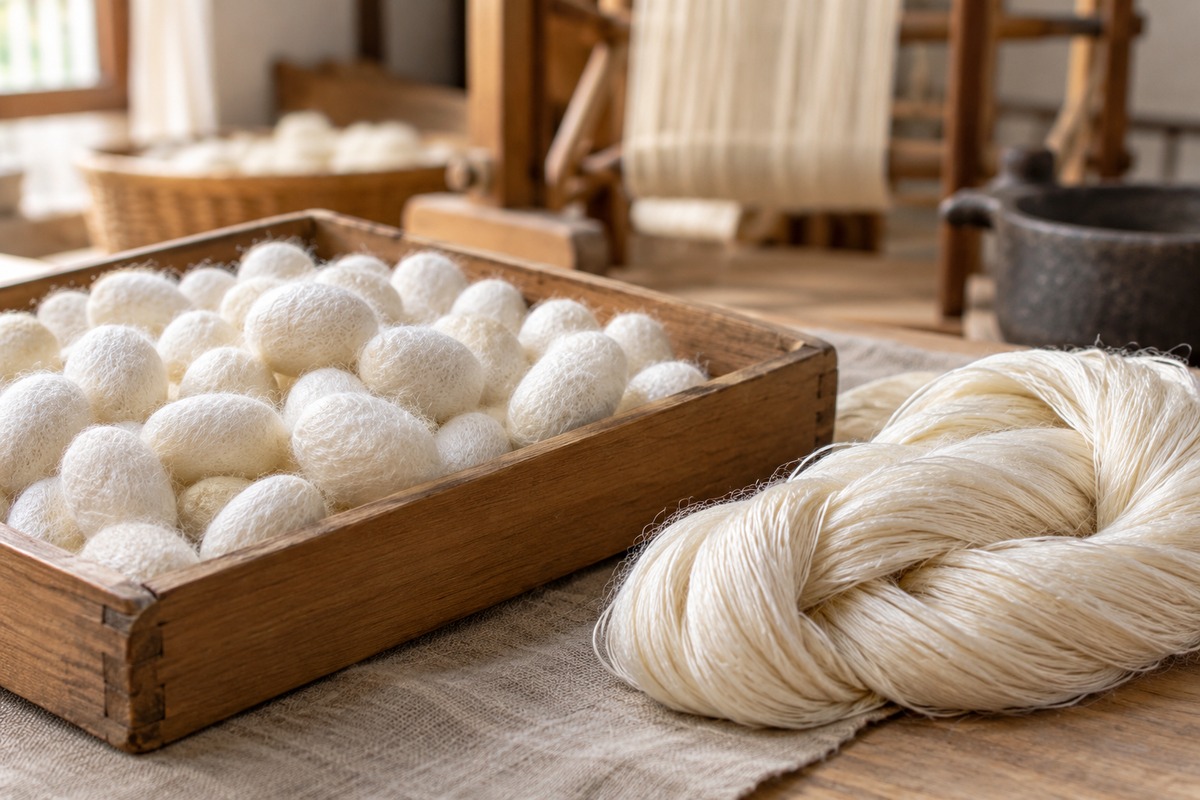
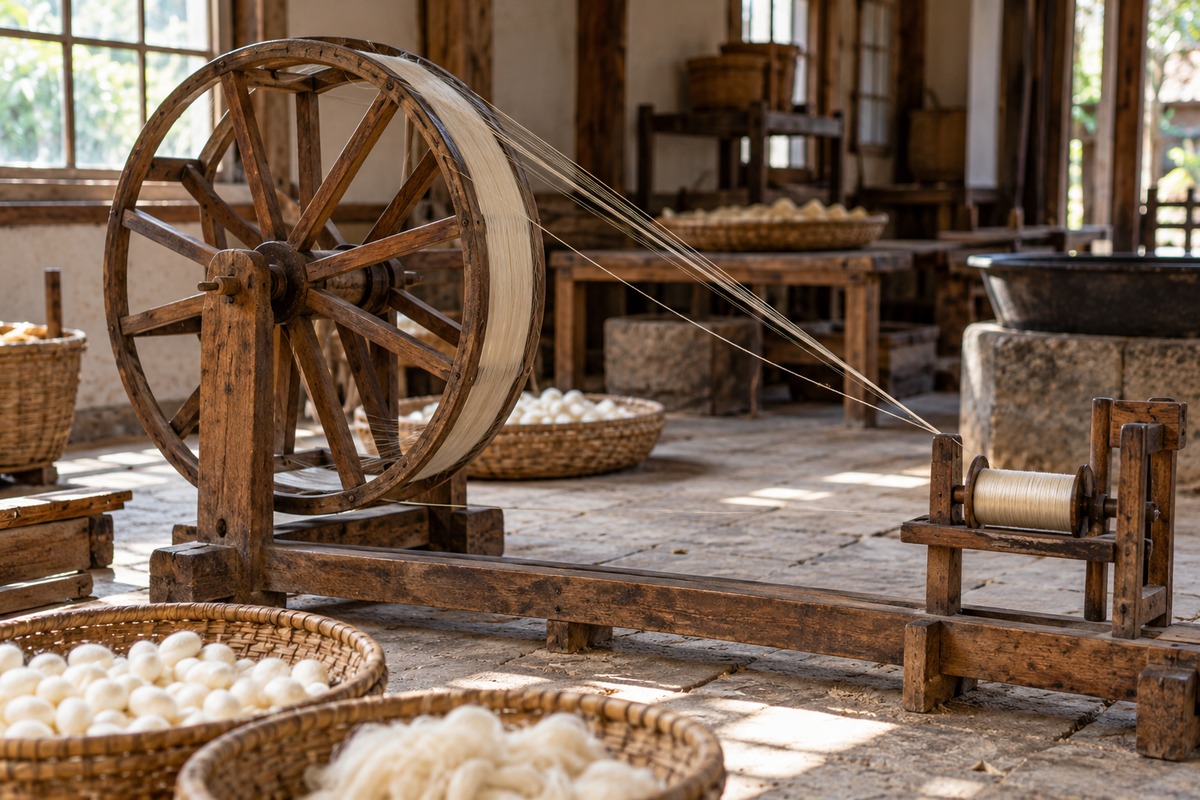
Preparing silk involves several operations that should not be confused with one another. In a report published on 22 April 2025, Xinhua described artisan Remzi Guler preparing cocoons for reeling in Bursa, Türkiye. The report connected the craft with training and efforts to renew local silk production. Softening a cocoon so that its filament can be unwound is one processing task. A separate laboratory question concerns removing silk’s outer protein coating while limiting damage to the fibroin underneath. That distinction leads to a comparison of degumming treatments, rather than an assessment of the artisan’s own method.
Degumming removes sericin associated with the silk filament, leaving material richer in fibroin. For researchers preparing regenerated fibroin, the outcome depends on both removal and preservation. A treatment can remove material effectively while also altering the protein chains that the next process needs. Consequently, a large reduction in silk mass is not enough to establish the best result. The experiment considered here follows treated fibres into regenerated protein solutions and examines several kinds of evidence. It separates the amount lost during treatment from estimated residual sericin, thermal behaviour and the molecular-weight distribution inferred from subsequent analytical measurements.

Illustration details
- Separate research and production contexts
- 12 August 2023
- Degumming study published
- 22 April 2025
- Bursa silk report published
A comparison of treatment protocols
Xueping Liu, Qian Huang, Peng Pan, Mengqi Fang, Yadong Zhang, Shanlong Yang, Mingzhong Li and Yu Liu published the comparative silk-degumming study on 12 August 2023 in Polymers. They tested four protease treatments and a sodium-carbonate reference. Their question was whether sericin removal could be combined with reduced degradation of fibroin during preparation. These were laboratory comparisons using specified raw silk and processing conditions. The work did not investigate Bursa’s craft centres, nor did it measure the performance of textiles made by the people in the Xinhua report. The connection is the material-processing question, with the two sources retaining their separate settings.
The raw material was Bombyx mori silk supplied by a company in Suzhou, China. Samples were assigned to the selected degumming routes and then evaluated as treated fibres or processed further into regenerated fibroin solutions. This common starting material made the comparison more specific than a general survey of silk from different origins. It also defines a boundary: the results concern that material and those treatments. They do not establish that every silk type, yarn construction or prior processing history would respond identically to the same named enzyme or chemical reagent.
The enzymes were subtilisin, trypsin, bromelain and papain. The authors grouped them as neutral proteases and used conditions selected for each preparation. Sodium carbonate provided the alkaline reference. Naming the routes is useful, but the experiment did not simply exchange enzyme identity while keeping every other variable constant. The treatments also differed in temperature, pH, concentration and processing sequence. This means the observed results belong to the complete protocols. They cannot independently identify how much of a difference was caused by the enzyme itself and how much arose from the particular conditions chosen for its use.
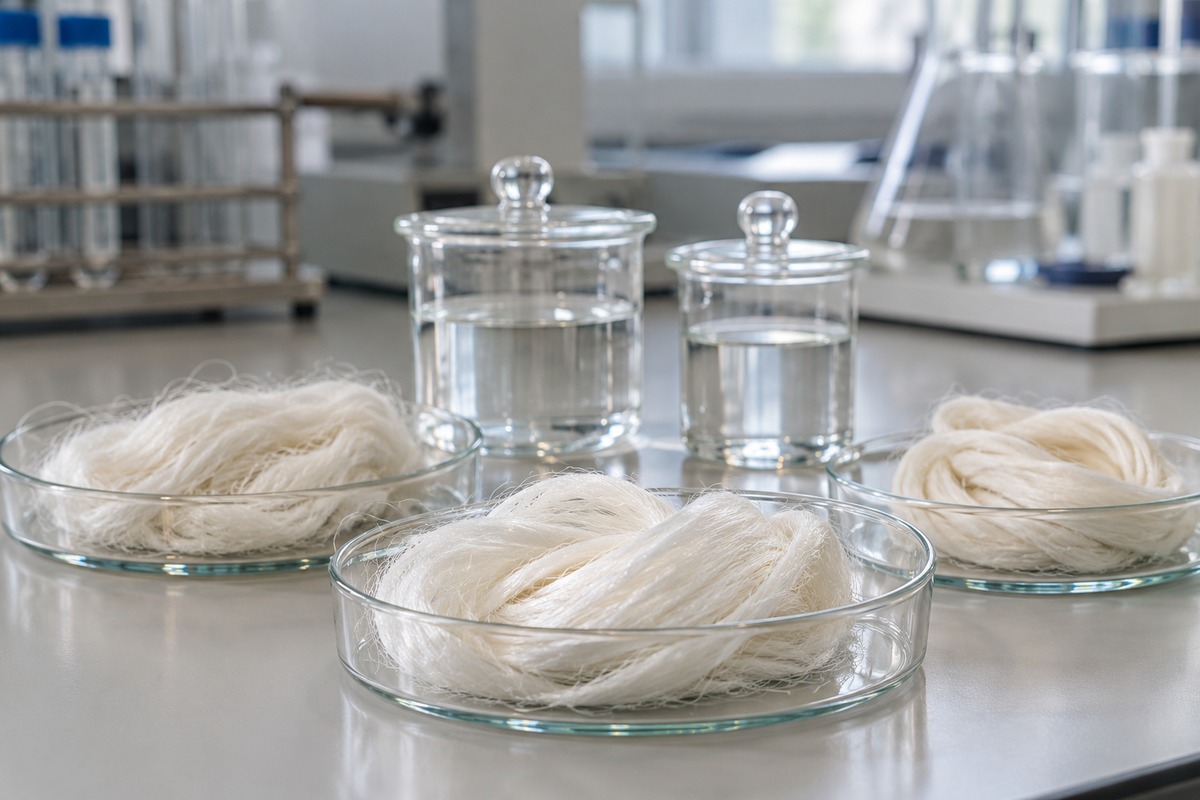
The word “neutral” also does not mean that every solution had exactly pH 7. The reported enzyme conditions ranged from pH 6.4 to 7.0, and the four treatment temperatures differed. The enzyme-treated samples were washed and the enzymes inactivated, while the carbonate reference followed its own repeated treatment. These details matter to interpretation even without reproducing a chemical recipe. A protocol that removes sericin under one combination of conditions is not automatically a universal optimum. The study compares selected laboratory routes; it does not provide a complete optimization over every possible time, dose, temperature and wash sequence.
Two material states must remain separate throughout the comparison. Some tests examined the degummed fibres themselves. Other tests examined fibroin after dissolution, dialysis and preparation of a regenerated solution. A surface observation on a fibre is therefore not the same measurement as a molecular-weight estimate from a later solution. The preparation stages between them can also affect the material. Following that sequence makes the paper easier to interpret: the researchers assessed both the visible condition and composition of treated silk and the characteristics of the protein obtained after the common regeneration procedure.
Mass loss does not measure selectivity alone
The degumming ratio was calculated from the conditioned mass before and after treatment. It records the fraction lost relative to the initial silk mass. In itself, this calculation does not identify every component that left the sample. Sericin removal contributes to the loss, but degradation or loss of fibroin could contribute too. That is why the researchers used additional analyses rather than treating the mass change as a complete description. The definition is particularly important when comparing treatments with similar ratios: similar amounts removed do not necessarily mean identical residual coatings or identical preservation of the underlying protein.
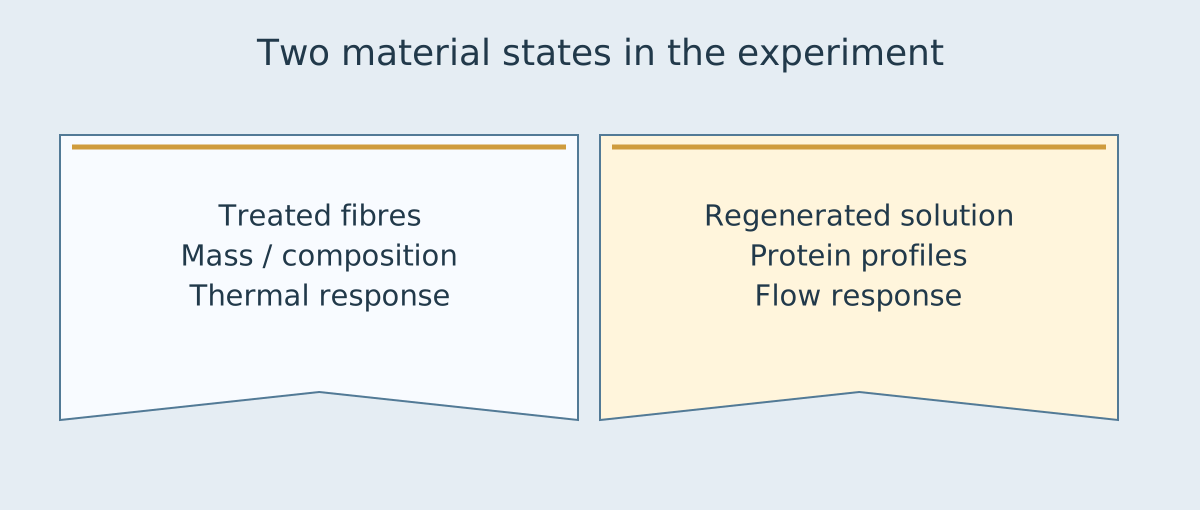
Illustration details
- Two material states in the experiment
- Treated fibres
- Mass / composition
- Thermal response
- Regenerated solution
- Protein profiles
- Flow response
The reported ratios were 22.30 percent for subtilisin, 24.53 for trypsin, 21.76 for bromelain and 23.85 for papain. The sodium-carbonate reference was 22.93 percent. The authors did not report a significant difference between each protease route and the carbonate reference for this measure, although trypsin and papain were higher than bromelain in their comparison. These values place the treatments in a similar broad mass-loss range. They do not, on their own, rank the routes by how selectively sericin was removed or how much of the fibroin chain structure survived subsequent preparation.
Bromelain illustrates the distinction. Its mass-loss ratio was the lowest of the four enzyme routes, yet several later measurements were consistent with greater preservation of higher-molecular-weight fibroin components. Trypsin and papain removed more mass but did not lead to the same overall protein profile. This does not mean that removing less material is always preferable. It means that the interpretation depends on what was removed and what remained. A meaningful degumming comparison must pair the mass ratio with evidence about coating removal and the condition of the fibroin, rather than selecting the largest percentage automatically.
The researchers described treated-fibre surfaces using scanning electron microscopy. Their account noted exposed fibre bundles after degumming and differences in grooves, stripes and small surface attachments among the routes. The carbonate-treated fibres showed deeper grooves, while some enzyme routes produced shallower surface features. These observations supplied morphological context for the comparison. They were not measurements of the finished fabric’s tensile strength, and they did not by themselves quantify a molecular-weight distribution. Here, the descriptions are attributed to the paper; its micrographs are not reproduced or presented as images of the generic silk illustrations accompanying this article.

Illustration details
- Selected degumming mass-loss ratios
- Bromelain route
- 21.76 %
- Trypsin route
- 24.53 %
- Carbonate reference
- 22.93 %
Amino-acid analysis supplied another view. The authors used the different composition of sericin and fibroin, particularly the relationship between aspartic acid and alanine, to estimate the sericin-containing fraction. The samples were hydrolysed for this analysis, so the output concerned amino-acid composition rather than intact protein chains. The calculation used an empirical relationship reported in the method. This makes it a different kind of evidence from mass loss or surface appearance. It can support interpretation of the remaining material, while its assumptions and the possibility that treatment changes fibroin composition remain relevant to the estimate.
The estimated sericin-containing fraction was 24.71 percent for raw silk. After the enzyme treatments, the reported values ranged from 0.64 to 0.76 percent; the carbonate-treated silk gave 0.33 percent. These results support the description of extensive coating removal under the tested conditions. However, they do not mean that the residual fraction was demonstrated to be exactly zero. Nor do the small values alone establish which treatment preserved fibroin best. The carbonate route had the lowest estimate by this calculation, while the molecular-weight analyses of regenerated fibroin pointed to other differences between the resulting materials.
The paper itself discusses why these estimates need care. Different treatments may hydrolyse fibroin to different degrees, affecting the amino-acid composition used in the calculation. Consequently, the residual-sericin estimate is most useful when read together with the other observations. It should not become an absolute purity certificate detached from the analytical method. This is a general lesson within the experiment: the same processing route can appear favourable on one measure and less favourable on another because the measures answer different questions. Combining them is more informative than replacing them all with the word “clean.”
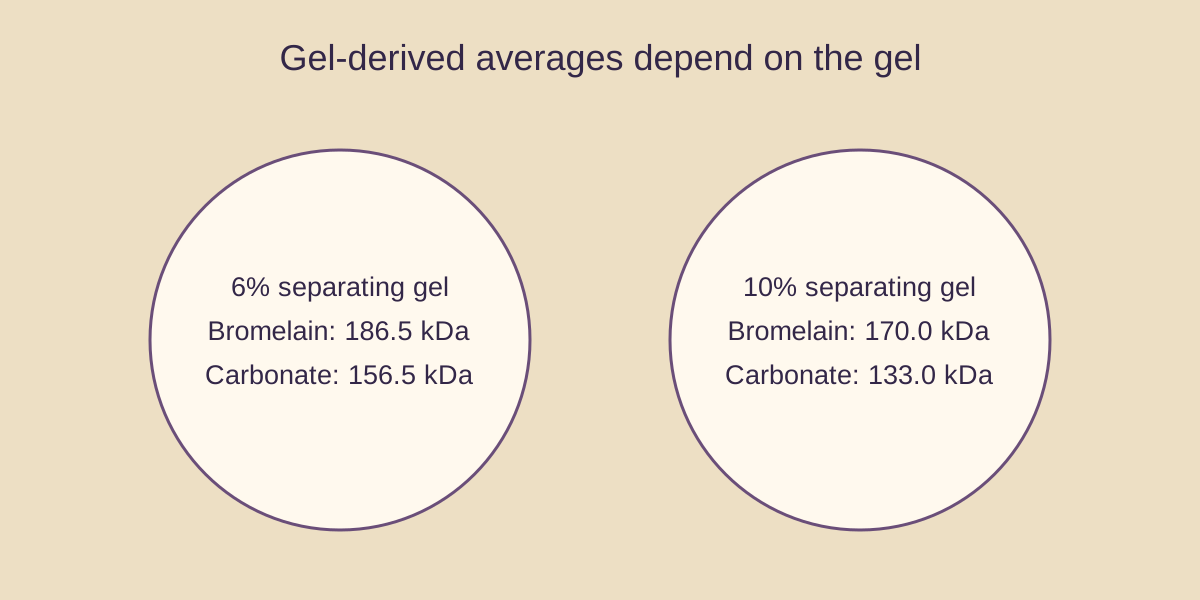
Illustration details
- Gel-derived averages depend on the gel
- 6% separating gel
- Bromelain: 186.5 kDa
- Carbonate: 156.5 kDa
- 10% separating gel
- Bromelain: 170.0 kDa
- Carbonate: 133.0 kDa
From thermal response to regenerated protein
Thermogravimetric analysis examined the treated fibres while temperature increased under nitrogen. The researchers compared the temperature of the maximum decomposition rate, using derivative curves. The carbonate-treated material had a reported maximum at 320.9 degrees Celsius. Among the enzyme-treated samples, values ranged from 321.9 for trypsin to 331.0 for bromelain. These are observations from the thermal-analysis programme, not the temperatures used for degumming. Keeping those two roles separate prevents a decomposition measurement from being mistaken for a manufacturing setting or a direct instruction about how the silk should be processed.
The higher decomposition-rate maximum for bromelain-treated silk was one part of the authors’ interpretation that this route caused less damage under the selected conditions. It does not establish a safe service temperature for a textile or a guaranteed lifetime for a product. The experiment did not test every form of heat exposure or every environment in which silk might be used. Its thermal result contributes to the comparison of prepared samples. It remains distinct from the later protein-solution measurements and from any claim about mechanical performance, which was not directly established by this thermal test.
To prepare regenerated fibroin, the researchers dissolved samples from each degumming route, then dialysed and filtered the resulting solutions. Applying the same general regeneration procedure provided a common next stage for comparison. Nevertheless, the material measured at this point had passed through both degumming and regeneration. The resulting molecular-weight profile should therefore be described as that of the regenerated fibroin derived from a particular treatment. It is not a direct measurement of an untouched filament inside a cocoon. This wording preserves the processing history that connects the original silk to the analytical sample.

The first molecular-weight approach was sodium dodecyl sulfate–polyacrylamide gel electrophoresis, or SDS–PAGE. The study used separating gels at two concentrations and compared the protein patterns with molecular-weight markers. It also analysed image intensity to obtain semiquantitative estimates. This method allowed the authors to compare the distribution of material across molecular-weight regions, rather than describing each solution as containing one uniform chain size. The distinction matters because degumming and regeneration produced mixtures. An estimated average summarizes a distribution and does not imply that every fibroin component in the sample has the reported molecular weight.
For the 6-percent separating gel, the reported average estimates were 186.5 kilodaltons for subtilisin-derived fibroin, 179.5 for trypsin, 186.5 for bromelain and 172.5 for papain. The carbonate-derived sample was 156.5 kilodaltons. These values came from the gel-analysis procedure and should retain that label. They support a comparison within the specified measurement, but not an assertion that the protein solutions contained only chains of those sizes. The authors also described higher-molecular-weight regions in the enzyme-derived samples, which forms part of the distribution evidence alongside the calculated averages.
The 10-percent separating gel gave different average estimates for the same preparation routes: 166.5, 168.0, 170.0 and 163.5 kilodaltons for subtilisin, trypsin, bromelain and papain respectively, compared with 133.0 for the carbonate route. The authors linked differences between the two gel analyses partly to their molecular-weight markers. This is a useful qualification, not a reason to silently choose one set as an exact universal value. Both sets pointed towards higher estimates for the enzyme-derived preparations than for the reference, while also showing that the reported numerical average depended on the analytical arrangement.

Illustration details
- Three views of regenerated fibroin
- SDS–PAGE
- Gel estimates
- Chromatography
- Elution profiles
- Rheology
- Flow response
Gel-permeation chromatography supplied a further comparison of the regenerated solutions. The enzyme-derived samples began eluting earlier than the carbonate-derived preparation under the study’s conditions, and the bromelain profile was described as relatively concentrated compared with the broader carbonate profile. The authors interpreted these patterns as evidence about differences in molecular-weight distribution. Elution volume, however, is the measured chromatographic coordinate; it should not be relabelled as an absolute molecular weight without the necessary calibration. The useful contribution is the pattern of the profiles and how it compares with the gel observations, rather than a second invented set of exact chain masses.
Rheological measurements added the response of the regenerated solutions to changing shear conditions. The paper reports higher viscosities for the enzyme-derived preparations than for the carbonate-derived solution in the lower-shear region, with bromelain highest among the tested routes. It also describes shear thinning as the conditions changed. These observations are consistent with the authors’ broader interpretation, but viscosity is not an independent direct count of protein-chain mass. Exact shear thresholds are not reproduced here because the publication uses inconsistent rate units and descriptions. The reported concentration information also does not justify treating every analytical preparation as identical across methods.
Reading the evidence together
The strongest reading of the comparison comes from the combination of methods. Mass loss indicated how much material left the silk. Amino-acid analysis supported an estimate of the remaining sericin-associated fraction. Microscopy described surface features, thermal analysis characterized decomposition response, and the regenerated solutions were examined through several complementary measurements. Agreement among these observations made the bromelain route interesting within the study. It did not convert every method into the same test or establish a single number that captures all aspects of degumming. Each result retains its own specimen state, assumptions and limits.
The scope is also narrower than a universal choice of enzyme for industry. The routes differed in conditions, the comparison used specified raw silk, and the work did not measure a complete industrial energy or cost balance. It did not directly establish the tensile strength of a finished textile or validate a clinical application of regenerated fibroin. Although the authors discuss possible uses, those possibilities are not outcomes of the measurements described here. The experiment is valuable as a comparison of preparation and characterization, with further work needed before transferring a preferred laboratory route into a different production setting.
A useful record of degumming therefore keeps the treatment and the measurement connected. The following checklist captures that approach for this paper. It prevents a mass-loss percentage from becoming a purity claim, an elution volume from becoming an uncalibrated chain mass, or a thermal maximum from becoming a service-temperature guarantee. It also preserves the difference between the fibre and the regenerated solution. These distinctions help explain what the research actually establishes while keeping its laboratory findings separate from the Bursa reeling and training activities that provided the production context at the beginning.
- Record the complete treatment route, including the fact that enzyme conditions differed.
- Read mass loss alongside the method used to estimate residual sericin.
- Keep treated-fibre observations separate from regenerated-solution measurements.
- Label gel-derived averages, chromatographic profiles and viscosity responses as different evidence.
- Distinguish measured laboratory outcomes from untested industrial or product-performance claims.
The central result is that removing silk’s coating and preserving its fibroin cannot be judged by the same mass-loss figure alone. Under the tested protocols, the enzyme routes combined extensive sericin removal with regenerated-protein profiles that differed from the carbonate reference. Bromelain provided a particularly favourable combination in the authors’ comparison, while the individual methods retained important qualifications. Following the material from raw silk through treated fibre to regenerated solution makes that conclusion understandable. It also defines the next question clearly: whether the same balance can be reproduced with another material, processing route and intended use, rather than assuming that one laboratory result already supplies the answer.
Production context: Xinhua, 22 April 2025. Technical discussion adapted in original English from Xueping Liu, Qian Huang, Peng Pan, Mengqi Fang, Yadong Zhang, Shanlong Yang, Mingzhong Li and Yu Liu, Polymers, 12 August 2023, DOI 10.3390/polym15163383, under CC BY 4.0. Wording, structure and explanation have been changed; source figures are not reproduced.

Leave a comment