Portugal's cork harvest: bark, skilled work and forest regeneration
Portugal’s cork harvest combines skilled bark extraction with forest renewal, from seasonal field work to a study of young oaks beneath contrasting canopies.
Published Apr 26, 2024
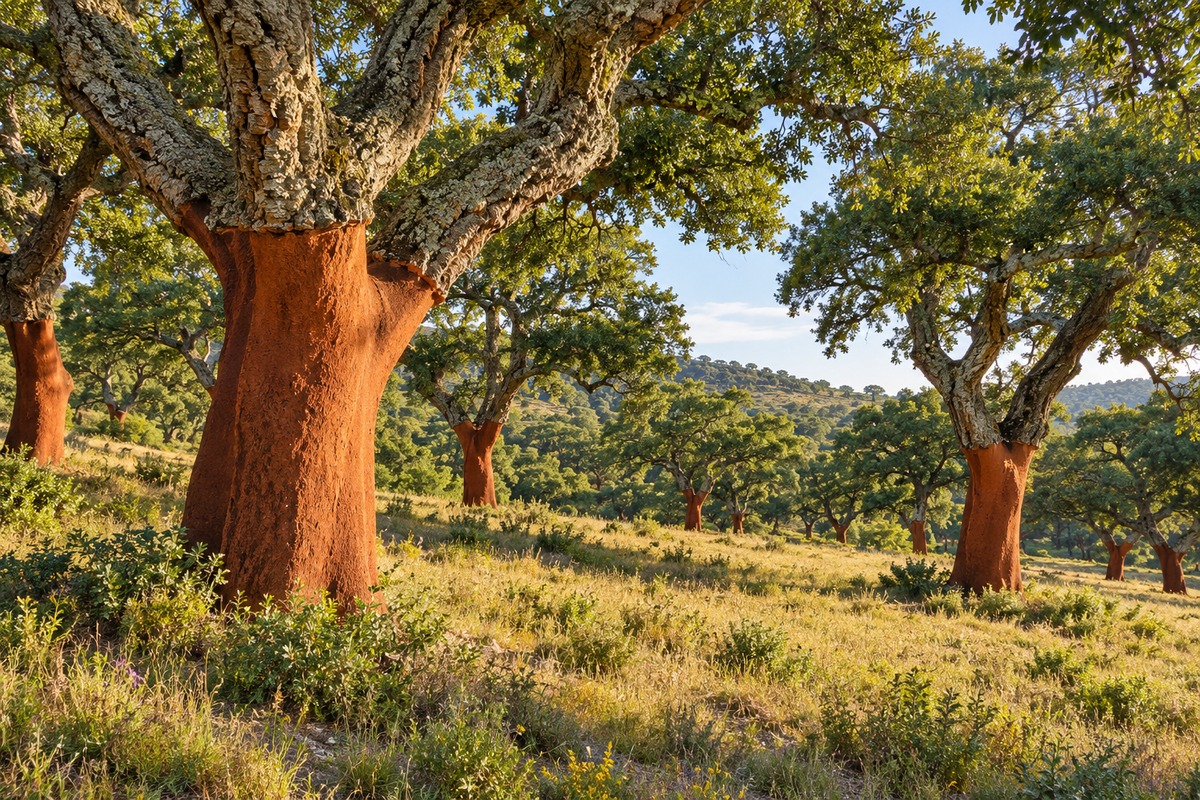
Cork harvesting removes a renewable layer of bark while leaving the oak standing. In Portugal, that work connects wine closures with skilled seasonal labour and the management of long-lived forests. Coruche, about 80 kilometres from Lisbon, is one centre of the trade. Harvester Fábio Mendes learned the craft from his father and has called for more young people to be trained. Harvesting paid around €120 a day during the April 2024 field reporting.
Portuguese cork harvesters faced labour shortages and a shorter, hotter season in April 2024. Amorim chief executive António Rios de Amorim expected mechanisation to assist workers while retaining their expertise. Mechanised work accounted for a reported 7% of harvesting in Portugal and Spain in 2023. Cork supply also depended on young trees becoming established and surviving successive dry summers.
Bark grows back on a different clock
Cork oaks, Quercus suber, grow in the western Mediterranean and regenerate their outer bark after harvesting. Successive extractions take place about nine years apart. Trees can live for roughly 150–200 years, supporting repeated harvests during their lives. In the Brunhoso research forest, cork production followed a nine-year cycle. New trees entered the population through acorn germination and seedling establishment, alongside the continued growth and bark regeneration of older trees.
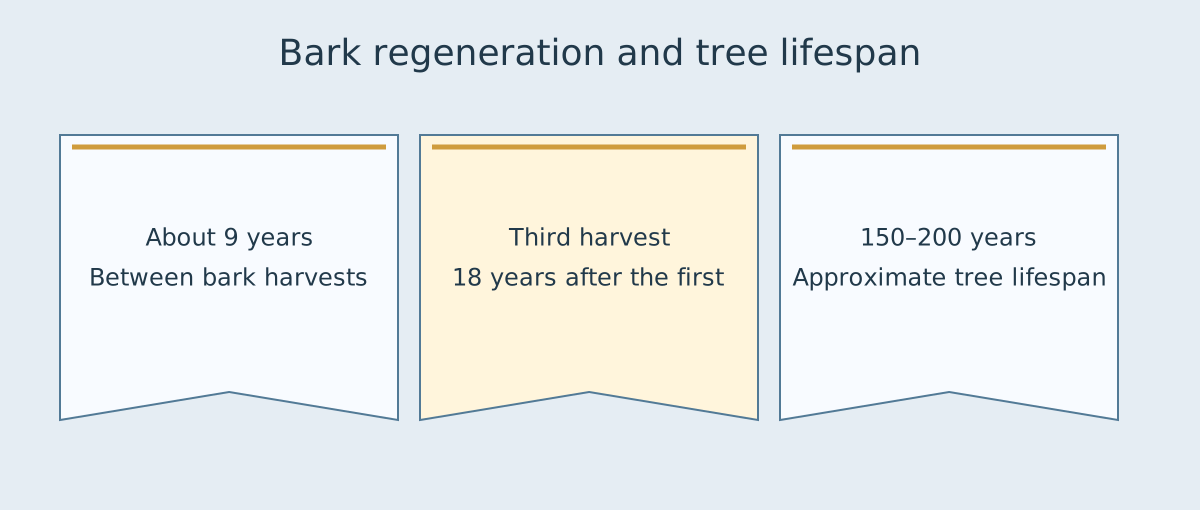
Illustration details
- Bark regeneration and tree lifespan
- About 9 years
- Between bark harvests
- Third harvest
- 18 years after the first
- 150–200 years
- Approximate tree lifespan
On May 30, 2024, Portuguese craftspeople Carlos Ferreira and Joao Ferreira demonstrated cork harvesting at the University of California, Davis. They worked with hand axes in an oak grove more than 80 years old. Greg Hirson of Cork Supply explained the operation to approximately 100 students and wine-industry participants. The two harvesters worked together to remove bark from the standing trees.
Cork Supply purchasing director Frederico Mayer distinguished the first extraction from later bark suitable for fine wine closures. The third harvest arrives about 18 years after the first, after two regeneration intervals. Moisture on the removed bark's inner surface helped identify the harvesting stage at Davis. Traditional harvesting takes place between mid-May and late August, during active growth.
New trees pass through several regeneration stages
Natural regeneration proceeds through acorn production, dispersal, germination and seedling establishment. Animals consume some seeds, while emerging plants encounter competition and herbivory on the forest floor. New seedlings develop their roots within the upper soil before gaining access to deeper water. In Mediterranean cork-oak forests, summer drought coincides with this early growth period. Seed availability, surrounding vegetation, soil conditions and tree cover form parts of the regeneration environment examined by Ribeiro and her co-authors.
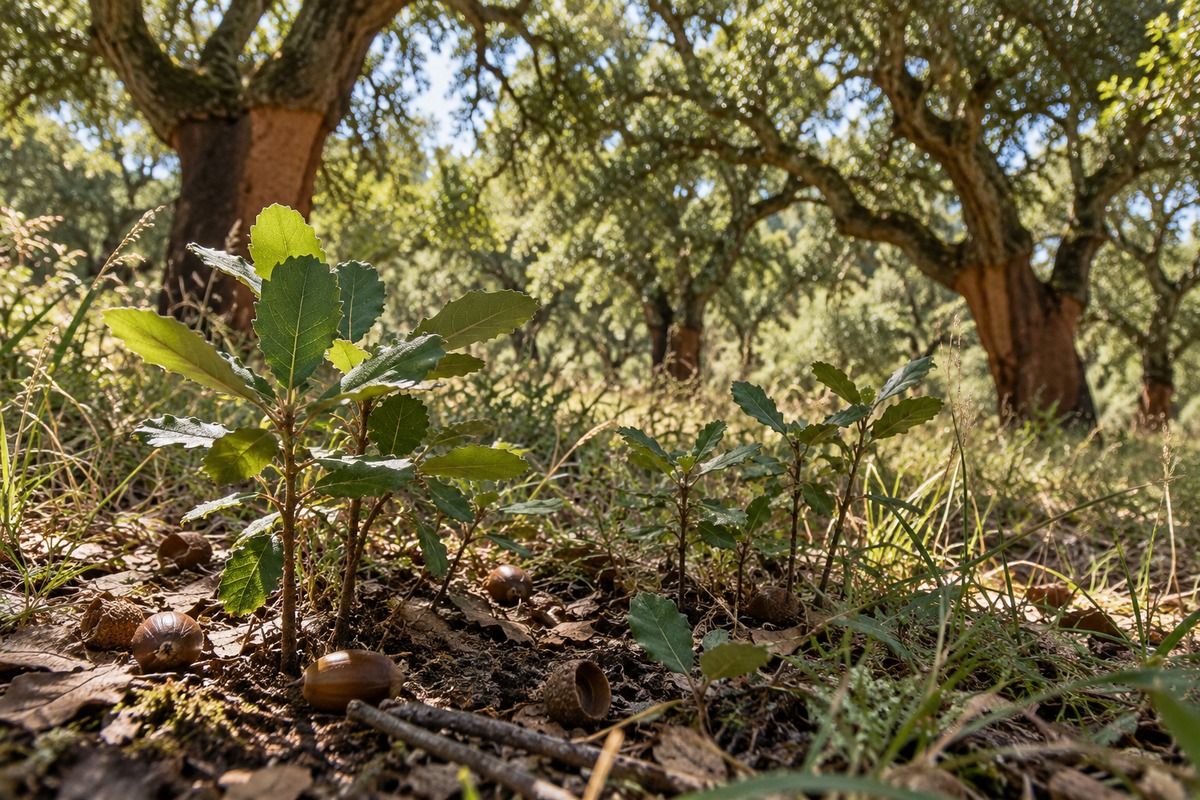
Stéphanie Ribeiro, Adelaide Cerveira, Paula Soares, Nuno Almeida Ribeiro, Constança Camilo-Alves and Teresa Fidalgo Fonseca examined those stages in a study published on June 11, 2024 in Frontiers in Forests and Global Change. Their research combined a review of regeneration factors with field monitoring near Brunhoso, in the municipality of Mogadouro in northeast Portugal. The field observations ran from February 2022 to January 2023, including the exceptionally dry summer of 2022.
Portugal's sixth national forest inventory recorded approximately 720,000 hectares of cork oak, representing 23% of the country's forested area. About 59% of cork-oak stands lacked natural regeneration in that inventory. Ribeiro and her co-authors used these historical findings as national context for their 2024 research. Their fieldwork took place near Brunhoso, in a private forest dominated by cork oaks and managed for cork extraction. Other vegetation included herbaceous plants, Cistus and Lavandula species, and seedlings of Quercus faginea and Quercus rotundifolia.
Two stands with different canopy cover
The Brunhoso stands were designated A and B. Stand A occupied 20.5 hectares and faced north on a 24-degree slope; stand B occupied 35.9 hectares and faced northwest on a 19-degree slope. Their oldest trees were at least 74 years old, according to the owner. The stands shared broadly comparable climatic conditions and differed in canopy structure. The research formed part of the ForManRisk forest-management project. Four permanent circular plots, A1, A2, B1 and B2, were installed for tree measurements and regeneration observations.
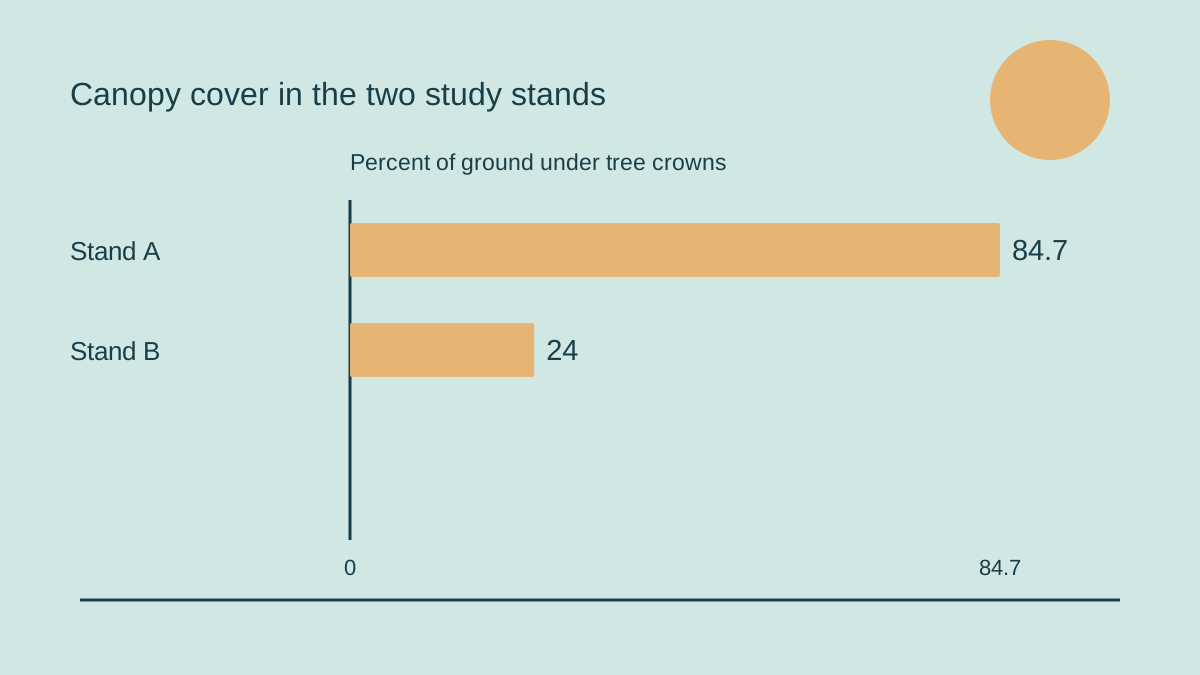
Illustration details
- Canopy cover in the two study stands
- Percent of ground under tree crowns
- 0
- 84.7
- Stand A
- 84.7
- Stand B
- 24
Stand A contained an estimated 600 living trees per hectare and canopy cover of 84.7%, while stand B contained 260 trees per hectare and 24% canopy cover. Basal area was 26.2 square metres per hectare in A and 6.0 in B. Quadratic mean diameter was 23.6 centimetres in A and 17.2 in B. Their stand-density indices were 75% and 20% respectively. The two plots in A contained 60 observed living trees; the two in B contained 26. Crown-cover calculations used the vertical projection of tree crowns over the ground.
Each stand contained two permanent circular plots of 500 square metres, positioned 50 metres apart. Five four-square-metre regeneration plots were installed inside each circle. Wire divided each square into four one-square-metre units, producing 40 subplots per stand and 80 overall. Living trees at least 1.30 metres tall received diameter, height and crown measurements. Diameters were measured at 1.30 metres above ground with a caliper of one-millimetre precision. A Vertex hypsometer provided tree-height measurements with ten-centimetre resolution.
What the field team counted
The researchers returned in February, June and September 2022, then January 2023. Their records separated acorns, living seedlings and dead seedlings. Seedlings were also divided by height, with groups up to 10 centimetres, above 10 and up to 30 centimetres, and above 30 centimetres. Selected smaller plots received additional measurements of seedling height, basal diameter and germinated or ungerminated acorns.
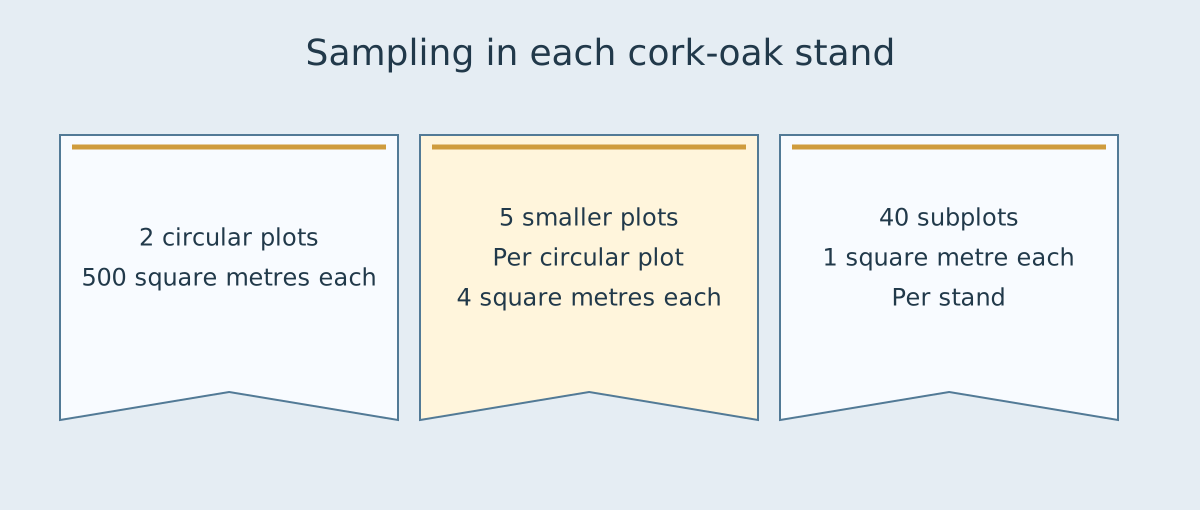
Illustration details
- Sampling in each cork-oak stand
- 2 circular plots
- 500 square metres each
- 5 smaller plots
- Per circular plot
- 4 square metres each
- 40 subplots
- 1 square metre each
- Per stand
The field team recorded the following features during its repeated visits:
- Acorn counts recorded the seed resource present in the sampled ground at each visit.
- Seedling counts recorded established young plants, with separate height classes.
- Mortality observations recorded plants that had disappeared or dried out and could not resprout.
- Measurements of adult trees described the canopy and stand structure surrounding that regeneration.
Four crown radii were measured for each recorded tree, moving clockwise from the direction of the steepest slope. Crown areas were calculated from the mean radii. The tree populations had uneven-aged structures and wide diameter ranges. A five-centimetre diameter class was the most frequent in both stands. Stand A also contained trees in classes above 55 centimetres. Smaller stems occurred alongside large older trees within the same stands, under the contrasting levels of crown cover.
Seedlings beneath the denser canopy
Stand A had more seedlings throughout the monitoring. Mean counts per four-square-metre plot were 20.6 in February 2022, 22.8 in June, 21.0 in September and 19.7 in January 2023. The corresponding means in B were 0.1, 0.6, 0.2 and 0.2. Within A's February total, seedlings no taller than ten centimetres averaged 11.9 per plot, those above ten and up to 30 centimetres averaged 6.2, and those above 30 centimetres averaged 2.5. By June, those height-class means were 12.3, 8.5 and 2.0 respectively. In January, the three height-class means in A were 9.5, 7.4 and 2.8 seedlings per four-square-metre plot.
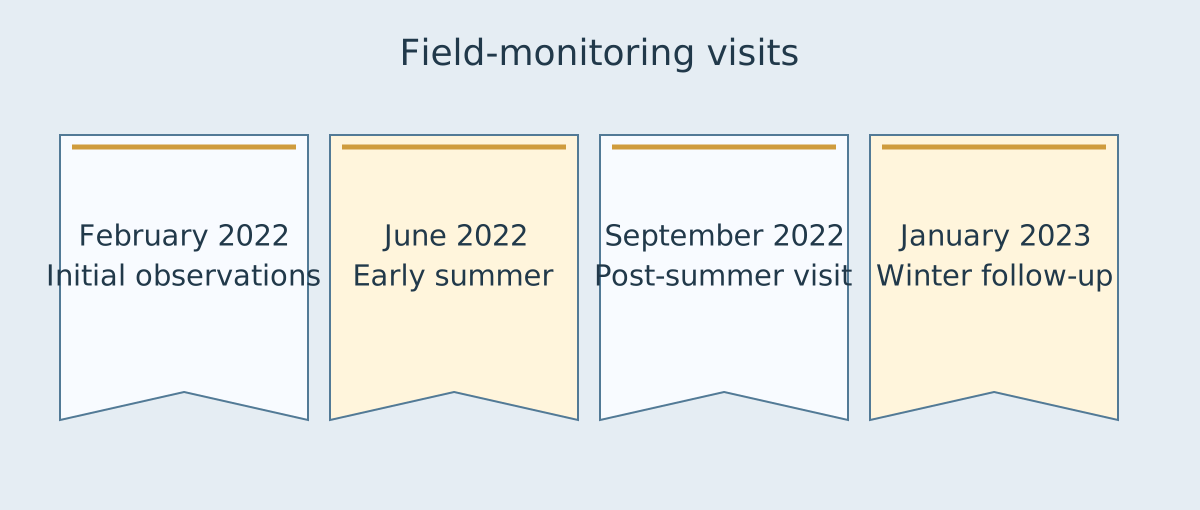
Illustration details
- Field-monitoring visits
- February 2022
- Initial observations
- June 2022
- Early summer
- September 2022
- Post-summer visit
- January 2023
- Winter follow-up
Mean acorn counts per four-square-metre plot in A were 27.2 in February, 19.7 in June, 7.5 in September and 9.0 in January. Stand B's corresponding means were 3.2, 0.4, zero and 2.7. Acorn numbers were lowest after summer in both stands. Ribeiro and her co-authors associated the winter recovery with the usual November–December seed-production season. They also identified predation or grazing as possible contributors to the earlier decreases. Seedling abundance peaked in June in A, during the monitoring sequence following spring germination.
Stand A had a mean 2.2 dead seedlings per four-square-metre plot in September, equivalent to 9.5% of the seedlings in that assessment. In January, mean mortality was 0.6 seedlings, or 3%. Stand B had no recorded dead seedlings in February or June, followed by means of 0.2 in September and January. Its living-seedling mean was also 0.2 on both latter visits. In A, the September living plants included means of 9.6 in the smallest height class, 9.0 in the middle class and 2.4 above 30 centimetres.
Seedling counts and mortality
Mean seedling numbers differed significantly between the two stands on all four measurement dates, with higher values in A. Mortality differences between stands were not statistically significant at any visit. For A, repeated-measures analysis found no significant change in mean total seedling numbers across the monitoring dates. The within-subjects test gave an F value of 0.520 and a significance value of 0.511. Acorn numbers differed significantly between stands in February, June and September; the January comparison had a p value of 0.051.

Ribeiro and her co-authors interpreted the denser canopy as providing protective conditions during extreme drought. Shade can moderate exposure to solar radiation and help retain soil moisture around young plants. Newly emerged seedlings have shallow root systems compared with mature trees, making surface conditions especially relevant during summer. The researchers nevertheless retained a balance in their discussion: more canopy can provide shelter while trees and seedlings also compete for water, light and nutrients.
Ribeiro and her co-authors recommended maintaining canopy cover to protect natural regeneration during hot, dry conditions. They also recommended considering sowing in low-density stands such as B, where the observed natural regeneration was sparse. Further research across different soils and climates was proposed to identify suitable canopy cover for other cork-oak areas. These management recommendations followed the four visits to the two Brunhoso stands.
Managing the surrounding vegetation
Grasses, shrubs and trees surround emerging cork oaks. In the literature reviewed by Ribeiro and her co-authors, shrubs could shelter seedlings from herbivores and improve their microclimate, while dense or tall vegetation competed for resources. Grazing could damage young plants, and soil ploughing or harrowing could injure roots or destroy saplings. Frequent shrub clearance was another management factor associated with mortality. The researchers discussed these pressures alongside rainfall, temperature and the limited root development of newly emerged seedlings.
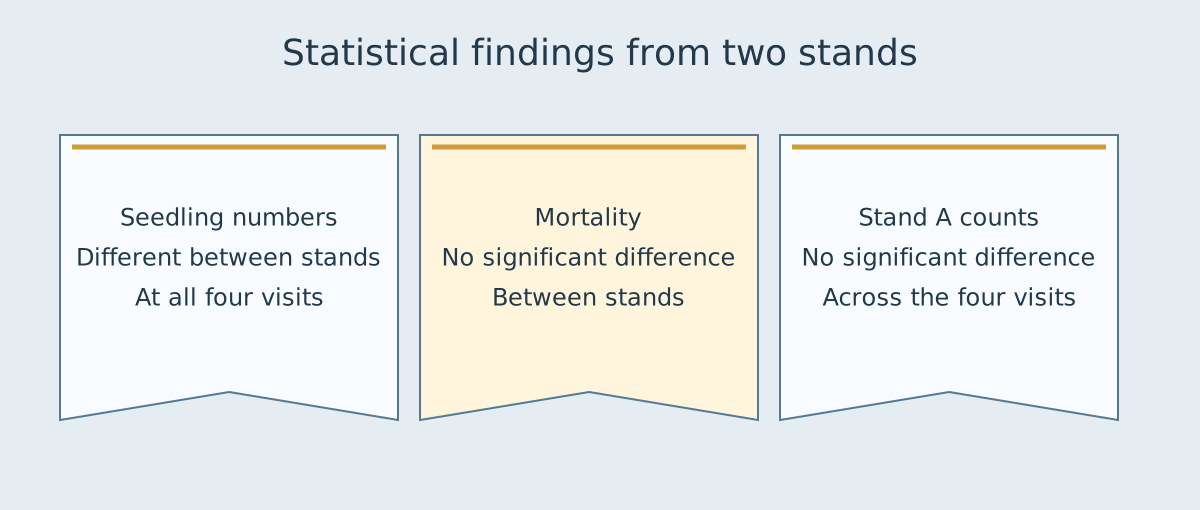
Illustration details
- Statistical findings from two stands
- Seedling numbers
- Different between stands
- At all four visits
- Mortality
- No significant difference
- Between stands
- Stand A counts
- No significant difference
- Across the four visits
Weather during field monitoring
The study area lies in Trás-os-Montes at an altitude of around 600 metres. During 1971–2000, mean annual temperature averaged 10.9°C and mean annual precipitation was 1,010 millimetres. In June 2022, the Bragança weather station recorded an average minimum of 12.6°C, an average maximum of 27.5°C and total precipitation of 9.4 millimetres. September precipitation reached 20.3 millimetres, with average minimum and maximum temperatures of 11.2°C and 25.4°C. These station observations accompanied the fieldwork in the same district. February 2022 precipitation was 5.6 millimetres; average minimum and maximum temperatures were 0.8°C and 14.9°C.
Severe to extreme drought affected the region between January and September 2022. Adult cork oaks could obtain water from deeper soil layers, while newly emerged seedlings depended more heavily on water near the surface. The researchers discussed hydraulic lift, through which cork oaks move water from depth towards shallower soil. Excess water also presents a different pressure: compact, wet soils can favour damaging disease. Phytophthora cinnamomi was among the major biological threats considered in the review of cork-oak regeneration.
Plantation work and company forestry programmes
Amorim reported 871 hectares converted into cork-oak plantations since 2021, including 225 hectares in 2024. Within the Tejo Internacional Natural Park, its cumulative area was 176 hectares, including 88 hectares in 2024. Research addressed tree growth, water availability and resistance to pests, disease and adverse conditions.
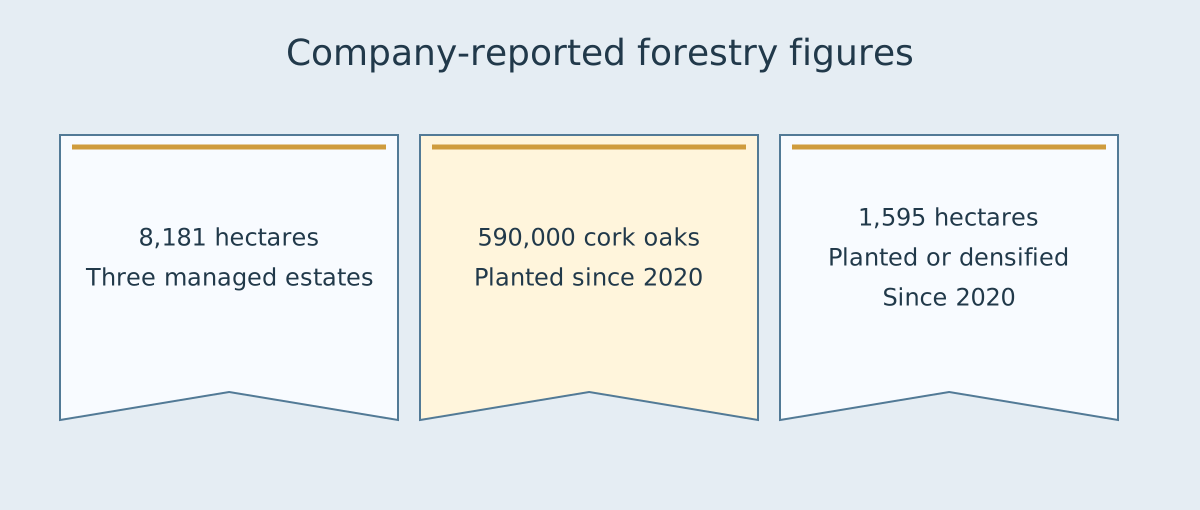
Illustration details
- Company-reported forestry figures
- 8,181 hectares
- Three managed estates
- 590,000 cork oaks
- Planted since 2020
- 1,595 hectares
- Planted or densified
- Since 2020
Corticeira Amorim’s Forestry Intervention Project began in 2013. Its programme used drip irrigation until the first bark harvest, then removed irrigation and returned to nine-year extraction intervals. The company aimed to halve the approximately 25-year wait for first stripping.
Amorim’s 2024 environmental disclosure recorded 8,181 hectares of agroforestry properties: 5,105 at Herdade de Rio Frio, 2,799 at Herdade da Baliza and 277 at Herdade da Venda Nova. It reported 590,000 cork oaks planted and 1,595 hectares planted or densified on managed properties since 2020.
The Brunhoso trees also differed in their average dimensions. Mean total height was 5.3 metres in A and 3.8 in B; mean height to the crown base was 1.8 and 1.0 metres respectively. Mean individual crown area was 14.1 square metres in A and 9.2 in B. Diameters measured at breast height averaged 14.5 centimetres in A and 12.9 in B. Standard deviations for those diameters were 18.8 and 11.5 centimetres, reflecting the wide ranges of tree sizes within the sampled stands. Standard deviations for total tree height were 3.5 metres in A and 1.9 in B; for individual crown area they were 25.1 and 15.4 square metres respectively.
Adapted and paraphrased from Ribeiro, Cerveira, Soares, Ribeiro, Camilo-Alves and Fonseca, Frontiers in Forests and Global Change (2024), DOI 10.3389/ffgc.2024.1332708. The research is licensed under Creative Commons Attribution 4.0. Wording and organisation have been adapted; the authors retain credit for the study and measurements. Company forestry figures are attributed to Corticeira Amorim’s 2024 environmental disclosure.
Leave a comment