Molten-salt heat storage: mixtures, measurements and material stability
Molten salts carry and store heat in solar-tower systems. Two laboratory studies show how mixture composition, test conditions and equipment affect the properties being measured.
Published Jul 19, 2024

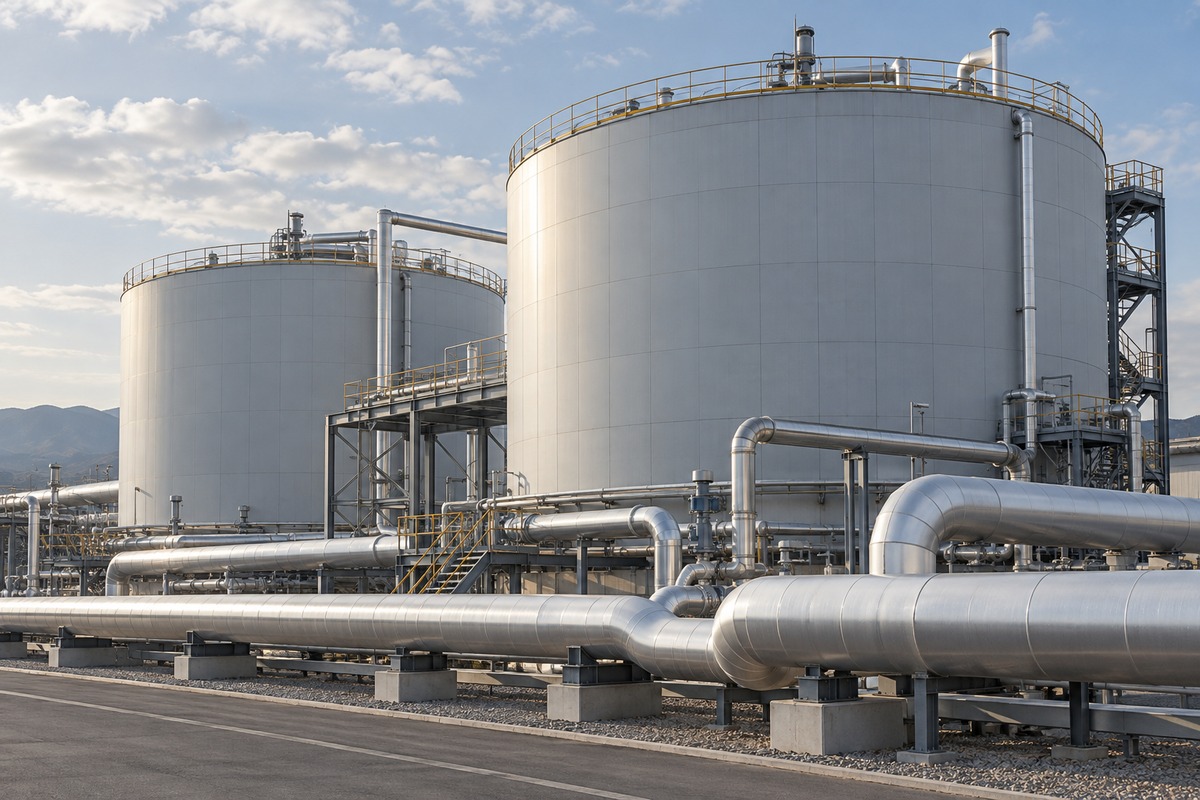
In July 2024, Xinhua described a solar-thermal project in Guazhou County, in China, where two heat-absorbing towers would share one turbine generator. China Three Gorges Corporation said the main project had begun commissioning and was expected to enter operation by the end of that year. Heliostats and molten-salt storage formed part of the reported system. That commissioning-stage account provides a setting for a separate materials question: how do researchers determine the properties and stability of the liquid that carries and stores heat?
A solar-tower system collects sunlight as heat before producing electricity through a power cycle. A heat-transfer and storage medium connects those stages. Its useful properties include the amount of heat it can absorb, how it flows and how its composition changes during exposure to high temperatures. The salt formulations studied in the laboratory papers discussed here are examples of research materials. The Xinhua report does not identify the Guazhou installation's exact salt recipe, so the experimental formulations cannot be assigned to that project from the news account alone.

Illustration details
- Dated laboratory and project sources
- 8 Jul 2023
- Solar Salt stability study
- 15 May 2024
- Ternary-mixture study
- 19 Jul 2024
- Guazhou commissioning report
Heat capacity describes one part of storage
Specific heat capacity relates a material's temperature rise to the heat absorbed per unit mass. When a representative heat capacity is used, the available temperature interval also enters the estimate of sensible heat storage. Density connects a mass-based description to the volume occupied by the material. These properties describe different parts of the storage calculation. A high heat capacity does not, by itself, describe heat-transfer speed, pumping requirements or the chemical compatibility of a storage vessel. Those questions require additional measurements on the fluid and on the materials that contain it.
Solar Salt is a commonly studied mixture containing 60% sodium nitrate and 40% potassium nitrate by mass. Its composition is specified in both papers considered here. The term identifies a particular formulation, rather than every salt used in solar-thermal research. Other mixtures change the relative amounts of the nitrates or introduce additional components. The composition matters because phase changes, viscosity and chemical reactions depend on the substances present and their proportions. Comparing two named formulations therefore begins with their full ingredient lists and with a clear statement of whether percentages refer to mass or another basis.
Melting and chemical stability set different questions
A salt must be liquid for the flowing applications described in these studies, making its melting behaviour an important material characteristic. At higher temperatures, chemical changes can become important even while the medium remains liquid. A melting measurement and a decomposition measurement consequently describe different transitions. The first concerns physical phase behaviour; the second concerns changes in chemical composition. Researchers also distinguish a temperature identified during a heating scan from the behaviour of a material held at one temperature for a prolonged period. The observation time and the surrounding atmosphere belong to the result.
Huaiyou Wang, Jinli Li, Yuan Zhong, Xu Liu and Min Wang examined nitrate-based formulations containing sodium sulfate in a paper published on 15 May 2024. Their affiliations included the Qinghai Institute of Salt Lakes of the Chinese Academy of Sciences. The study compared prepared ternary mixtures with binary Solar Salt and measured several thermophysical properties. Its laboratory preparation used batches of about 20 grams. The work also included structural characterisation and molecular modelling, while the discussion here focuses on the reported composition, thermal measurements, heat capacity and flow properties.
A formulation changes more than one ingredient
The formulation labelled TMS-2 contained 42.01% sodium nitrate, 56.30% potassium nitrate and 1.69% sodium sulfate by mass. These proportions differ from the 60:40 nitrate balance of the binary comparison material. The experiment therefore compares two complete formulations: it changes the relative nitrate amounts as well as including sulfate. This distinction matters when describing the observed property differences. Assigning the entire result to the small sulfate fraction alone would remove another compositional change from the comparison. The published recipe provides the necessary basis for retaining both changes in the description.
The researchers used differential scanning calorimetry and thermogravimetric measurements to investigate thermal behaviour. Calorimetry records the heat-flow response associated with changes such as melting, while thermogravimetry follows sample mass as conditions change. These observations provide different information about the same prepared material. In the thermal scans, the study used nitrogen and a heating rate of ten degrees Celsius per minute. Stating those conditions makes the numbers interpretable as results of that measurement procedure. It also helps distinguish them from a prolonged storage test under a different gas atmosphere.
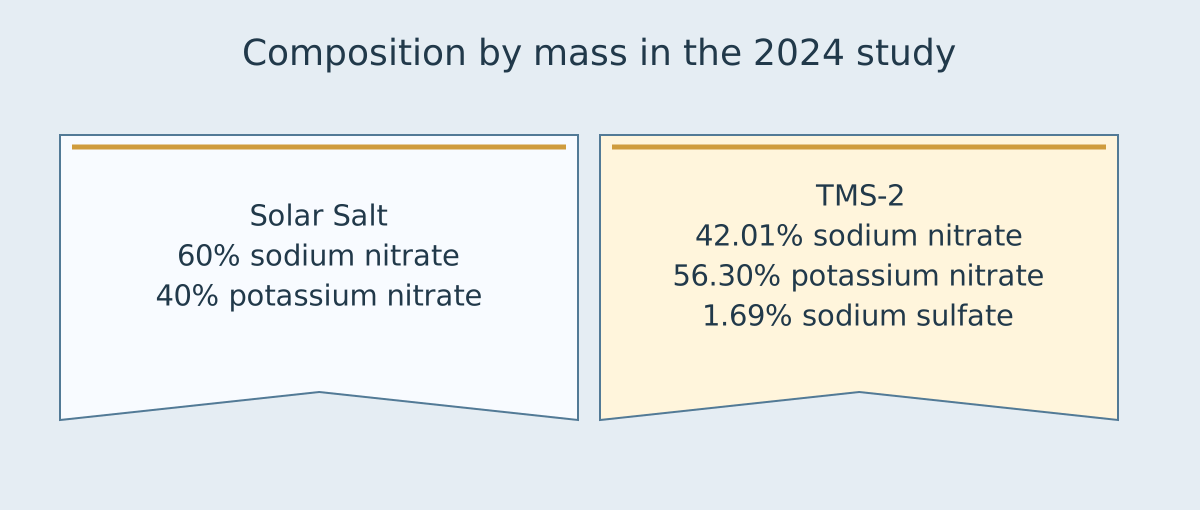
Illustration details
- Composition by mass in the 2024 study
- Solar Salt
- 60% sodium nitrate
- 40% potassium nitrate
- TMS-2
- 42.01% sodium nitrate
- 56.30% potassium nitrate
- 1.69% sodium sulfate
What the thermal scans measured
In the published table, the binary Solar Salt sample had a melting point of 227.47 degrees Celsius, while TMS-2 had a value of 220.97 degrees. The difference was 6.5 degrees in this comparison. Other ternary formulations in the study had their own melting values, so the designation TMS-2 refers to one selected composition. These measurements describe the prepared samples and the method used. They do not establish the temperature of every location in a storage installation, where pipework, vessels and heat exchangers form a much larger physical system.
The same table reported decomposition temperatures of 572.32 degrees Celsius for the binary sample and 611.25 degrees for TMS-2. These are thermal-analysis results under the study's specified scan conditions. A value reached during a rising-temperature measurement is not a demonstration that a plant can operate continuously at that temperature. The later chemical-stability experiment discussed below followed composition over hundreds of hours, addressing a different aspect of material behaviour. Keeping the methods separate prevents a short thermal scan from becoming an unsupported long-term operating guarantee.
Heat capacity and viscosity require separate measurements
For the liquid-state measurements reported in the 2024 paper, average specific heat capacities were 1.55 joules per gram per kelvin for Solar Salt and 1.69 for TMS-2. The authors reported a difference of 9.03% between those averages. Their calorimetric procedure compared the sample response with a baseline and a sapphire reference, while accounting for sample mass. The resulting numbers characterise heat absorption in the tested materials. They provide one input to a storage assessment, alongside the usable temperature interval and other material properties, rather than a direct measure of electricity-generation efficiency.
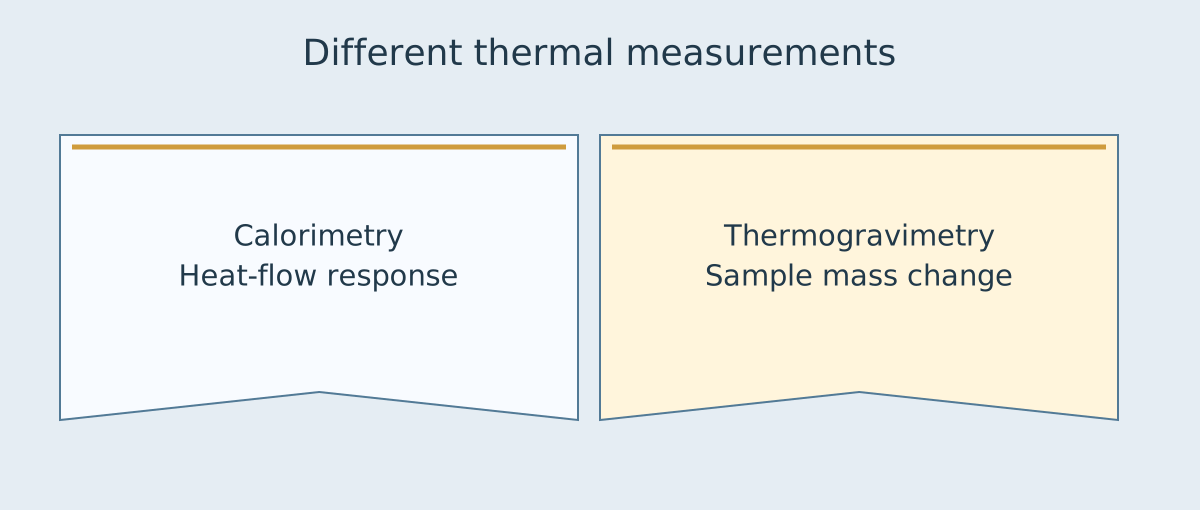
Illustration details
- Different thermal measurements
- Calorimetry
- Heat-flow response
- Thermogravimetry
- Sample mass change
Viscosity describes another property relevant to moving the liquid through equipment. The study measured it separately using a rheometer. Across the tested temperature range, both the binary salt and TMS-2 became less viscous as temperature increased, and TMS-2 was slightly more viscous than the binary comparison. The combination illustrates a material trade-off: the formulation with the higher reported heat capacity did not have the lower viscosity in this experiment. A selection based on several properties can therefore differ from a ranking based on one reported thermal number.
The authors also identified corrosion behaviour and interactions with structural materials as topics for further research on TMS-2. That qualification remains part of the result. A formulation can have measured thermal advantages while its compatibility with stainless steels or other containment materials still needs investigation. The distinction concerns the boundary between a sample property and an engineered storage system. Containers, heat-transfer surfaces and moving components remain in contact with the fluid, so their interactions form another set of material questions beyond the calorimetric comparison of the salts themselves.
Following composition during prolonged heating
A separate paper by Julian Steinbrecher, Markus Braun, Thomas Bauer, Sebastian Kunkel and Alexander Bonk was published on 8 July 2023. The authors worked at the German Aerospace Center, DLR, in Germany. Their experiments examined the high-temperature chemistry of binary Solar Salt, with particular attention to the test apparatus and gas environment. They investigated nitrate, nitrite and oxide-ion behaviour at temperatures including 600 and 620 degrees Celsius. The question was how to obtain interpretable chemical-equilibrium data while reducing side reactions that could alter the measured salt composition.
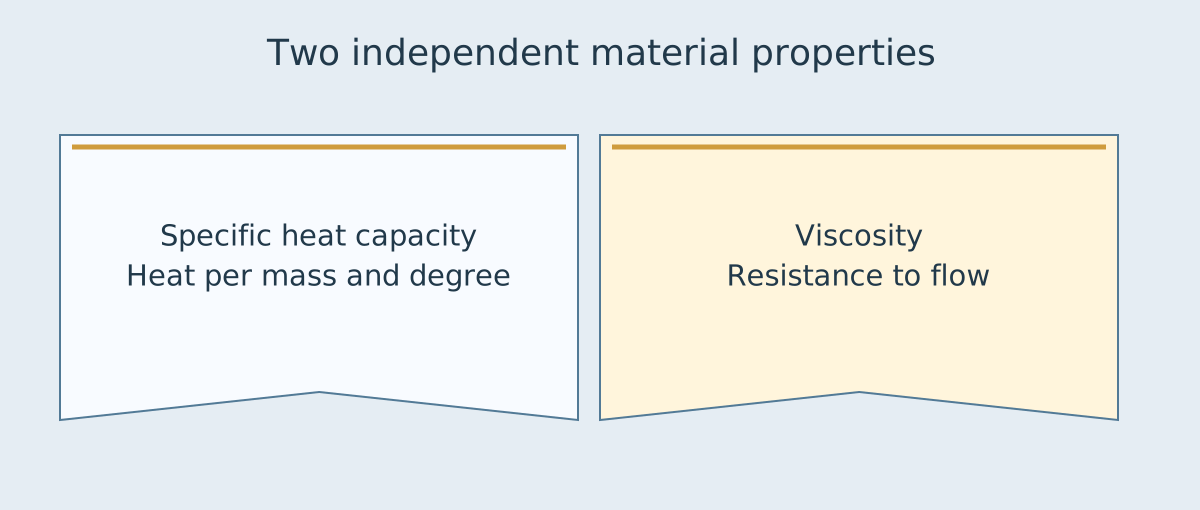
Illustration details
- Two independent material properties
- Specific heat capacity
- Heat per mass and degree
- Viscosity
- Resistance to flow
The DLR experiments used about 150 grams of Solar Salt in an alumina crucible within an autoclave test rig. The apparatus maintained a controlled temperature and gas environment and allowed repeated salt sampling during extended heating. The study included experiments lasting roughly 1,200 hours, with some parameter investigations extending further. This laboratory scale differs from both the smaller prepared batches of the 2024 study and the large tanks of a power installation. The stated sample size and equipment arrangement define the physical setting in which the chemical observations were made.
Liquid salt can undergo chemical reactions
The chemistry examined by the DLR group includes conversion between nitrate and nitrite, associated with oxygen exchange. Further reactions at elevated temperatures can produce oxide-ion species and nitrogen-containing gases. The paper notes that the detailed mechanism of oxide formation had not been settled into one universally agreed reaction scheme. Its experiments addressed measured composition and the conditions under which it approached stable values. The important distinction is that retaining a liquid phase does not mean retaining an unchanged chemical composition. Phase behaviour and chemical stability remain separate characteristics of the heated medium.
The components touching a sample can also participate in its chemistry. The researchers described corrosion of metallic agitator components, involving iron, chromium and nickel from the alloy. These interactions could introduce impurities and change the observed decomposition behaviour. A measured salt composition could therefore include effects from the experimental equipment as well as from the intended salt-and-gas system. The issue is especially relevant when interpreting equilibrium data: an additional reaction with an equipment surface changes the chemical system whose behaviour the experiment is supposed to describe.

Changing the apparatus changed the result
To reduce these effects, the team replaced metallic components with ceramic ones, including an alumina stirrer. The revised stirrer also had an optimised geometry intended to improve mixing. The comparison therefore involved an improved apparatus, with changes to both contact material and stirring arrangement. Under matched temperature and gas conditions, the investigators compared the revised results with earlier measurements using metallic components. Their interpretation linked the lower amount of decomposition products to a reduction in corrosion-related side reactions. The equipment description is consequently part of the evidence, rather than a minor detail detached from the salt data.
One comparison at 620 degrees Celsius used an oxygen- and nitric-oxide-containing gas environment. In the earlier metallic-component setup, the reported oxide-ion level was about 0.1 mol%. With the ceramic setup, the corresponding concentration stabilised near 0.045 mol% under the stated matching conditions. Those values concern the measured chemical composition in the experiments. They are not percentages of storage efficiency or of electricity produced. Their significance is that the observed material behaviour changed when the experimental system was modified, even though the intended binary salt formulation remained the same.
Analytical limits belong with the numbers
The researchers measured nitrate and nitrite using ion chromatography and determined oxide-ion content through an automated acid–base titration procedure. These methods address different parts of the anion mixture. Results were discussed as relative molar percentages, which have a different basis from the mass percentages used to specify the original sodium- and potassium-nitrate recipe. Maintaining that distinction avoids treating a composition measurement during reaction as though it were simply another version of the starting formulation. It also preserves the relationship between the reported value and the analytical method that produced it.
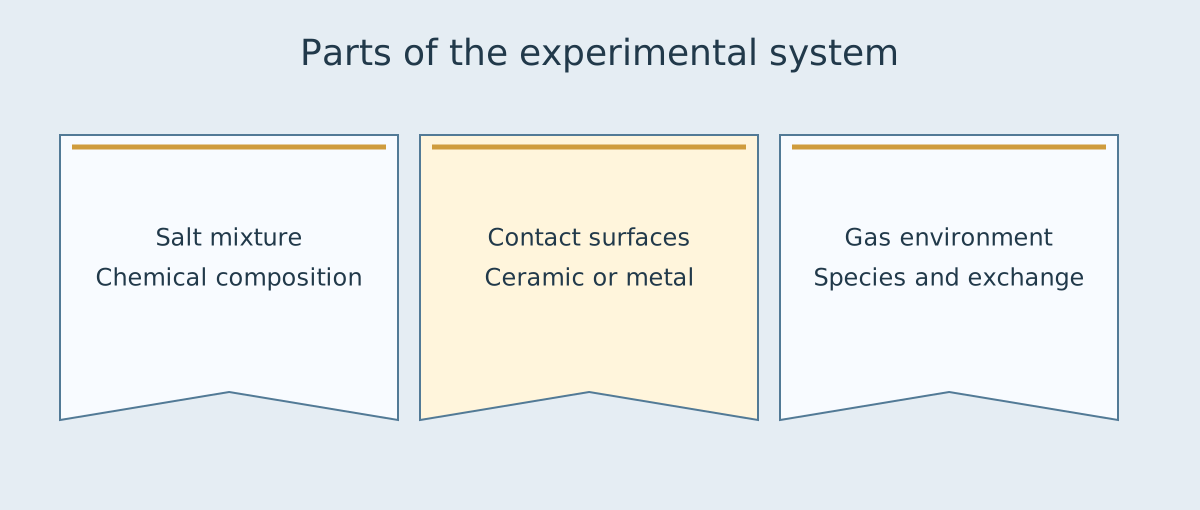
Illustration details
- Parts of the experimental system
- Salt mixture
- Chemical composition
- Contact surfaces
- Ceramic or metal
- Gas environment
- Species and exchange
For oxide-ion analysis, the study reported a detection limit below 0.01 mol% and a quantification limit above 0.07 mol%. Measurement uncertainty increased near the lower concentrations: the relative error at the detection limit was reported as approximately 14%, while above the quantification limit it could be as low as 2%. These limits qualify how small differences can be interpreted. A low measured value still needs its analytical context, and a result near a detection boundary should not be treated as a perfectly exact description of the sample's composition.
Time and gas exchange influence stability measurements
Stable values did not appear instantly in the extended experiments. The methods section describes nitrate–nitrite equilibration after approximately 300 hours and oxide-ion equilibration after approximately 500 hours in the relevant stabilised experiments. These durations belong to that experimental arrangement and chemical environment. Other conditions could produce continuing changes rather than the same endpoint. The researchers therefore followed composition through repeated samples and evaluated whether the reaction behaviour had settled. A single observation soon after reaching temperature would have described a different stage of the experiment.
The gas phase was another active part of the chemical system. The team compared environments containing different nitrogen-oxide species and found different effects on oxide-ion formation and stabilisation. Their work also distinguished nitrate–nitrite behaviour from the subsequent reactions producing oxide species. A gas environment that influenced one part of the chemistry did not automatically settle every other reaction. The study's conclusions therefore concern salt composition together with the surrounding atmosphere. They do not provide a single temperature-only definition of stability that can be transferred without the rest of the experimental conditions.
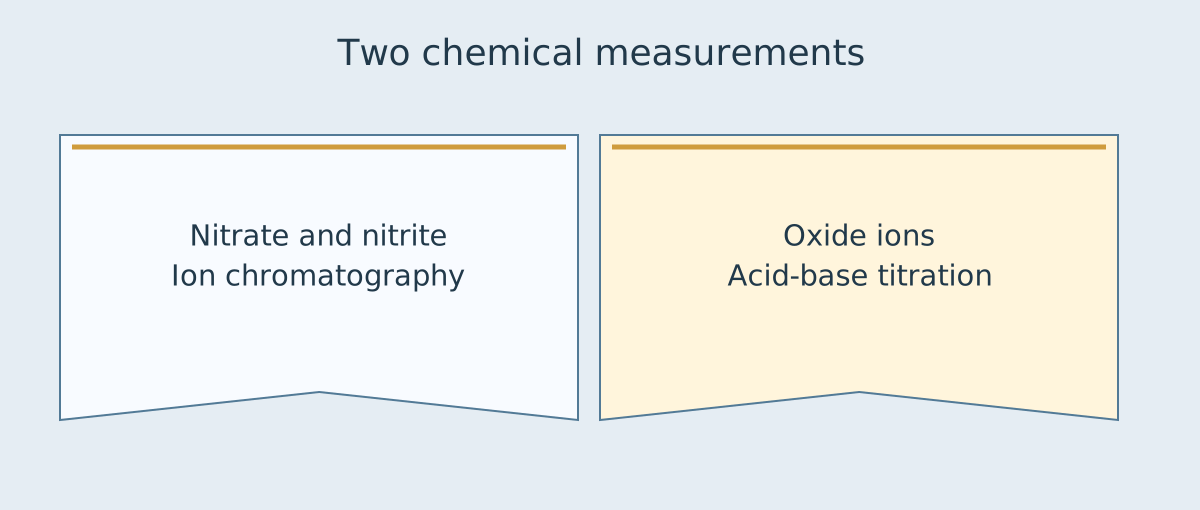
Illustration details
- Two chemical measurements
- Nitrate and nitrite
- Ion chromatography
- Oxide ions
- Acid-base titration
Laboratory geometry and plant scale
The investigators also examined mixing and pressure-related conditions to explore possible transport limitations. They did not establish such limitations under the forced-mixing conditions they tested, while discussing indications that static salt and changes in the surface-to-bulk relationship could matter at larger scale. The paper treats reactions near the liquid–gas interface and reactions within the bulk as potentially different parts of the process. Scaling a system changes that geometry. The authors consequently identify transport and interface questions as relevant when moving from a laboratory sample towards much larger heat-transfer or storage applications.
The two papers address related material questions through different observations. The 2024 study compares formulations using thermal scans, calorimetry and flow-property measurements. The 2023 study follows the chemical evolution of a defined binary mixture under controlled, extended exposure. Their temperatures, apparatus, gas conditions and measured quantities are not interchangeable. A higher decomposition temperature in a scan, a higher average heat capacity and a lower oxide-ion concentration each describe a different result. Reading them together requires retaining those differences rather than combining the numbers into one unsupported overall performance score.
For molten-salt storage, an informative material description connects composition with phase behaviour, heat capacity, viscosity, chemical reactions and compatibility with equipment. It also states the test duration and analytical limits. The solar-tower project provides the industrial setting, while the laboratory studies show how particular properties are investigated. Their results support a detailed account of the tested materials and methods. Demonstrating the performance of an entire power installation would require a different body of operating evidence, including the specific fluid, equipment and conditions used at that site.
- Keep the complete salt formulation and percentage basis with each comparison.
- Distinguish melting measurements, thermal scans and prolonged chemical-stability tests.
- Record the equipment surfaces, gas environment and sample scale.
- Read small composition differences alongside detection limits and measurement uncertainty.
Project context: Xinhua, 19 July 2024. The technical explanation is adapted and reworded from Huaiyou Wang, Jinli Li, Yuan Zhong, Xu Liu and Min Wang, their study of nitrate–sulfate salt formulations, published 15 May 2024; and Julian Steinbrecher, Markus Braun, Thomas Bauer, Sebastian Kunkel and Alexander Bonk, their study of Solar Salt stability and experimental design, published 8 July 2023. Both papers are available under the Creative Commons Attribution 4.0 licence. Wording and illustrations were created anew; original figures and tables are not reproduced.



Leave a comment